Adam Smith vs Karl Marx: the difference, explained simply
If you are studying Adam Smith vs Karl Marx, you are comparing two thinkers who looked at the same kind of workplace and saw very different things. Smith saw a machine for making a nation rich. Marx saw a place where profit came out of unpaid hours. This guide sets out both views fairly, shows where scholars still argue about how to read each man, and walks you through one workshop seen through both pairs of eyes. It gives no verdict. That part is yours.
Adam Smith vs Karl Marx: who they were
Adam Smith (1723-1790) was a Scottish philosopher and economist, and a leading figure of the Enlightenment. According to the World History Encyclopedia, he was born in Kirkcaldy, taught moral philosophy at the University of Glasgow, and died in Edinburgh. He wrote two major books: The Theory of Moral Sentiments (1759), about how we judge right and wrong, and The Wealth of Nations (1776), about what makes a country prosperous.
Karl Marx (1818-1883) was born almost a century after Smith. The Stanford Encyclopedia of Philosophy notes that he is often treated as an activist, but he was trained as a philosopher, with a doctorate in ancient philosophy. His best-known works are Capital and The Communist Manifesto. He wrote the Manifesto with Friedrich Engels, who also worked with him on The German Ideology.
So the first difference is simple timing. Smith was writing before Britain's Industrial Revolution got into full swing, and some critics say his views dated quickly once economies industrialised.
Division of labour: one idea, two worries
Both men wrote about the division of labour, which means splitting work into separate tasks done by different people.
For Smith, this was the engine of wealth. He thought specialisation would greatly increase efficiency. His famous example is pin making: it would be ridiculous, and unprofitable, to ask a skilled pin-machine worker to mine the metal and do every other step first. Yet Smith had a worry too. He backed taxes to pay for educating the poor, partly to make up for the mind-dulling work of people who ran machines all day.
For Marx, a social division of labour is one of the two conditions for producing goods to sell, along with a market. His worry went deeper than dull work. He thought the way work was organised under capitalism cut people off from their own nature.
Markets and the invisible hand
Smith is linked to the phrase "invisible hand". As the World History Encyclopedia explains it, a market left to itself adjusts on its own as production and demand change, while self-interest drives each trade. His best-known line on this says we get our dinner not from "the benevolence of the butcher, the brewer, or the baker" but from their regard for their own interest.
How much weight did Smith put on this? Readers disagree. One reading, which the Stanford entry on Smith calls the libertarian reading, stresses his view that politicians cannot know the future of their societies and do better protecting individual liberty, through defence and justice. The same entry says this captures something real, but that Smith did not favour as hands-off an approach as some of his self-proclaimed followers today. He thought states could redistribute wealth to some degree and protect the poor. He also warned that merchants try to bend politicians to their interests. The World History Encyclopedia goes further and calls the view of Smith as a champion of pure laissez-faire incorrect.
Labour, value and profit
Both men worked with a labour theory of value. Smith separated use value, how useful a thing is to you, from exchange value, what it will fetch in trade. Marx built on this.
In Capital, Marx argued that the value of a good is set by the "socially necessary" labour time needed to make it. That means labour done at the average level of intensity and productivity for that line of work. From here he built his account of profit, which the next sections use.
Alienation, exploitation and class
In his early writings, Marx named four ways workers are alienated, or cut off, under capitalism:
- From the product: they make something they neither own nor control.
- From the activity: they are forced to work in ways that are "mentally and/or physically debilitating".
- From other people: they learn to see others only as means to their own ends.
- From their own human nature: their capacity for free, creative work is frustrated.
Note one surprise. For Marx, alienated work could still be well paid and secure. The problem is how work is arranged, not only the wage.
Exploitation is a separate idea. Marx said profit comes from hours the worker gives beyond what the wage is worth. Scholars disagree here as well. Robert Nozick argued that if the labour theory of value fails, this account of exploitation collapses with it. Others, such as John Roemer, have tried to restate the core idea without that theory.
A worked example: one pin workshop, two lenses
Picture one small pin workshop. Follow it step by step, first as Smith, then as Marx.
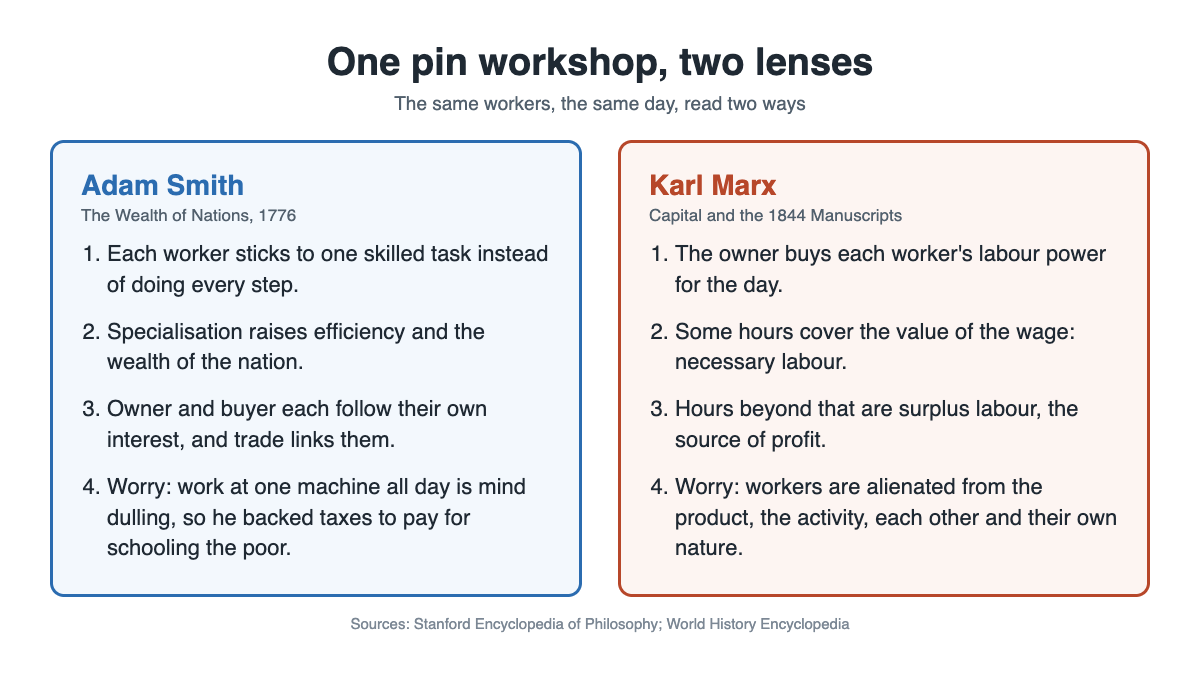
Through Smith's eyes:
- Each worker sticks to one skilled task instead of doing every step.
- Specialising raises efficiency, so the workshop adds to the nation's real wealth, which Smith measured as the "annual produce of the land and labour" of a society.
- The owner and the buyer each follow their own interest, and trade links them.
- The cost: repetitive machine work dulls the mind, so Smith supported schooling for the poor paid by taxes.
Through Marx's eyes:
- The owner buys each worker's labour power, their ability to work, for the day.
- Marx asks what it takes to keep that worker alive for a day. In his own illustration, suppose those goods take four hours of labour to produce.
- Then the first four hours of the shift only cover the value of the wage. Marx calls this necessary labour.
- Every hour after that is surplus labour. It creates surplus value, which for Marx is the source of all profit.
- The wage hides this split. It looks like pay for the whole day.
Now try it yourself. Take a job you know, perhaps a fast food kitchen. Ask Smith's question: how does splitting the tasks raise output, and what does it cost the worker's mind? Then ask Marx's question: which part of the shift pays for the wage, and who keeps the rest?
History and where society was heading
Smith saw history in four stages: hunters, shepherds, agriculture, and finally commerce. He saw the age of commerce as the inevitable concluding stage, since people are social and trade is a social activity.
Marx saw history as a series of ways of organising production, each marked by class struggle. Each form of society rises while it helps human productive power grow, then falls when it holds that power back. He expected this process to lead to communism. But he was famously reluctant to describe it in detail. He held that its basic structure would be delivered by the historical process, not by a plan or blueprint drawn up in advance.
The role of morality in Marx's critique is still debated. The Stanford entry says there is no settled scholarly consensus.
Frequently asked questions
What is the main difference between Adam Smith and Karl Marx?
Smith argued that markets and specialisation make nations richer, with a limited role for the state. Marx argued that profit under capitalism comes from workers' surplus labour and that history would move beyond capitalism.
Did Adam Smith support completely free markets?
Scholars read him differently. The sources used here say he backed some state action, such as taxes to school the poor, and did not go as far as later laissez-faire thinkers.
Did Marx and Smith both use a labour theory of value?
Yes, both worked with one. Marx developed it further into his theory of surplus value and profit.
What did Marx mean by alienation?
He meant workers being cut off from what they make, from the work itself, from each other, and from their own creative nature.
Get started
Smith and Marx both appear in "Thinkers of the Economy", an Intermediate course on Learn 100 Influential People, alongside Ricardo, Malthus, Keynes, Hayek and Friedman. Intermediate covers "how ideas, faiths, inventions and markets spread and changed the world." Lessons take about 9 minutes, with questions where you choose, put in order, match, sort and estimate a number. 38 cards set out where researchers disagree, and every lesson lists its sources so you can read the original work. Questions from finished lessons come back for review, up to 5 a day. You sign in with your email and an emailed code, and accounts are for people aged 13 and over.
Comments
No comments yet.
Sign in or make an account to comment.