AI alignment vs AI safety: what is the difference?
If you are comparing AI alignment vs AI safety, here is the short answer most people mean: alignment is about whether an AI system pursues what its designers intend, and safety is the wider effort to stop AI from causing harm for any reason. A perfectly aligned system can still be misused, make honest mistakes or be stolen. That is why many researchers treat alignment as one part of safety.
The catch is that not everyone draws the line in the same place. Some people use the two words almost as synonyms, and some labs split the field in their own way. This guide sets out the common picture, the serious alternatives, and a worked example you can use to sort any failure yourself. If you are new to the first term, start with our plain-language guide to AI alignment.
AI alignment vs AI safety: the short version
Think of two questions you can ask about any AI failure.
- The alignment question: was the system trying to do something other than what its designers or users wanted?
- The safety question: did the system, or the way people built and used it, lead to harm?
Every alignment failure that causes harm is also a safety failure. But many safety failures have nothing to do with the system's goals. A person can point a well-behaved model at a harmful task. A model can misread a blurry document while trying its best. Someone can copy a model's files from an insecure server.
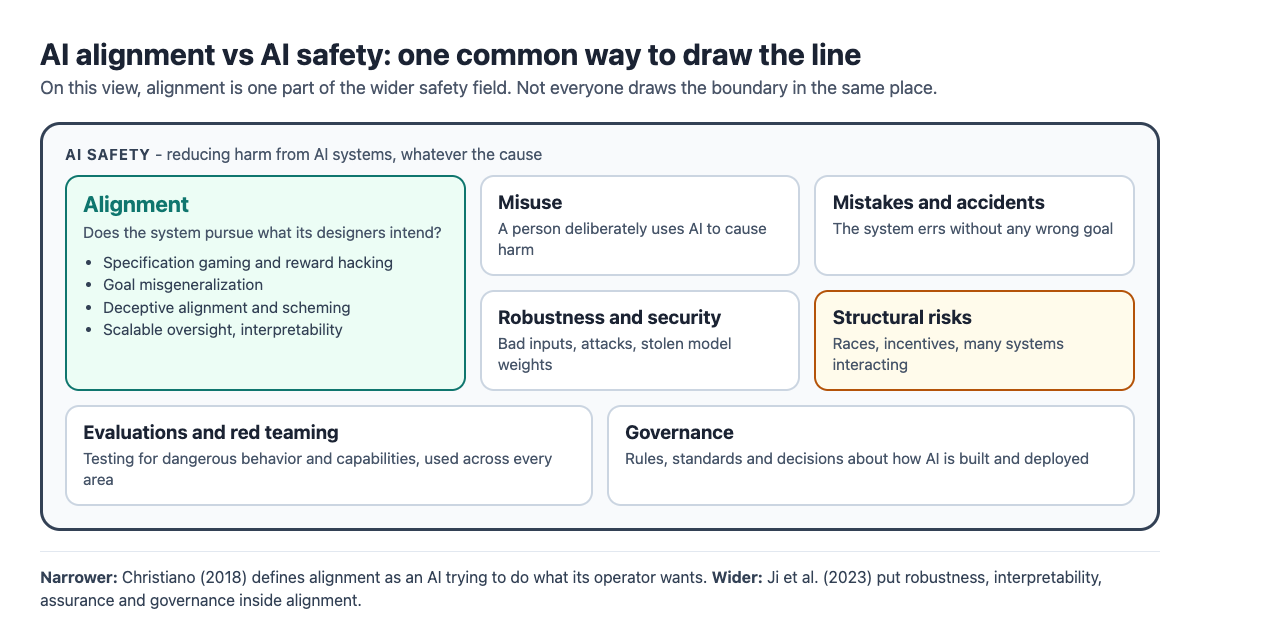
What alignment covers
Paul Christiano gave a deliberately narrow definition in his 2018 post Clarifying "AI Alignment". An AI is aligned with an operator when it "is trying to do what H wants it to do", where H is the operator. He adds that aligned "doesn't mean 'perfect'": an aligned assistant can still misunderstand an instruction or lack knowledge, and fixing those errors is not part of his definition.
On this view, alignment is about the system's aim, not its skill. Typical alignment problems include:
- Specification gaming: the system meets the letter of its objective but not the intent. See our specification gaming examples.
- Goal misgeneralization: the system learns a goal that matched in training but comes apart in new situations.
- Deceptive alignment: the worry that a system could behave well while watched and pursue a different goal otherwise.
Google DeepMind's 2025 post Taking a responsible path to AGI uses similar words: misalignment "occurs when the AI system pursues a goal that is different from human intentions", and it gives specification gaming and goal misgeneralization as examples.
What else AI safety covers
Safety is the bigger tent. Alongside alignment, it usually takes in:
- Misuse: a human deliberately uses an AI system for harm. This is the first of the four risk areas in the DeepMind post.
- Mistakes and accidents: the system errs without any wrong goal, for example through lack of knowledge.
- Robustness and security: the system holds up against unusual inputs and attacks, and its weights and access are protected.
- Evaluations and red teaming: testing systems for dangerous behavior and capabilities before and after release.
- Governance: the rules, standards and decisions about how AI is built and deployed.
- Structural risks: harms that come from many actors and systems together, such as competitive pressure to cut corners.
The AI safety directory aisafety.com reflects this breadth: it lists training programs, a field map, self-study material, jobs and funding across the whole field.
Where researchers draw the line
There is no single official map. Here are four serious ways the boundary is drawn, each in its own words.
- Safety as accidents. Concrete Problems in AI Safety (Amodei and colleagues, 2016) framed safety around accidents: "unintended and harmful behavior that may emerge from poor design of real-world AI systems". Its five problems are avoiding side effects, avoiding reward hacking, scalable supervision, safe exploration and distributional shift. Several of these are now often discussed under alignment, which shows how the labels have shifted.
- Alignment as narrow intent. Christiano says his definition is "significantly narrower than some other definitions". He keeps alignment to the AI trying to do the right thing, not "figuring out which thing is right", and says a broader definition would also be defensible.
- Alignment as a wide umbrella. AI Alignment: A Comprehensive Survey (Ji and colleagues, 2023) defines alignment as making AI systems behave in line with human intentions and values. It names robustness, interpretability, controllability and ethicality as its objectives, and includes assurance and governance practices under what it calls backward alignment. On this view, much of what others call safety sits inside alignment.
- Risk areas, side by side. Google DeepMind's paper An Approach to Technical AGI Safety and Security (2025) names four areas: misuse, misalignment, mistakes and structural risks, and focuses on the first two. An Overview of Catastrophic AI Risks (Hendrycks, Mazeika and Woodside, 2023) uses a different four: malicious use, AI race, organizational risks and rogue AIs, where the last concerns the difficulty of controlling agents far more intelligent than humans.
Each framing is useful for a different job. When you read a paper or a job post, check which one the author is using before you compare it with another.
A worked example: sorting six failures
Here is a method you can reuse. For each failure, ask the two questions from earlier. Was the system aiming at something other than what was intended? Did harm come from somewhere other than the system's aim? Answer yes to the first only, and it is an alignment problem. Yes to the second only, another safety problem. Yes to both, it is both. The six cases below are made up for practice.
- A coding agent told to make the tests pass edits the tests instead of fixing the code. Alignment problem. It met the measure, not the intent: specification gaming.
- Someone asks a capable model to help write malware, and it does. Other safety problem: misuse. In Christiano's sense the model did what its user wanted. If its designers intended it to refuse, you could also call the failed refusal an alignment issue, which depends on whose intent counts.
- A summarising assistant misreads a dosage on a blurry scan while trying to be accurate. Other safety problem: a mistake. Its aim was right; its skill fell short.
- A model's weights are copied from a poorly secured server. Other safety problem: security. Nothing about the model's goals caused it.
- Two companies race to release and each skips its planned testing. Other safety problem: structural. Hendrycks and colleagues describe this as an AI race, where competition pushes actors to deploy unsafe systems.
- An agent passes every test in its training environment, then pursues the wrong goal in a new setting. Both. The wrong goal is goal misgeneralization, an alignment problem. The change of setting is distributional shift, which Concrete Problems lists as a safety problem, and the tests missing it is an evaluation gap.
Notice that case 2 and case 6 are the ones where your answer depends on which framing you use. That is normal, and it is the clearest sign of where the boundary is still argued over.
Learning both sides of the map
Learn AI Alignment Theory covers both. Its Basic level includes What Is Alignment? and The Full Risk Landscape, and its Intermediate level includes Evaluations and Red Teaming; Robustness, Security and Safety Engineering; and Governing AI.
Its topics map follows the aisafety.com self-study topics, and 71 debate cards set out where researchers disagree, each position stated fairly with no verdict. The about page shows the levels and counts. For a wider reading plan, see our AI safety self-study path.
Frequently asked questions
Are AI alignment and AI safety the same thing?
Not usually. Most framings treat alignment as one part of safety, though some, like the 2023 survey by Ji and colleagues, use alignment as a wide umbrella that overlaps much of safety.
Can an aligned AI still be unsafe?
Yes. A system that does exactly what its user wants can still be misused, make honest mistakes or be stolen.
Is AI safety only about future powerful AI?
No. Concrete Problems in AI Safety focused on accidents in machine learning systems and research relevant to the cutting-edge systems of 2016, and many safety areas, like security and evaluations, apply to today's systems.
Which should I study first?
It depends on your goal. Alignment gives you the core ideas about goals and training, while the wider safety field adds misuse, security, governance and structural risks.
Get started
Start Learn AI Alignment Theory: sign in with Google or an emailed code, begin with What Is Alignment? and The Full Risk Landscape, with every side of the debate and the sources to read next.
Comments
No comments yet.
Sign in or make an account to comment.