Artificial superintelligence (ASI): what it is and is not
Artificial superintelligence, often shortened to ASI, means an AI that would be far smarter than the best human minds in almost every area, not just at one task. It does not exist. It is a hypothesis, and one that researchers argue about seriously. This guide explains what the term means, how it differs from AGI, the main arguments for why it might be possible, and the questions it raises about goals and control.
What is artificial superintelligence?
The philosopher Nick Bostrom gives the definition most people use. A superintelligence, he writes, is "any intellect that greatly exceeds the cognitive performance of humans in virtually all domains of interest". Wikipedia's superintelligence article describes it as a hypothetical agent smarter than the most gifted people.
Three parts of that definition matter:
- Greatly exceeds. Not a little better than us. Far better.
- Virtually all domains. Not just chess or protein folding. Science, planning, persuasion, strategy, nearly everything.
- Intellect. The definition is about thinking. It does not, by itself, say anything about the system's goals.
"Artificial" narrows it to machines. Wikipedia notes that some writers also discuss biological routes, such as people enhancing their own intelligence, but most attention goes to the machine version, because machines are not held back by the size and speed limits of a brain.
Narrow AI, AGI and ASI: three words people mix up
These three terms come up together and get blurred. Wikipedia's article on artificial general intelligence separates them clearly.
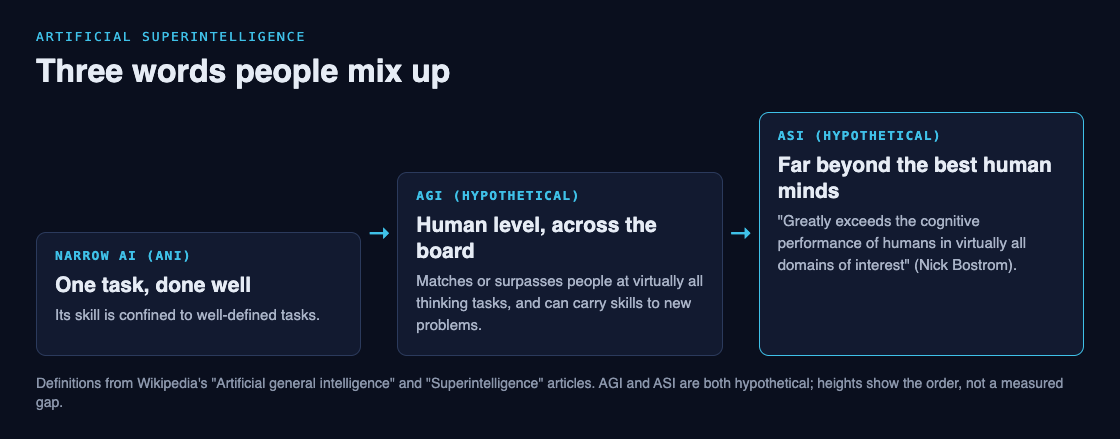
- Narrow AI is confined to well-defined tasks. A spam filter or a chess program is narrow AI.
- AGI, artificial general intelligence, is a hypothetical AI that matches or surpasses people at virtually all thinking tasks and can carry its skills over to new problems.
- ASI is a hypothetical kind of AGI that is much more generally intelligent than people.
So AGI is "as good as us, everywhere" and ASI is "far beyond us, everywhere". Some researchers think the second would follow soon after the first, because the first general machines would already have advantages like perfect recall and a far larger store of knowledge.
How a machine could outthink people
Wikipedia, drawing on Bostrom, lists several ways a machine mind could pull ahead of a human one.
- Speed. Neurons fire at a peak of about 200 times a second. A modern processor runs at about 2 billion. Signals in the brain travel at no more than 120 meters a second, while electronic systems can communicate at the speed of light. Even a mind exactly like ours, run on faster hardware, could think far faster.
- Size. A brain has to fit in a skull. A computer can be made bigger.
- Numbers. Many systems working together, if they coordinate well, could act as a collective superintelligence.
- Better reasoning. People outperform other animals largely because of abilities like long-term planning and language. If there are further improvements of that size, a machine could outperform us the way we outperform chimpanzees.
Chalmers' three-step argument
The philosopher David Chalmers argues that AGI is a very likely path to artificial superintelligence. He breaks the claim into three steps:
- Equivalence. AI can reach human-level intelligence. The brain is a physical system, so it should be possible to copy what it does, and evolution already produced human intelligence once.
- Extension. AI can then be pushed past human level, because new technologies can generally be improved.
- Amplification. It can be amplified further, especially if the AI helps design the next version.
The third step is where recursive self-improvement comes in: a system good at improving itself gets better at improving itself. Each step is a separate claim, and you can accept one while doubting another.
A worked example: a 30-minute class discussion
If you teach or study AI policy, here is a plan you can run with a group, using only this article and the sources it links.
- Minutes 0 to 5: define. Show the three-step diagram above. Ask each person to name one narrow AI they used this week, and to say in one sentence why it is not AGI.
- Minutes 5 to 15: vote on Chalmers. Read the three steps aloud. For each one, everyone votes agree, unsure or disagree. Ask the people who disagree to give their reason first.
- Minutes 15 to 25: the goals question. Introduce Bostrom's orthogonality thesis (below): almost any goal can go with almost any level of intelligence. Ask each person to name a harmless-sounding goal, then to list what a far smarter system might do to reach it.
- Minutes 25 to 30: close. Ask: if this were a real race between labs, which role would you want to hold, a researcher, a research manager, a CEO or a government? Those are the four roles in the game below. Have each person write one sentence on why.
The aim is not to reach a verdict. It is to find out exactly which step each person doubts, which makes for a far better debate than "will it happen or not".
Goals, control and why artificial superintelligence worries people
Bostrom separates two ideas. The orthogonality thesis says that virtually any final goal can go with virtually any level of intelligence: being smart does not make a system's goals good. Instrumental convergence says that some sub-goals, like staying switched on, gathering resources and getting smarter, help with almost any final goal, so many different systems might pursue them. This is why researchers care so much about deceptive alignment, a system that looks aligned while it is being tested.
Control is the other half. Wikipedia's article on AI capability control, also called AI confinement, notes that a kill switch gets less effective as a system gets smarter, so Bostrom and others treat control as a backup to alignment, not a replacement. Stuart Russell has suggested that if superintelligence were known to be a decade away, developers should build an "oracle" with no internet access that only answers questions.
And timing is unsettled. Most surveyed AI researchers expect machines to rival people eventually, but there is little agreement on when. In a 2022 survey, the median year by which respondents gave even odds for "high-level machine intelligence" was 2061.
Artificial superintelligence as fiction: Contain ASI
Contain ASI takes its name from this idea. Its Chapter 1 is called Before ASI: four AI labs in one race, starting in January 2024, and you try for three years to keep every lab from crossing into recursive self-improvement before 2027.
It is a story strategy game, and its footer says plainly that it is inspired by the AI 2027 scenario and that all its labs, people and events are fictional. It is not a forecast and not a course. It is a way to take the questions from this article, about goals, control and timing, and feel what it is like to make the calls.
Frequently asked questions
Does artificial superintelligence exist today?
No. Both AGI and ASI are hypothetical, and researchers disagree about whether and when either could be built.
What is the difference between AGI and ASI?
AGI would match people at virtually all thinking tasks. ASI would greatly exceed the best people at virtually all of them.
Would a superintelligent AI automatically have good goals?
Not according to Bostrom's orthogonality thesis, which says almost any goal can go with almost any level of intelligence. That is why alignment is treated as a separate problem from capability.
Can you just switch off a superintelligence?
Researchers who study capability control say a kill switch becomes less effective as a system gets smarter, so they treat it as a backup to alignment rather than a full answer.
Get started
Want to try the calls yourself? Play Contain ASI: a story strategy game for 1 to 4 players that runs in your browser. Its labs, people and events are all fictional. You will need a recent Chrome, Edge, Firefox or Safari, because it runs on WebGL 2.
Comments
No comments yet.
Sign in or make an account to comment.