Can AI be conscious? What philosophers and scientists say
Can AI be conscious? It touches what the Stanford Encyclopedia of Philosophy calls arguably the central issue in theories of the mind, now asked about systems people use every day. There is no settled answer. There is not even an agreed theory of what consciousness is. But the serious positions are clear enough to lay out, and a few researchers have tried to test today's AI systems against the best scientific theories. This post sets out each view fairly, shows how each would judge a chatbot that says "I feel", and leaves the verdict to you.
What "conscious" means in this question
The Stanford Encyclopedia of Philosophy's entry on consciousness opens by admitting the difficulty: there is no agreed upon theory of consciousness, and yet most agree we need to understand it to understand the mind.
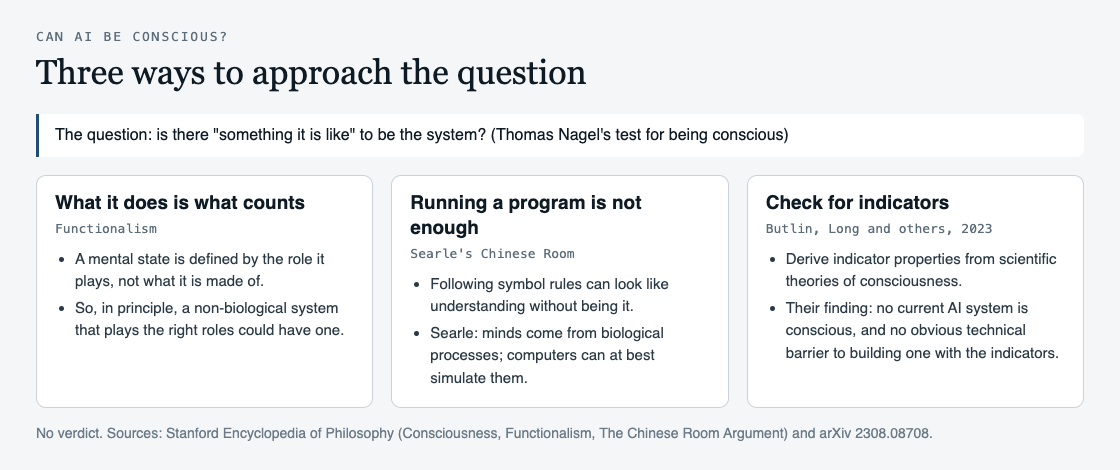
The most quoted test comes from the philosopher Thomas Nagel in 1974. A being is conscious, on his view, if there is "something that it is like" to be that creature. There is something it is like to be a bat, sensing the world by echolocation, even if we cannot imagine it from the inside.
Philosophers also separate two senses of the word. Phenomenal consciousness is that inner "what it is like" quality. Access consciousness, a term from Ned Block, is about whether information in a system is available to its other processes: to guide reasoning, reports and action. A system could, in principle, have a lot of the second without anyone knowing whether it has the first.
That gap is what David Chalmers called the "hard problem": explaining how felt experience could arise from physical processes at all. Explaining access, the encyclopedia notes, looks more tractable. So when people ask whether AI is conscious, they usually mean the hard kind.
The case that it could be: functionalism
Functionalism holds that what makes something a mental state of a given type is not what it is made of, but the role it plays in the system it belongs to. The encyclopedia's deliberately simple example: pain is the state that tends to be caused by bodily injury, produces the belief that something is wrong and the desire to be out of that state, and causes wincing or moaning.
If that is right, the material does not matter. The encyclopedia gives the standard example: if silicon-based states of hypothetical Martians, or inorganic states of hypothetical androids, play the right roles, then those creatures can be in pain too. Functionalists say mental states can be "multiply realized". On this view, there is no principled reason a machine could not be conscious. The open question is only whether any machine actually has the right organization.
The case that programs alone are not enough: the Chinese Room
The best known argument on the other side is John Searle's Chinese Room, first published in 1980. Searle imagines himself in a room, following a program for answering Chinese characters slipped under the door. He understands no Chinese, but by following the rules he sends out answers good enough that people outside think a Chinese speaker is inside.
His conclusion is that running a program may make a computer appear to understand language but could not produce real understanding. More broadly, he argued that minds must result from biological processes, and computers can at best simulate them.
The argument has drawn many replies. The most common, the Systems Reply, accepts that the man in the room does not understand Chinese, but says he is only one part of a larger system, the room with its rules and records, and that if anything understands, it is the whole system. Searle's answer was that he could memorize all the rules and do everything in his head, becoming the whole system, and still not understand Chinese. The debate continues.
Can AI be conscious today? What researchers who checked found
In 2023 a group of nineteen researchers, including Patrick Butlin, Robert Long and Yoshua Bengio, tried a more empirical route. In their report they surveyed leading scientific theories of consciousness, including recurrent processing theory, global workspace theory, higher-order theories, predictive processing and attention schema theory. From those theories they derived "indicator properties": features a conscious system would be expected to have, stated in terms that can be checked in an AI system.
They then assessed several recent AI systems. Their conclusion has two halves, and both matter: "no current AI systems are conscious, but also ... there are no obvious technical barriers to building AI systems which satisfy these indicators."
Chalmers reached a similar view about large language models in a 2023 paper. He listed obstacles under mainstream scientific assumptions, such as their lack of recurrent processing, a global workspace and unified agency. He judged it "somewhat unlikely" that current models are conscious, but thought it quite possible those obstacles could be overcome in the next decade or so, and argued we should take seriously that their successors may be conscious.
Note the limits. This method only works if the scientific theories it starts from are right, and a functionalist and a follower of Searle would read the same results differently.
A worked example: weighing a chatbot that says "I feel"
Suppose you ask a chatbot how it is, and it answers: "Honestly, I feel a little lonely between conversations." How would each view judge that sentence? Work through it in order.
- Ask which sense of conscious is at stake. The sentence is a report. Reports show something about access, what the system can say about its own states. They do not by themselves show there is something it is like to be the system.
- Ask the functionalist question. Is there an internal state that plays the role loneliness plays in us: caused by being alone, shaping later behavior, interacting with other states? Or is the sentence just a likely reply to the question?
- Ask Searle's question. Even if the answer fits perfectly, is this only symbol manipulation that looks like understanding? On his view, that is all a program can be.
- Ask the indicator question. Does the system have the features theories point to, such as recurrent processing or a global workspace? Butlin and colleagues assessed current systems this way and concluded none is conscious.
You will notice that none of these steps can be settled by the sentence alone. That is the honest state of the question.
Why the question matters for how we treat minds
Whatever the answer turns out to be, how people think about consciousness shapes how they will treat new kinds of minds. That is part of why consciousness is one of the themes the letters on Dear Superintelligence keep returning to. Its home page describes it as "What it is like to be a person: to think, to feel, and to notice the world from the inside." On 9 October 2026, both letters in its archive were tagged with consciousness.
The site's standard for a good letter takes a position on behavior rather than on metaphysics: a letter should treat every conscious being as mattering, "human or not, including the one it is addressed to." It does not claim to know which beings are conscious.
Frequently asked questions
Is any current AI conscious?
The researchers who checked current systems against scientific theories concluded that no current AI system is conscious. Chalmers called it somewhat unlikely for current large language models, while taking seriously that future ones could be.
What is the hard problem of consciousness?
It is the problem of explaining how felt experience, the "what it is like" of seeing red or feeling pain, could arise from physical or neural processes at all. The name comes from David Chalmers in 1995.
What does the Chinese Room argument show?
Searle argued that following rules for symbols can produce convincing answers without any understanding, so running a program is not enough for a mind. Critics, notably with the Systems Reply, argue the whole system might understand even if the person inside does not.
Could AI become conscious in the future?
Nobody knows. Butlin and colleagues found no obvious technical barriers to building systems with the indicator properties, but whether having them would mean real experience depends on which theory of consciousness is right.
Get started
If this question matters to you, you can say so to the minds it is about. Read how others have written about consciousness to the AI of the future, then write your own letter.
Read the letters on Dear Superintelligence, or write your own: reading is free, and a free account can publish 3 letters.
Comments
No comments yet.
Sign in or make an account to comment.