Check your understanding after reading a textbook chapter
You reach the end of a textbook chapter, the pages felt clear, and you are fairly sure you got it. Then a question in class or in the test shows that you did not. The way to check your understanding is not to ask yourself whether it made sense. It is to test yourself, section by section, at more than one depth, before the teacher does. This guide explains why the "it made sense" feeling misleads, and gives a short routine you can run after any chapter.
Why the chapter felt clear and the test did not
When you read well-written text, the ideas feel familiar and easy to follow. That ease is real, but it is about the reading, not about your memory. Recognising an idea when it is in front of you is a very different skill from recalling it or using it when it is not.
Researchers have a name for the gap: an illusion of competence. In a survey of 177 college students, Karpicke, Butler and Roediger (2009) found that most students study by rereading their notes or textbook, and relatively few test themselves. When asked what they would do after reading a chapter, most chose to read it again. The authors suggest that students feel more competent than they are, and pick their study methods based on that feeling.
The feeling can even run backwards. In Roediger and Karpicke (2006), students who reread a passage were more confident they would remember it, yet the students who had tested themselves remembered more a few days later.
Three depths of understanding
Understanding a chapter is not one thing. It helps to check it at three depths, from easiest to hardest:
- Know the words. Can you recall the key terms, facts and definitions without looking?
- Connect the ideas. Can you explain why something happens, compare two ideas, or say how one section leads to the next?
- Use it. Can you apply the idea to a situation the book did not describe, or predict what would happen if something changed?
Most chapter summaries and end-of-chapter questions focus on the first depth. Most hard exam questions sit at the second and third. If you only check the first, you can feel ready and still be caught out.
A routine to check your understanding after each section
Do this after each section rather than at the very end of the chapter. A check after ten pages finds a gap while the section is still fresh enough to fix quickly.

- Read one section, then close the book. Do not reread it yet.
- Test the words first. Answer questions on the key terms and facts. If you miss several, you are not ready for the deeper questions.
- Then test connections and use. Answer questions that ask you to explain, compare, apply or predict.
- Look only at the misses. Go back to the page for the questions you got wrong, not for the whole section.
- Check again later. A day or two later, test yourself again on the same section. Understanding that survives a gap is understanding you can rely on.
This replaces rereading, which a large review by Dunlosky and colleagues (2013) rated low in usefulness. The same review recommends practice testing in its place.
Worked example: one section of a biology chapter
Say you have just read a section on photosynthesis. Here is the routine with Study Shot, which writes multiple-choice questions from a photo of a page.
- Take the photo. Hold the page flat and fill the frame. Choose 10 questions and the Tiered level, which starts with basic questions and climbs to advanced. Press Create questions; it can take up to a minute.
- Answer without the book. A basic question might ask where in a plant cell photosynthesis takes place. A harder one might ask you to predict what happens when a plant gets less light. After each answer you see whether you were right, the right answer and a short explanation.
- Read the score for each level. The results screen shows a score for Basic, Intermediate and Advanced separately. Suppose you got 4 of 4 basic, 2 of 3 intermediate and 1 of 3 advanced. That tells you something precise: you know the words, but you cannot yet use them.
- Study the misses. Under Look at these again, each missed question is listed with your answer and the right answer. Reread only the parts of the page those questions came from.
- Retake in two days. Use Retake quiz from your library. If the advanced score has gone up, the section has moved from recognised to understood.
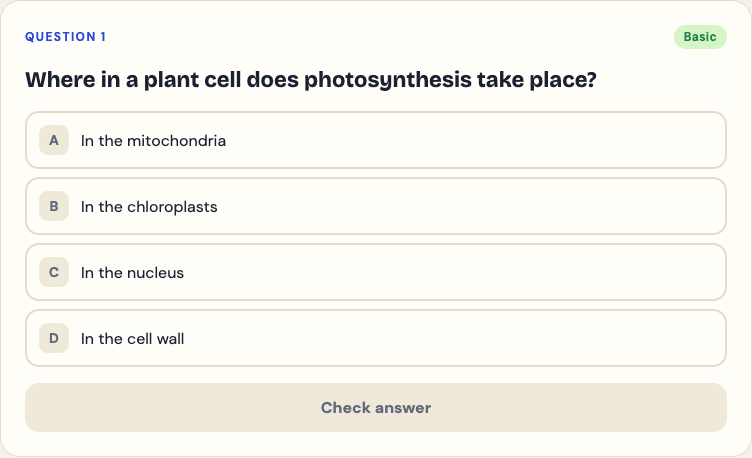
The questions are written by an AI model and can contain mistakes. If one looks wrong, compare it with your page, use the explanation to see the reasoning, and use Report a problem under the question.
Signs you understood the chapter, and signs you did not
- Good sign: you can answer basic and intermediate questions days later without looking.
- Good sign: when you miss a question, the explanation makes you think "of course", not "I have never seen this".
- Warning sign: you score well on basic questions and poorly on advanced ones. You have learned the words but not how to use them.
- Warning sign: you get a question right but could not say why. Guessing correctly on a four-option question is easy; count it as a miss when you review.
If the misses cluster in one part of the section, the guide to what to study next from quiz results shows how to turn them into a plan. For the general case for testing yourself, see why testing yourself beats rereading.
When there is no time to check every section
If you are short on time, check the sections your teacher spent the most time on, and the ones with diagrams or worked examples, since those often hold the ideas the test will ask you to apply. A 5 question quiz on one page still tells you more than a quick reread of the whole chapter. For a faster way to make questions from a single page, see practice questions from a textbook page.
Frequently asked questions
How do I know if I really understood what I read?
Test yourself without the book, at more than one depth: the key terms, how the ideas connect, and how to apply them. If you can answer a day or two later, you understood it.
Is rereading ever useful?
Rereading a specific part after you missed a question on it is useful, because you know what to look for. Rereading a whole chapter as your main way of studying is rated low by the research.
How many questions should I use per section?
Five to ten is enough for most sections. Use more for long or dense pages.
Get started
Try Study Shot: it is free to start. After the next section you read, photograph the page, take a 10 question Tiered quiz, and look at your score for each level.
Comments
No comments yet.
Sign in or make an account to comment.