Elaborative interrogation: ask why to remember more
"Ask yourself why" is one of the most common pieces of study advice. It even has a technical name: elaborative interrogation. The idea is that when you read a fact, you ask why it is true and answer in your own words, which ties the fact to what you already know. It sounds sensible, and some guides present it as a proven method. The honest picture is more mixed. This guide explains what elaborative interrogation is, what the research actually found, and how to use why-questions as an add-on to methods with stronger evidence.
What elaborative interrogation means
Elaborative interrogation is a way of studying facts by asking why each one makes sense. "Interrogation" just means questioning, and "elaborative" means you add detail from your own knowledge. You read a fact, stop, ask "why would that be true?", and answer it.

For example, if your biology page says that the left side of the heart has a thicker wall than the right, you would ask why. A good answer: the left side pumps blood to the whole body, while the right side only pumps it to the nearby lungs, so the left side needs more muscle. Now the fact is not a random detail. It has a reason attached.
What the research says about elaborative interrogation
The evidence is mixed, and it is worth knowing both sides.
A large review of ten study methods by Dunlosky and colleagues (2013) rated elaborative interrogation as moderately useful. That is above rereading and highlighting, which were rated low, but below practice testing and spacing, which were rated high. One reason for the middle rating was that it had not been tested enough in real classrooms.
Two smaller studies, one before the review and one after it, did not find an advantage:
- In O'Reilly and colleagues (1998), 55 university students learned facts about the heart and blood system. One group answered why each fact made sense. Another explained what each fact meant and how it related to what they already knew, a method called self-explanation. A third simply repeated the facts aloud. Self-explanation did best. Asking why was no better than repeating.
- In Kühl and Bertrams (2019), 97 people studied a text either normally or with prompts asking them to produce parts of it. The prompts made no difference to later tests of memory or of using the ideas. The authors questioned whether the method helps when learning is measured this way.
So the fair summary is: asking why may help, especially compared with passive reading, but it is not as reliable as testing yourself, and a closely related method, explaining what the fact means and connecting it to what you know, did better in one direct comparison.
How to use why-questions well
Given that evidence, here is a sensible way to use the technique:
- Use it with testing, not instead of it. Testing yourself has the strongest evidence. In Roediger and Karpicke (2006), students who tested themselves remembered more days later than students who reread. Asking why fits naturally inside a practice quiz.
- Go beyond "why". Also ask what the fact means and how it connects to something you already know. That is closer to self-explanation, which did better in the O'Reilly study.
- Answer without looking. If you read the reason off the page, you are rereading. Answer first, then check.
- Check your answer. A confident wrong reason is worse than none. Compare it with the page or a trusted explanation.
- Pick the facts that need a reason. Asking why about a date or a name rarely helps. Asking why about a process, a rule or a cause often does.
Worked example: why-questions inside a practice quiz
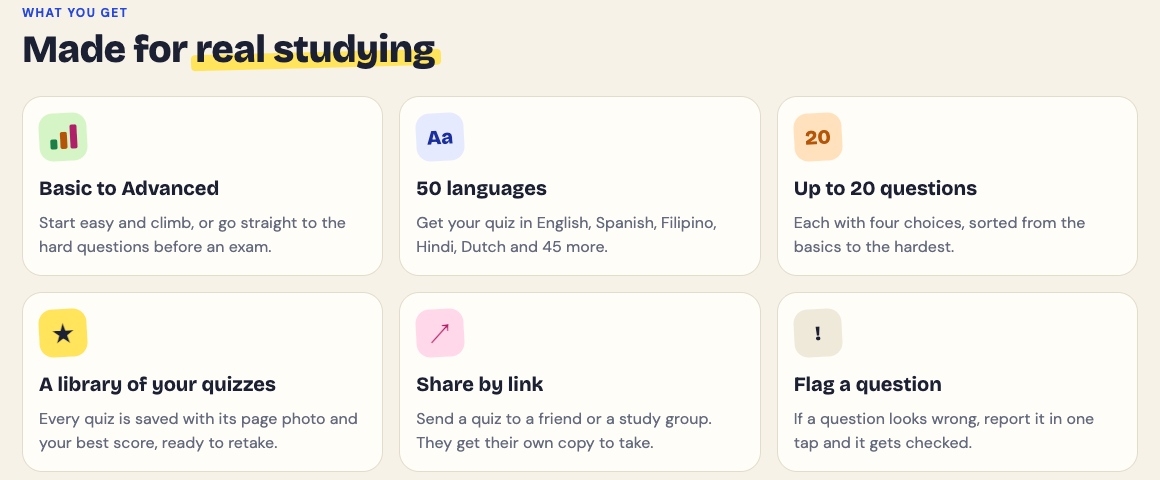
Say you are studying a page on the heart. Here is how to combine why-questions with a practice quiz in Study Shot, which writes multiple-choice questions from a photo of a page.
- Choose the level. Photograph the page and create 10 questions at the Intermediate level, which asks you to explain, compare and connect ideas. Those questions are about reasons, which suits this method better than Basic questions on definitions.
- Answer, then ask why before checking. Pick an option. Before pressing Check answer, say in one sentence why you think it is right. If you cannot, note that, even if you get the question right.
- Compare with the explanation. After Check answer you see Correct! or Not quite., the right answer and an explanation of one to three sentences. Does your reason match? If not, which part did you miss?
- Connect it. For the questions you missed, add one sentence linking the fact to something you already knew. For the heart wall question, that might be: "Like a longer hose needs more pressure."
- Retake later. A few days later, retake the quiz from your library. This time, try to say the reason before you even read the options.
The questions and explanations are written by an AI model and can contain mistakes. That is one more reason to compare your own reason with the explanation and your page, not to take either on trust.
Common mistakes
- Asking why without answering. The question alone does little. The work is in producing an answer.
- Accepting a vague answer. "Because that is how it works" is not a reason. Push for something specific.
- Using it on every fact. It takes time. Save it for the ideas that have a reason behind them.
- Replacing testing with it. Asking why is a helpful extra. Testing yourself and spacing your reviews are the core.
For the methods with the strongest evidence, see the retrieval practice guide. To use your quiz results to choose what to study next, see what to study next from quiz results.
Frequently asked questions
Does elaborative interrogation work?
It may help, but the evidence is mixed. A large review rated it moderately useful, and two studies found no advantage over simpler methods. It is best used alongside testing yourself.
What is the difference between elaborative interrogation and self-explanation?
Elaborative interrogation asks why a fact is true. Self-explanation asks what it means and how it connects to what you already know. In one direct comparison, self-explanation did better.
Which subjects suit why-questions?
Subjects with causes and processes, such as biology, chemistry, history and economics. They suit lists of names or dates much less.
Can I use why-questions with flashcards?
Yes. After you recall the answer on a card, add one sentence on why it is true, then flip the card and check. The recall is the main benefit; the why-question is an extra.
Get started
Try Study Shot: it is free to start. Photograph one page, take an Intermediate quiz, and before checking each answer, say in one sentence why you think it is right.
Comments
No comments yet.
Sign in or make an account to comment.