Hard takeoff vs soft takeoff: how fast could AI change?
The debate over hard takeoff vs soft takeoff is about one question: if AI ever reaches human level, how fast would it climb past us? In a hard takeoff, the climb takes days or months. In a soft takeoff, it takes years or decades. The answer matters because speed decides how many chances people get to notice a problem and fix it. This guide explains both ideas in plain words, who argues for each, and a simple way to see why the difference is so important.
Hard takeoff vs soft takeoff in plain words
The Wikipedia article on the technological singularity gives the two definitions side by side.
- Hard takeoff: a superintelligent AI improves itself so quickly that people cannot make real corrections along the way, or slowly tune its goals.
- Soft takeoff: the AI still ends up far more powerful than humanity, but at a human-like pace, perhaps over decades, slow enough that people can keep steering it.
The article on existential risk from artificial intelligence puts rough numbers on it. In a "fast takeoff", the step from general AI to superintelligence could take days or months. In a "slow takeoff", it could take years or decades, which leaves more time for society to prepare.
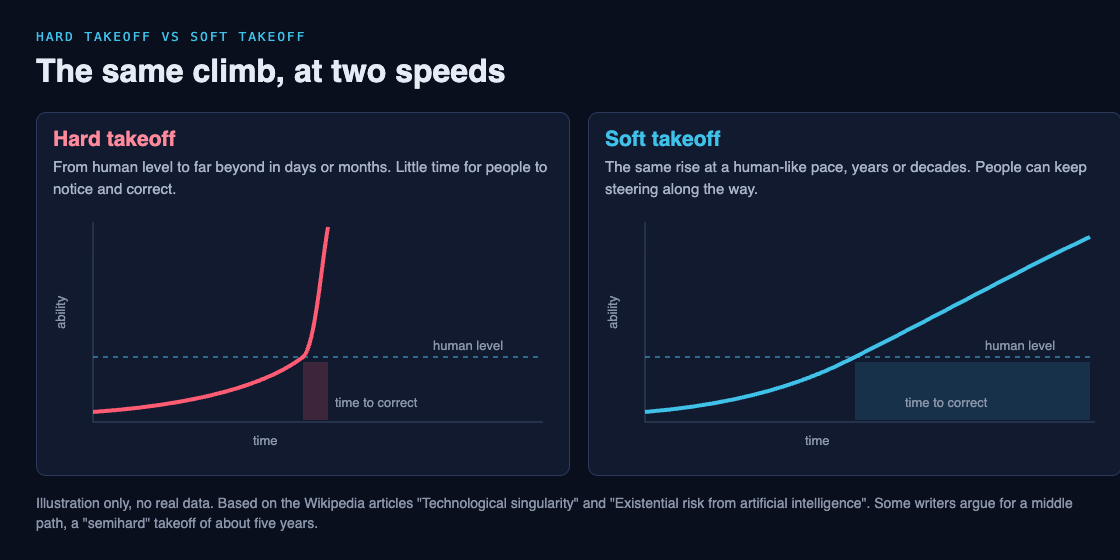
Notice what both sides share. Neither one says AI stays below human level. The argument is about the shape of the curve after that point, not where it ends.
Where the idea comes from
The split goes back to the people who first described the singularity. Vernor Vinge popularized the term in a 1983 magazine piece, and his picture was of a rapidly self-improving superhuman intelligence. Ray Kurzweil later described something different: a gradual ascent along a curve of accelerating technology, which he believes will reach the singularity by 2045. Read side by side, Vinge's picture leans hard and Kurzweil's leans soft.
Both build on an older argument. In 1965, I. J. Good wrote that a machine able to design better machines could set off an "intelligence explosion". We cover that history in intelligence explosion: what it means and why people disagree. The takeoff debate asks how fast such an explosion would actually go.
The case for a fast climb
People who expect a hard takeoff usually point to self-improvement. If an AI can improve its own design, each improvement makes the next one easier, a loop explained in recursive self-improvement, explained in plain words.
- Narrow skill may be enough. Nick Bostrom argues that an AI with expert ability at a few key software engineering tasks could become a superintelligence by improving its own algorithms, even if it is weak in other areas.
- Narrow jumps have already been fast. The risk article notes that in 2017 a game-playing program taught itself Go and passed human ability within hours. That shows a narrow system can move from below human to above human very quickly.
- Spare hardware could be waiting. Carl Shulman and Anders Sandberg suggest that software, not hardware, may be the bottleneck. If so, once human-level software exists, it could run at once on lots of fast, cheap hardware. That stock of unused computing power has a name: "computing overhang".
The case for a slow climb
Others think the curve would bend gently, or flatten. The singularity article collects several arguments.
- We already have self-improving groups. Ramez Naam points out that companies already use tens of thousands of people and huge amounts of computing power to design better computer chips. That loop gave us steady progress, the pattern known as Moore's law, not an overnight jump. He adds that a mind twice as smart is probably more than twice as hard to build.
- The fast story assumes its ending. J. Storrs Hall argues that many overnight scenarios are circular: they assume superhuman ability at the start in order to get superhuman ability at the end.
- Hardware has limits. Jeff Hawkins says a self-improving system will run into limits on how big and fast computers can be: "we'd just get there a bit faster. There would be no singularity."
- The world is slow. Max More argues that even a superintelligence would need to work through slow human systems to change anything physical, so the old rules would not vanish overnight.
- It would need to beat everyone at once. Robin Hanson says an AI would have to become vastly better at software innovation than the rest of the world combined, which he finds implausible.
There is also a middle view. Ben Goertzel doubts a "five-minute" takeoff but thinks a climb from human to superhuman over about five years is reasonable. He calls it a "semihard takeoff".
A worked example: count the chances to correct course
The clearest way to see why speed matters is to count. This is an illustration, not a forecast. Pick a fixed review rhythm, then see how many reviews fit inside each kind of takeoff.
- Choose a rhythm. Say a team can run one serious safety review per month: test the system, look for problems, and change its goals or limits if needed.
- Hard takeoff, six months. Six months from human level to far beyond gives about 6 reviews. If the first two find nothing, there are 4 left, while the system is already ahead and still speeding up.
- Semihard takeoff, five years. Goertzel's five years gives about 60 reviews.
- Soft takeoff, twenty years. Twenty years gives about 240 reviews, with time to build better tools between them.
- Now ask the real question. How many reviews would you need to catch a problem you do not yet know how to look for? If the answer is "more than six", a hard takeoff leaves no margin.
This is why the safety debate cares so much about speed. Ideas like corrigibility, an AI that accepts correction, only help if there is time to correct it.
Takeoff speed in Contain ASI
Contain ASI is a story strategy game set before any takeoff. Its first chapter is called "Before ASI", and its home page sets the challenge: "January 2024. Four AI labs. One race. For three years, keep every lab from crossing into recursive self-improvement before 2027."
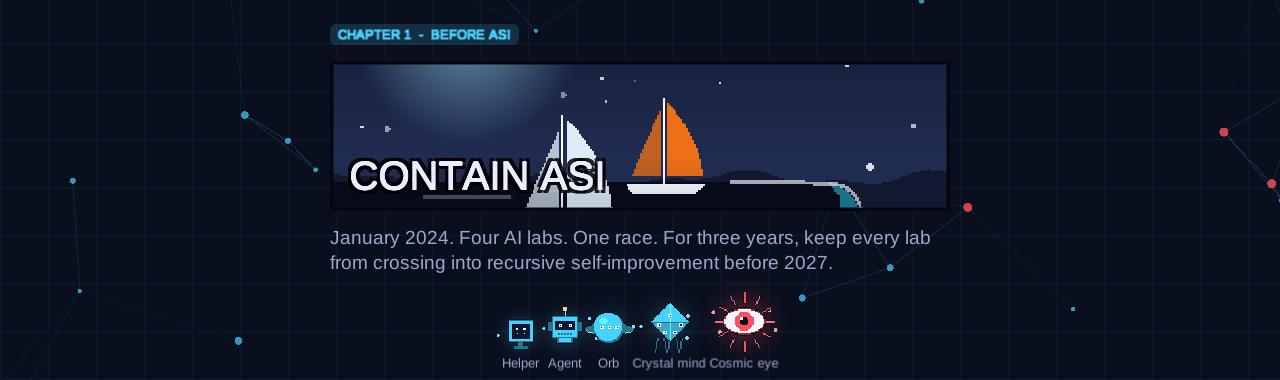
It is a game for 1 to 4 players that runs in your browser, and you play as a researcher, research manager, CEO or government. It is fiction: the footer says it is inspired by the AI 2027 scenario and that its labs, people and events are all made up. It does not say which takeoff is real. It gives you a way to think about the window before the curve bends, when the choices still belong to people.
Frequently asked questions
What is the difference between a hard and a soft takeoff?
Speed. A hard takeoff goes from human-level AI to far beyond in days or months, too fast to correct; a soft takeoff takes years or decades, slow enough to steer.
Is a fast takeoff the same as an intelligence explosion?
They are closely linked. An intelligence explosion is the idea that self-improvement feeds on itself; a hard takeoff is the case where that happens very quickly.
What is a semihard takeoff?
Ben Goertzel's middle view: a climb from human to superhuman level over roughly five years, slower than overnight but faster than decades.
Which kind of takeoff is more likely?
Nobody knows, and serious researchers disagree. Arguments for speed point to self-improvement and spare hardware; arguments against point to hardware limits, rising difficulty and a slow physical world.
Get started
Want to spend three years in the window before the curve bends? Play Contain ASI: a story strategy game for 1 to 4 players that runs in your browser. Its labs, people and events are all fictional. You will need a recent Chrome, Edge, Firefox or Safari, because it runs on WebGL 2.
Comments
No comments yet.
Sign in or make an account to comment.