How did castles defend against a siege? Gates, walls and plans
Most siege stories are told from outside the walls: the army arrives, the machines go up, the stones fly. But how did castles defend against a siege? The short answer is preparation. A castle that held was usually one whose defenders had planned for each way the attackers might try to get in, long before they arrived.
This guide explains how defenders held a castle, using English Heritage's guide to medieval siege warfare. It walks through one real defense, Dover in 1216, and ends with a free browser game, Two Towers, where holding the gate is the whole job.
Why a siege was a contest of preparation
A siege was expensive for both sides. English Heritage notes that it took huge amounts of money, time and manpower, and that only the wealthy and powerful could keep an assault going for long. That gave defenders a real chance: if they could hold out longer than the attackers could afford to stay, the siege could fail.
It could also end without a final assault. Sometimes the two sides agreed terms and the defenders surrendered. At Kenilworth in 1266, a siege of almost six months ended in an honourable surrender when the defenders' food ran out. Food, in other words, was a weapon.
Before the attackers arrive
English Heritage says good defense relied on foreknowledge, so that careful preparations could be made. The checklist looked like this:
- Send away people who cannot fight, so food lasts longer.
- Stockpile food and water, plus beer and wine in case the water was poisoned. Most castles had wells and cisterns for rainwater.
- Have a large and experienced enough garrison, since the attacking force was often bigger.
- Build up missiles: arrows, bolts and stones.
- Store oil and tar, with a way to heat them.
- Keep timber, stone and earth ready to repair breaches in the walls.
How did castles defend against a siege on the walls?
Each attacking method had a matching answer. Here are the pairs English Heritage describes:
- Against ladders: long poles to push the attackers' ladders away from the wall.
- Against rams and bores: cranes with long chains and hooks to grab and overturn them.
- Against attackers at the foot of the wall: brattices, also called hoards, which were overhanging timber galleries from which stones and hot liquids could be dropped straight down.
- Against miners: countermines, dug where the attackers' tunnels would have to break into them, so the miners were found before they could bring the wall down.
- Against the attackers' machines: the defenders' own siege engines, mounted on towers and walls and inside the defenses.
What was at stake if the defense failed
Defenders were not only protecting stone. English Heritage describes three possible endings to a siege, and they explain why garrisons fought so hard or, sometimes, gave in.
- The attackers break in. The defenders were then at the attackers' mercy, especially after a costly siege, and the result could be massacre, execution and plunder, with men, women and children sometimes treated equally harshly.
- The defenders surrender on agreed terms. Usually only the elite could expect reasonable treatment and leave with some possessions. Poorer people often lost their rights, their homes and sometimes their freedom.
- The attackers give up. A siege drained money and men, so an attacker who could not win quickly might leave.
English Heritage adds that, for those in charge, it was sometimes easier and cheaper to surrender and walk away than to risk a siege. At other times there was too much at stake to give in. Every defense started from that choice.
The gate: weak point and strongest part
A wall can be solid; a gate has to open. That made the entrance the obvious target, and it is why so much effort went into it. The gate card in Two Towers puts it in one line: "The gatehouse was a castle's weak point, so it was usually built as its strongest part."
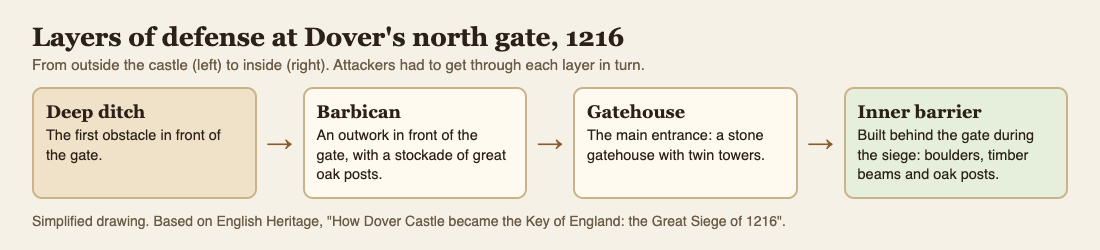
A strong entrance was built in layers, so that getting past one part only brought attackers to the next. Dover in 1216 is a clear example.
A worked example: holding Dover in 1216
English Heritage's account of the great siege of Dover Castle shows the defense working step by step:
- The garrison. Hubert de Burgh held the castle with 140 knights and many more soldiers, and he had defended castles before.
- The outer layer falls. The main entrance was a gatehouse at the castle's northern point, protected by a barbican with a deep ditch and a stockade of oak posts. The French miners undermined the stockade, and the attackers took the barbican.
- The gatehouse is breached. Miners then tunnelled under the twin-towered gatehouse, and one of its towers came down.
- The prepared answer. Behind the breach, the garrison had already built a barrier of boulders, timber cross-beams and oak posts. When the attackers rushed in, they were driven out with very heavy losses.
- Holding on. The attackers settled down to starve the castle out, but the garrison held until a truce in October.
- Learning from it. After the siege, the damaged north gateway was blocked solid and replaced by a new main entrance, the Constable's Gate. A new barbican was built outside the old gate, linked to the castle by tunnels.
Step four is the heart of it. The defenders expected the gate might fall and built the next layer before it did.
Feel the problem in a game: Two Towers
In Two Towers, a free tower defense game in the browser, your whole job is the city gate. Attackers march out of the woods toward it, and if it falls, the game is over. Between attacks you can repair the gate and reinforce it with gold, which is the same choice the Dover garrison faced: fix the damage now, or build for the next wave.
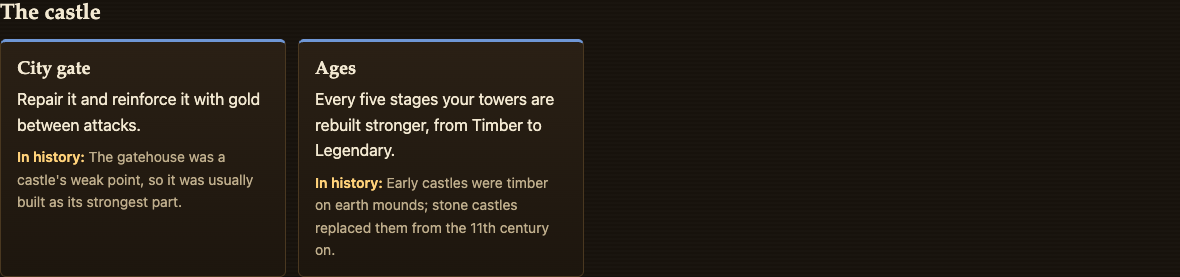
The battering ram, slow and heavily armored, strikes the gate hardest, so you learn quickly why real defenders kept hooks and cranes for rams. Every five stages your towers are rebuilt stronger, and the Ages card adds a history line: early castles were timber on earth mounds, and stone castles replaced them from the 11th century on.
The game gives one line of history per card, not a full account. It is a way to feel why the gate mattered so much, before or after reading the real story.
Frequently asked questions
How did castles defend against a siege?
Mostly through preparation: stored food and water, a strong garrison, stocks of missiles, and a ready answer to each attack, from poles against ladders to countermines against miners.
Why was the gate the weakest part of a castle?
Because it had to open. Builders made up for it by making the gatehouse the strongest part and adding outer works such as a barbican.
How long could a castle hold out?
As long as its food and its defenses lasted. Kenilworth held for almost six months in 1266 before its food ran out.
Get started
Play Two Towers: it is free and plays in your browser on a computer or a phone. Keep the gate repaired, reinforce it before the hard stages, and see how long the city stands.
Comments
No comments yet.
Sign in or make an account to comment.