How to help your child study for a test
The night before a test, many parents do the same two things: read the notes aloud, or ask "do you know it?" and accept "yes". Neither helps much. If you want to help your child study for a test, the most useful role you can play is not teacher or checker but question-asker. This guide explains what the research says works, gives a 20 minute evening routine, and shows how to run it with a practice quiz made from your child's own textbook page.
What actually helps children remember
A large review by Dunlosky and colleagues (2013) looked at ten common study techniques. Only two were rated highly useful, and one reason was that they help learners of different ages and abilities:
- Practice testing: answering questions from memory, rather than looking at the answers.
- Spreading practice out: several short sessions across different days, rather than one long one the night before.
Rereading and highlighting, the methods most students use, were rated low. So the two things worth bringing to your kitchen table are questions, and a calendar.
Why "do you know it?" is the wrong question
Children, like adults, are poor judges of what they know. In a survey of 177 college students, Karpicke, Butler and Roediger (2009) found that most studied by rereading, and relatively few tested themselves. The authors suggest students feel more competent than they are. Those were university students, and the survey says nothing about how younger children judge themselves, but it is a good reason to check with a real question rather than ask.
Rereading even makes the feeling stronger. In Roediger and Karpicke (2006), students who reread a passage were more confident they would remember it, but the students who tested themselves remembered more days later. A child who has just read the notes will honestly say "I know it". The only way to find out is to ask a real question and wait for the answer.
Your role: ask, wait, explain
You do not need to know the subject. You need to do three things well:
- Ask a question from the material, then stay quiet. The effort of pulling out the answer is what makes the practice work.
- Wait longer than feels comfortable. Do not hint, and do not answer for them.
- Explain or look it up together when they miss. Then come back to that question later in the session.
Praise effort on the hard questions, not just the right answers. A wrong answer during practice is useful information, not a failure.
A 20 minute evening routine to help your child study for a test

- 2 minutes: pick the page. Ask your child which page or section the test covers, and start there.
- 10 minutes: questions. Your child answers questions without looking at the page. Read the explanation together after each one.
- 5 minutes: the misses. Go back over each missed question. Ask your child to explain the right answer in their own words.
- 3 minutes: plan the next round. Agree a day, two or three days later, to do the same questions again.
Repeat on two or three evenings before the test, rather than doing one long session the night before. That gives your child both of the methods the research rates most highly.
Worked example: a science test on Friday
Say your child has a science test on plant cells on Friday, and it is Monday. Here is the routine with Study Shot, which writes multiple-choice questions from a photo of a page, so you do not have to write the questions yourself.
- Monday: make the quiz. Your child photographs the textbook page on plant cells, on a phone or computer, and creates 10 questions at the Tiered level, which starts with basic questions on key words and climbs to harder ones that ask them to apply the idea.
- Monday: answer together. Your child picks an answer and presses Check answer. The screen shows Correct! or Not quite., the right answer and a short explanation. Read the explanation aloud together. You do not need to know the topic; the explanation does that part.
- Monday: the misses. On the results screen, Look at these again lists every missed question with your child's answer and the right one. Ask your child to explain each right answer to you.
- Wednesday: retake. Open the quiz from the library and press Retake quiz, without rereading the page first. Compare the grade with Monday's: Getting there means 50 percent or more, Good 70 percent or more, Mastered 90 percent or more.
- Thursday: a short last round. One more retake, then rest. If the score for the harder questions is still low, spend five minutes on those parts of the page.
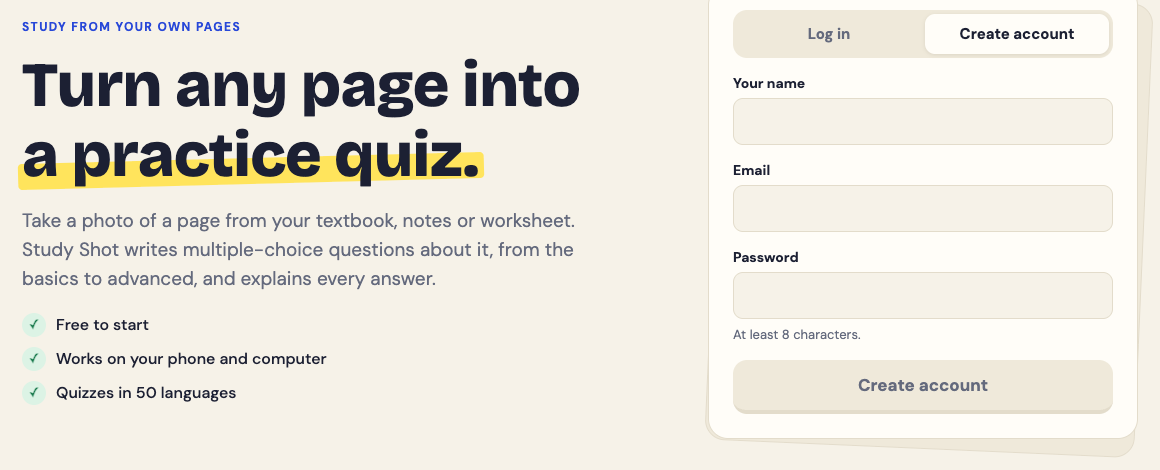
Study Shot needs an account with a name, an email and a password, so decide together how your family wants to set that up. The questions are written by an AI model and can contain mistakes. If one looks wrong, check it against the textbook page with your child; spotting the mistake is good practice too, and you can use Report a problem under the question.
Common mistakes parents make
- Reading the notes aloud. It feels helpful, but it is rereading with an audience. Ask questions instead.
- Giving the answer too quickly. Wait. The struggle to remember is the part that builds memory.
- One long session the night before. Two or three short sessions across the week work better and cause less stress.
- Only checking the score. The missed questions tell you what to go over, not the percentage.
- Turning it into a test of the child. Keep it low stakes. A practice quiz is for learning, and a low score on Monday is the point of practising on Monday.
When the test is tomorrow
If you only have one evening, do one round of questions, go over the misses, and do a second round of the same questions an hour later or the next morning. Then let your child sleep. For a longer run-up, the one week revision plan lays out a day by day schedule, and the retrieval practice guide explains in more detail why testing beats rereading.
Frequently asked questions
Do I need to understand the subject to help?
No. Your job is to ask the questions and wait for the answers. A quiz with explanations covers the subject knowledge.
How long should we study each evening?
Around 20 minutes on two or three evenings before the test is a good start. Short and spread out beats long and crammed.
What if my child gets upset about wrong answers?
Say early on that practice is meant to find mistakes, and that wrong answers now mean fewer in the test. Praise the effort, and keep the score private if it helps.
Get started
Try Study Shot: it is free to start. Tonight, ask your child for the page their next test covers, photograph it together, and do the 20 minute routine.
Comments
No comments yet.
Sign in or make an account to comment.