How to make a daily walk more fun, and keep doing it
Knowing how to make a daily walk more fun matters more than knowing why walking is good for you. Most people already know the why. What stops them is the same street, the same loop and the same thought on day four: this is boring. This guide shows you what actually counts as a useful walk, then gives you five ways to make it something you look forward to, including a walking game built around the cats in your neighbourhood, and a week of walks you can copy.
How to make a daily walk more fun: start with a reason to go
A walk with no purpose is easy to skip. A walk with a small reason attached is not. The reason does not have to be big. Posting a letter, checking on a tree that is about to flower, or finding out whether the cat on the corner is out today all work.
The trick is to make the reason about the walk itself, not about exercise. Exercise is the side effect. The thing you go out for is the small goal, the new street or the person you walk with.
That is the thread through every idea below. Each one gives your brain something to look forward to, so your feet follow.
What counts: ten brisk minutes is a real start
You do not need an hour. The NHS page on walking for health says a brisk 10-minute daily walk has lots of health benefits and counts towards your 150 minutes of weekly exercise.
What makes it brisk? The NHS describes a brisk walk as about 3 miles an hour, faster than a stroll. Its simple test: you are walking briskly if you can still talk but cannot sing the words to a song.
The same page says walking briskly can help you build stamina, burn excess calories and make your heart healthier. So even the fun walks in this guide are doing real work, as long as some of the time you pick up the pace.
Give every walk a small goal
Goals turn a loop into a mission. Pick one per walk, and keep it small enough to finish:
- A place: a bench you have never sat on, the end of a street you always pass, a park on the far side of the main road.
- A count: five red doors, three dogs, every cat you see.
- A photo: one good picture of something you would normally walk past.
- A time: the same route as yesterday, a little faster.
Write the goal down before you leave, even in a note on your phone. A goal you said out loud is much harder to skip than one you only thought about.
Change the route, the company and the sound
The NHS page has three ideas that fit here. First, add variety to your walks: a park, a canal towpath or a heritage trail feels very different from your usual street. Second, walking in a group is, in its words, a great way to start walking, make new friends and stay motivated. Third, walking while listening to music or a podcast can take your mind off the effort.
You can mix these through the week. A walk with a friend on Monday. A new route on Wednesday. A podcast episode that you only let yourself hear while walking on Friday. Each one is a different kind of reward, so the habit stays fresh.
The NHS also says the easiest way to walk more is to make walking a habit. Variety is how you keep a habit from going stale.
Turn the walk into a game with Cat Go
Games are the strongest small goals, because they keep score for you. Cat Go is a game that plays in your web browser, built around the cats you meet outside. In the site's own words: "Walk anywhere, photograph a real cat, lure it with food and catch it. Every catch keeps its breed and where you found it."
When you open it, the home screen is a map. A bar at the top shows your player name, how many cats you have caught, how many of the game's 34 breeds you have found, and how much kibble and tuna you hold. Cat Go needs your location to find treat stops and to record where each cat was caught; the site says nothing else is shared. If location is off, the screen tells you so and asks you to turn it on in your browser's site settings.
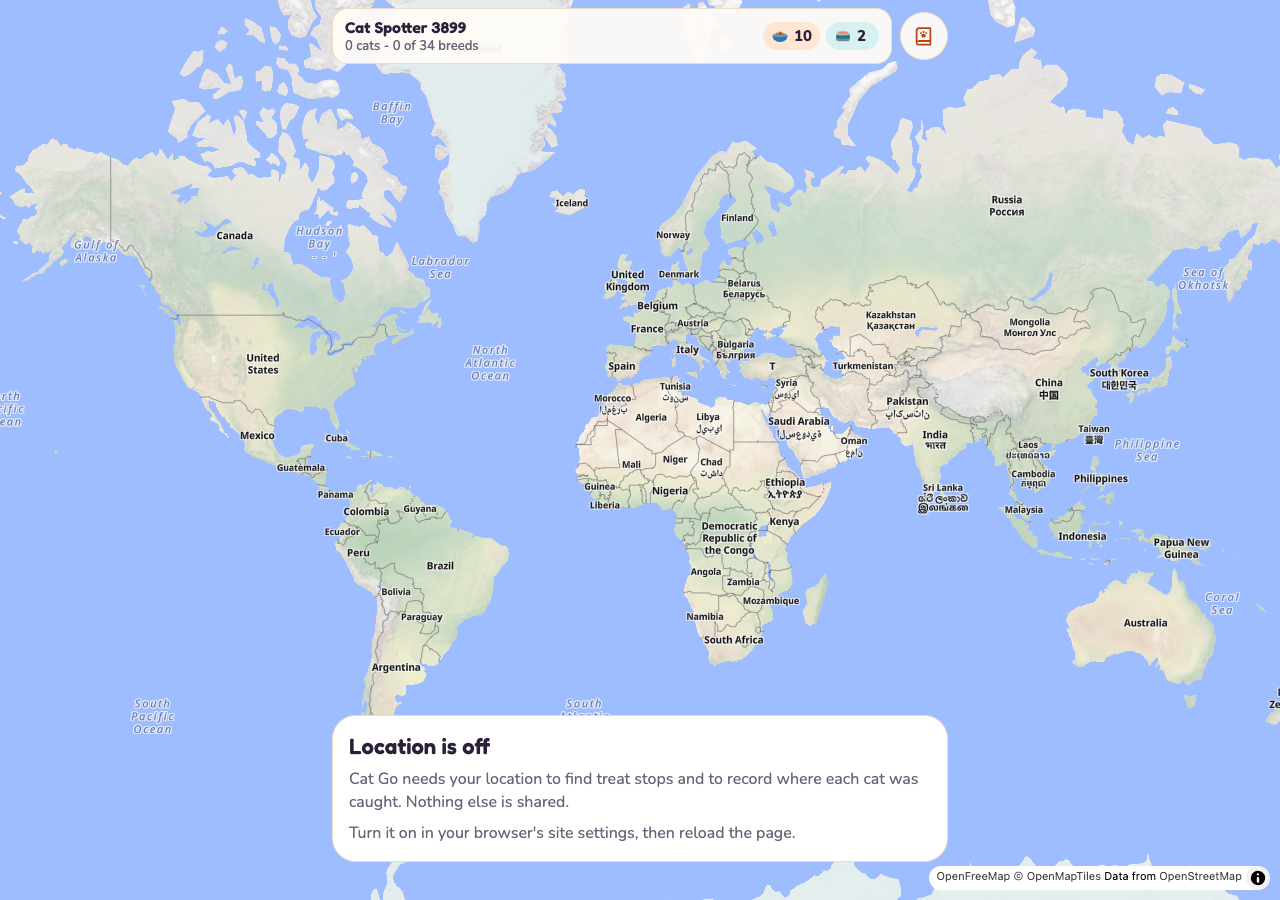
Cat Go's home screen before location is allowed.
Here is how a walk works in the game:
- Head for a treat stop. Treat stops sit on the map. Away from one, the card tells you how far it is and that walking within range lets you collect kibble, and sometimes tuna.
- Collect treats. At the stop the card says "You're here. Grab what's in the bowl." Afterwards the stop shows when it is refilling, so you have a reason to come back.
- Meet a real cat. You photograph it, say which breed it is, and toss in-game treats to win it over. If you run out, the game says "Out of food - visit a treat stop to lure cats."
- Watch your Catdex grow. It counts cats caught and breeds found.
The kibble, the tuna and the catch are all inside the game. The real cat is only photographed, from where you stand, and you never need to go onto anyone's property.
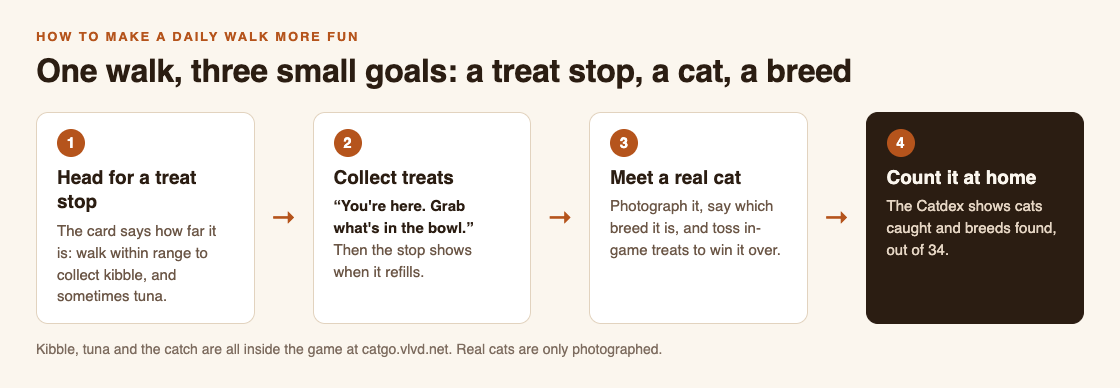
One walk, three small goals.
A worked example: one week of walks
Here is a week that mixes every idea above. Each walk is at least ten minutes, with part of it brisk enough that you could talk but not sing.
- Monday, the treat stop walk. Open Cat Go, find the nearest treat stop on the map and walk there briskly. Collect your treats and walk back.
- Tuesday, the company walk. Ask a friend or family member along. Same route, more talk.
- Wednesday, the new street. Take one turning you have never taken. Note anything you did not know was there.
- Thursday, the cat count. Count every cat you see. Photograph one in Cat Go and try to say which breed it is. If you are unsure, the game says mixed breed is always a safe pick.
- Friday, the podcast walk. Save an episode for this walk only.
- Saturday, the long one. A park, a towpath or a trail. Check whether Monday's treat stop has refilled on the way.
- Sunday, the review. A short, slow walk. Open your Catdex and see how many cats and breeds the week added.
Families can share one goal: the children choose the breed, the adults keep the pace brisk. When you cross a road, look up from the phone first.
Frequently asked questions
How long does a daily walk need to be?
The NHS says a brisk 10-minute daily walk has lots of health benefits and counts towards your 150 minutes of weekly exercise.
How do I know if I am walking briskly?
The NHS test is simple: you can still talk, but you cannot sing the words to a song. That is about 3 miles an hour.
What is the easiest way to stick with walking?
The NHS says the easiest way is to make walking a habit. Small goals, new routes, company and a game all help keep that habit fresh.
Does Cat Go work without location?
No. Cat Go needs your location to find treat stops and to record where each cat was caught, and it needs the camera to catch a cat.
Get started
Pick tomorrow's small goal now, and make the walk at least ten minutes. Then play Cat Go in your browser: walk anywhere, photograph a real cat, lure it with food and catch it, and keep each catch with its breed and the place you found it.
Comments
No comments yet.
Sign in or make an account to comment.