How to quiz each other in a study group
A study group can be the best hour of your week or the least useful one. Too often it turns into reading the notes out loud, or chatting with the books open. The fix is simple: quiz each other. When every person has to pull answers out of memory and explain them, the group becomes a testing session with built-in teachers. This guide explains why that works, gives a plan for a one hour session, and shows how to share one practice quiz so everyone answers on their own first.
Why a study group should quiz each other
Testing yourself is one of the most reliable ways to remember what you study. In a classic study by Roediger and Karpicke (2006), students who read a passage and then tried to recall it remembered more two days and a week later than students who simply read it again. Rereading only came out ahead on a test five minutes later. A large review by Dunlosky and colleagues (2013) rated practice testing as one of the two most useful study methods it looked at, and rereading as one of the least.
A group adds two things to testing on your own. Someone else picks the questions, so you cannot skip the ones you do not like. And when someone gets an answer wrong, another person has to explain it, which is a second round of practice for the explainer.
What matters more than the group
A group is not magic. In an online anatomy course, Novak and colleagues (2022) compared students who studied by teaching and questioning a partner with students who did the same activities alone. Exam results were about the same. The authors' conclusion is useful for any study group: the format matters less than whether students are studying actively.
So a group that reads together is still rereading. A group that tests, explains and corrects is doing the work. The plan below keeps everyone active for the whole hour.
A one hour plan to quiz each other
- Before you meet (5 minutes). One person makes a practice quiz from the page everyone has to learn and shares it with the group.
- Answer alone first (15 minutes). Everyone takes the same quiz on their own phone or computer, in silence. This is the most important rule. If you answer together, the fastest person answers and everyone else just agrees.
- Compare the misses (20 minutes). Go round the group. Each person names one question they missed. Someone who got it right explains the answer without reading from the page.
- Explain the wrong options (10 minutes). For the hardest questions, take turns saying why each wrong option is wrong. This is where a group beats working alone: you hear more than one explanation.
- Agree the next step (10 minutes). Pick the page for next time, who makes the quiz, and a day for everyone to retake this one.
The quiz does not have to come from an app. It could be questions each person writes on cards, or a past paper. What matters is that everyone answers before anyone explains.
Worked example: one shared quiz for a chemistry group
Say four friends have a chemistry test on reaction rates. Here is the plan with Study Shot, which writes multiple-choice questions with four options from a photo of a page.

- Make the quiz. Maria photographs the textbook page on reaction rates and creates 15 questions at the Tiered level, which climbs from basic questions on key terms to advanced ones that ask you to predict what happens.
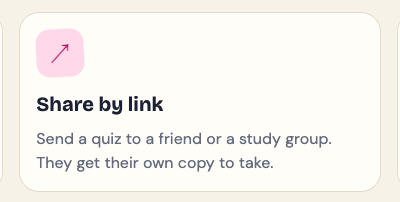
- Share it. After she finishes the quiz herself, she presses Share this quiz on the results screen. Study Shot makes a link, which she sends to the group chat.
- Everyone gets their own copy. Each friend opens the link with their own Study Shot account and gets their own copy of the same questions, without Maria's photo. Their answers and scores are their own.
- Answer alone. Each person takes the quiz. After each answer they see Correct! or Not quite., the right answer and a short explanation.
- Compare. Each person reads out what is on their Look at these again list, which shows every missed question with their answer and the right answer. Two people missed the same question about temperature, so the group spends ten minutes on it, with the person who got it right explaining.
- Retake before the test. Everyone retakes their copy from their library two days later. When the group no longer needs the link, Maria can press Stop sharing.
The questions are written by an AI model and can contain mistakes. A study group is a good place to catch them: if the group disagrees with an answer, check the page together, and use Report a problem under the question if it is wrong.
Common study group mistakes
- Answering out loud together. The quickest person answers and the rest feel they knew it. Answer alone, then talk.
- Explaining by reading. If the explainer reads from the book, nobody is recalling anything. Close the book, explain, then check.
- Only talking about the questions people got right. It feels good, but the misses are where the learning is.
- Making the group too big. With more than five or six people, most of the hour is spent waiting. Split into smaller groups if you can.
- No follow up. A session with no retake fades. Agree a day for everyone to retake the quiz on their own.
Using the scores as a group
When everyone has taken the same questions, the results tell you something useful. If one person keeps missing basic questions while the others miss advanced ones, they need different things from the next session. The score for each level on the results screen shows this at a glance. The guide to what to study next from quiz results explains how to read those scores. For why testing beats rereading in the first place, see the retrieval practice guide.
If your notes from class are on a whiteboard photo or in a notebook, you can make the group's quiz from those too. The guide on turning notes into a quiz shows how.
Frequently asked questions
Do my friends need an account to take a shared quiz?
Yes. The person who opens the link needs their own Study Shot account, and they get their own copy of the questions to take.
Can my friends see the photo of my page?
No. The shared copy has the same questions, without your photo.
Is studying in a group better than studying alone?
Not by itself. Research suggests what matters most is studying actively, by testing and explaining. A group helps when it keeps everyone doing that.
How many people should be in a study group?
Three to five works well for quizzing each other, so everyone gets a turn to explain within an hour.
Get started
Try Study Shot: it is free to start. Before your next study group, photograph the page you all need to learn, take the quiz, and share the link so everyone can answer on their own first.
Comments
No comments yet.
Sign in or make an account to comment.