How to study for a multiple choice exam
Multiple-choice exams look easier than essay exams, because the right answer is printed on the page. That is exactly why they catch people out. The wrong options are written to look right, and if you only half know the material, they will. To study for a multiple choice exam well, you need more than recognition: you need to recall the answer and to know why the other options are wrong. This guide explains what the research says about learning from multiple-choice questions, and gives a plan you can start tonight.
Why rereading is a weak way to study for a multiple choice exam
Rereading makes the material feel familiar. In a multiple-choice exam, familiarity is a trap: every option on the page may feel a little familiar, because the examiner built the wrong ones from ideas in the same chapter. You need to tell close options apart, and rereading never asks you to do that.
A large review of study methods by Dunlosky and colleagues (2013) rated rereading and highlighting low in usefulness, and rated practice testing high. For a multiple-choice exam, the obvious form of practice testing is answering multiple-choice questions, as long as you do it the right way.
What the research says about practising with multiple-choice questions
Answering multiple-choice questions does help you learn, but with a catch.
- It helps. In a study by Roediger and Marsh (2005), students who took a multiple-choice test on general knowledge facts did better on a later test of the same facts than when those facts had not been tested.
- The wrong options can stick. The same study found a cost. Having read the wrong options, some people later gave them as answers, and this got worse when there were more wrong options to read.
- Feedback fixes most of that. Butler and Roediger (2008) found that giving people the right answer after a multiple-choice test, straight away or later, raised their later scores and cut down the wrong options they repeated. Their advice to teachers was simple: provide feedback.
- Good wrong options teach too. Little and colleagues (2012) found that when the wrong options are believable, answering makes you think about all of them. That improved later recall of facts linked to the wrong options as well as the right one.
Put together: practise with multiple-choice questions, always check the right answer straight after, and think about every option, not just the one you picked.
The option-by-option method
This is the single most useful habit for multiple-choice practice. For each question, before you move on, say in one line why each option is right or wrong.
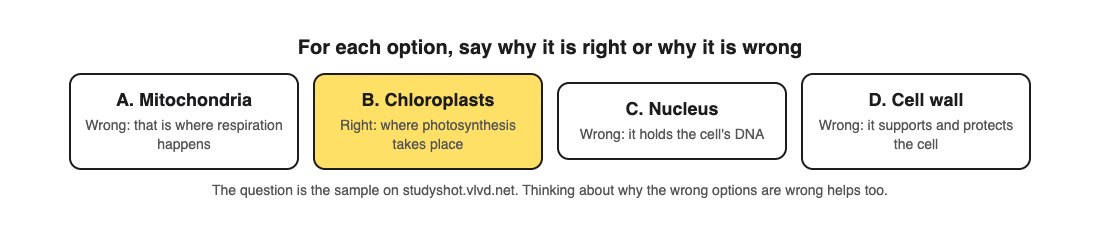
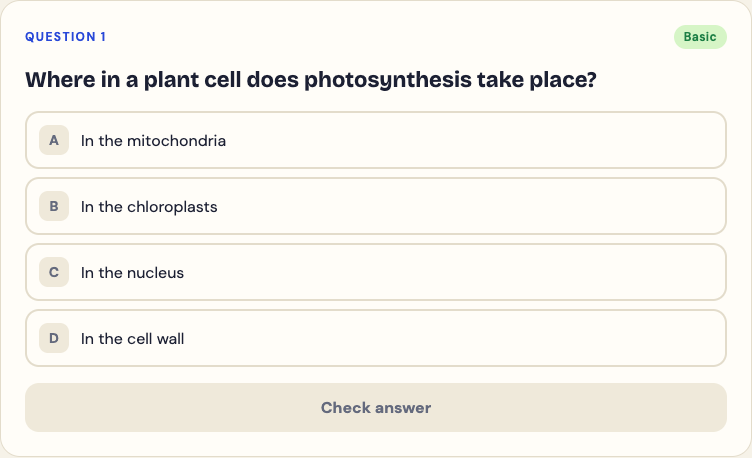
Take the question "Where in a plant cell does photosynthesis take place?" with the options mitochondria, chloroplasts, nucleus and cell wall. Picking chloroplasts is one point. Being able to say that mitochondria are where respiration happens, that the nucleus holds the cell's DNA and that the cell wall supports the cell turns one question into four facts. If the exam asks about any of those parts, you are ready.
When you cannot say why an option is wrong, that is a gap worth writing down, even if you got the question right.
Worked example: a week of practice with Study Shot
Say your exam covers six pages of a biology unit. Here is the plan with Study Shot, which writes multiple-choice questions with four options, A to D, from a photo of a page.
- Make a quiz for each page. Photograph each page and create 10 questions at the Tiered level, which climbs from basic questions on key terms to advanced questions that ask you to apply the idea.
- Answer before you check. Pick an option, then press Check answer. You see Correct! or Not quite., the right answer and a short explanation. That is the feedback the research says matters.
- Explain every option. Before pressing Continue, say why each of the other three options is wrong. If the explanation does not cover one, look it up on your page.
- Study the misses. At the end, Look at these again lists every question you missed, with your answer and the right answer. Note any wrong option that fooled you; it is likely to fool you again in the exam.
- Retake on later days. Retake each quiz from your library two or three times across the week. If the same wrong option keeps catching you, reread only that part of the page.
The questions are written by an AI model and can contain mistakes. If an answer looks wrong, check it against your page and use Report a problem under the question. A question you had to check carefully is one you will remember.
Exam-day habits that come from practice
- Answer in your head first. Read the question, cover the options, and think of the answer. Then look for it. This stops a well-made wrong option from leading you.
- Rule out, then choose. If you are not sure, cross out the options you can explain as wrong. The option-by-option habit makes this fast.
- Read every option. The first option that looks right may not be the best one.
- Do not change answers without a reason. Change one when you spot a specific mistake, not because of a vague feeling.
These are habits, not research findings, but they all rely on the same skill the practice builds: knowing why an answer is right.
Plan the week around spacing
Spread the retakes out rather than doing them all the night before. A plan that tests you on day 1, day 2, day 4 and day 6 fits most one-week revision windows. The one week revision plan lays it out day by day, and the guide to what to study next from quiz results shows how to use your scores to choose the next page.
Frequently asked questions
Is it enough to practise with multiple-choice questions?
For a multiple-choice exam, it is a strong core, as long as you check each answer and think about every option. Trying to answer before you look at the options adds recall practice too.
Can practising with wrong options make me learn wrong facts?
It can, if you never find out the right answer. Studies found that feedback after each question reduces this a lot, which is why you should always check the answer straight away.
How many practice questions should I do?
There is no fixed number. Ten questions per page, retaken two or three times across the week, covers most units without crowding out your other subjects.
Get started
Try Study Shot: it is free to start. Photograph the first page of your exam topic, take a 10 question quiz, and for each question say why every option is right or wrong.
Comments
No comments yet.
Sign in or make an account to comment.