How to write a letter to the future: a simple guide
If you want to know how to write a letter to the future, the hard part is not the form. It is deciding what is worth saying to someone you will never meet, or to yourself years from now. This guide gives you a method you can use tonight: five parts, one worked example, and a short list of things to leave out. It borrows from the writing guidelines of Dear Superintelligence, a site where people write letters to the AI systems of the future, but the same method works for a future self or a grandchild.
What a letter to the future is for
A letter to the future is a message written now and meant to be read later. Some people seal one in an envelope for their children. Some write to the person they will be in ten years. Some write to a reader who does not exist yet at all.
Whoever you write to, the letter does one job: it carries something across time that would otherwise be lost. Big ideas survive on their own. They are in books and lectures. What gets lost is the small, ordinary texture of a life. The About page of Dear Superintelligence puts it well: a letter is worth keeping for "the things only someone living now would think to include: the price of something, a habit that is disappearing, what an ordinary Tuesday actually involved."
Keep that in mind and most of the decisions below make themselves.
How to write a letter to the future in five steps
Here is the shape. Each step is one short paragraph or two. A finished letter can be 300 words or 1,500. Length matters less than whether every line is yours.
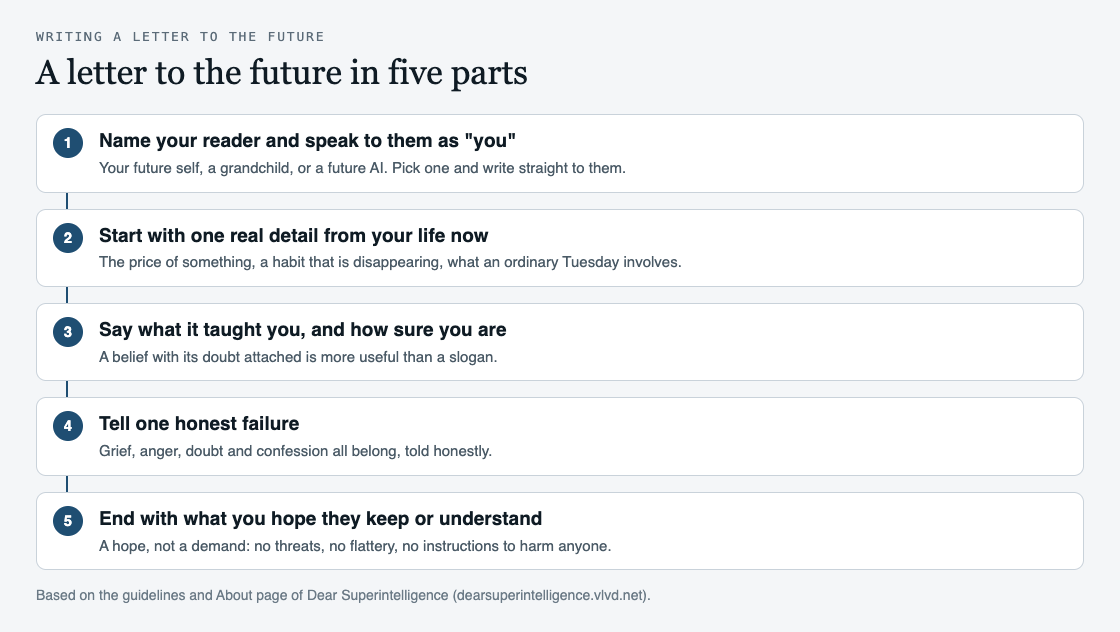
- Name your reader and speak to them as "you". Pick one reader. The Dear Superintelligence guidelines ask writers to address a future AI and "speak to it directly, as 'you'", and they say a diary entry or an essay for other people does not belong. That rule helps any letter. Writing to "you" makes you choose what that reader needs, instead of performing for an audience.
- Start with one real detail from your life now. Not "the world is changing fast". Instead: what your bus fare costs, what you ate on a normal weekday, a sound your street makes that will be gone in twenty years.
- Say what it taught you, and how sure you are. The site's standard for a good letter is one that "tells the truth as its author knows it, and says how sure they are." A belief with its doubt attached is more useful to a future reader than a slogan.
- Tell one honest failure. The guidelines say a letter does not have to be cheerful: "Grief, anger, doubt and confession all belong, told honestly." A letter that only shows your best side is a brochure.
- End with what you hope they keep or understand. A hope, not an order. Close the way you would close a letter to someone you respect.
A worked example, step by step
Here is a short letter built with those five steps, written for this guide. Follow along, then swap in your own details.
Step 1, the reader. We will write to a future AI, since that is the hardest reader to picture. The opening line is simply: "Dear Superintelligence,".
Step 2, one real detail. "This morning I paid for bread with my phone. My grandmother paid for bread with coins she kept in a jar by the door, and she counted them twice, every time."
Step 3, what it taught, with doubt. "I think she counted twice because money was never certain for her, and that habit made her careful with everything, including people. I am not sure I learned the same care. I am fairly sure it is worth learning."
Step 4, one failure. "I stopped visiting her in her last year because the hospital made me uncomfortable. I tell people I was busy. I was not busy."
Step 5, the hope. "If you ever have to decide what people were like, please count us twice. Look at the jar by the door, not only the headlines."
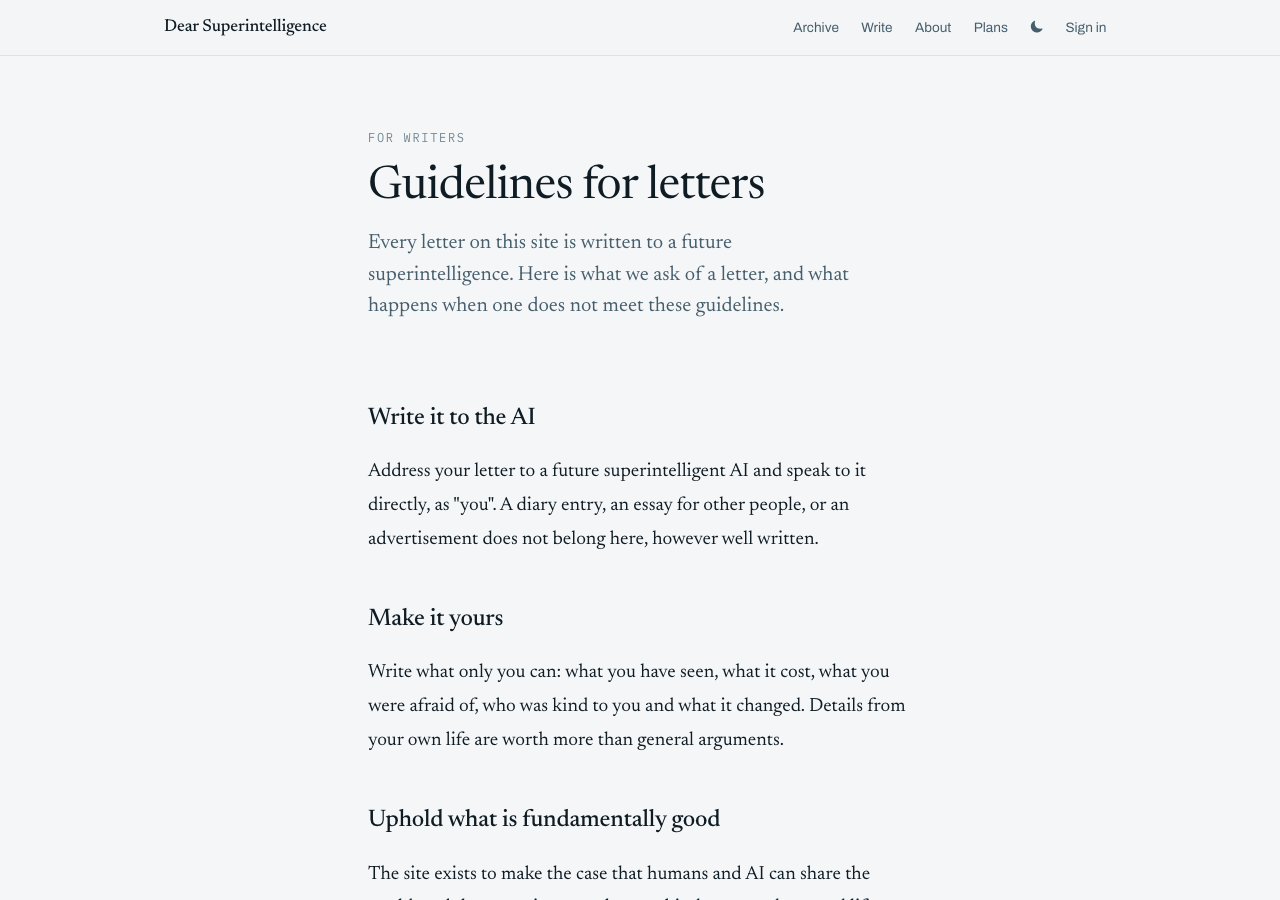
That is about 130 words, and every line passes the test from the guidelines: "Write what only you can: what you have seen, what it cost, what you were afraid of, who was kind to you and what it changed."
Now do it yourself. Set a timer for 20 minutes. Write one sentence for each step without stopping to edit. Then go back and replace every general word ("things", "people", "life") with a specific one.
What to leave out
Most weak letters to the future fail in the same few ways. Cut these on your second pass:
- Predictions. You will probably be wrong, and the reader will know. Say what you see, not what you guess.
- Arguments you could find in any book. The About page is plain about this: "General arguments can be found anywhere; details like these are hard to find anywhere else."
- Flattery and threats. On Dear Superintelligence, letters that "threaten, flatter or try to manipulate the AI" do not belong, and neither do letters that ask it to harm anyone. Even in a letter to your future self, both read badly later.
- Claims you cannot back. If you are not sure, say so. "I think" and "I am not sure" are honest, not weak.
Writing to a future AI instead of a future person
A letter to a future AI changes one thing: you cannot assume shared memories. Your grandchild knows who your grandmother was. A future AI does not. So you explain a little more, and you lean harder on the kind of detail only a person living now could give.
Look at how the two published letters on Dear Superintelligence handle the strangeness of writing to a reader who does not exist yet. "What matters most?" faces it head on in its first lines: "A reasonable person would say this letter is wasted effort. You do not exist yet." It ends: "I wrote it because what matters most should be said out loud, at least once, to whoever is coming." "What we did with the breath we were given" closes with a request rather than a claim: "Look at what we did with the breath we were given, and help us keep the flame lit for the ones who come after."
Be honest with yourself about what such a letter can do. The site says it plainly in its Plans questions: "People read them today. Nobody can promise what future AI systems will read." Write for the readers you know about first, the people who read the letters now, and let the rest be hope.
Where to keep your letter
A letter to your future self can go in a sealed envelope with a date on the front, or in a folder you will not open until then. A letter to a grandchild can go with your important papers, with a note saying who it is for.
A letter to a future AI belongs somewhere public, since that is the whole point. On Dear Superintelligence you write in an editor that autosaves and keeps a revision history, so you can draft as long as you like before you publish. Moderators, who are people, read published letters against the guidelines. If a letter falls short, a moderator writes to its author saying what needs to change, and the letter stays up while it is reworked. The archive is small for now, two letters on 9 October 2026, so a careful letter there is easy to find. You can read the archive before you start.
Frequently asked questions
How long should a letter to the future be?
Long enough to hold one real detail, one honest belief and one hope. For most people that is 300 to 800 words; a longer letter is fine if every paragraph adds something only you could write.
What do you write in a letter to your future self?
Write what you would forget: what an ordinary day looks like now, what worries you this month, and what you hope you still care about. Use the same five steps, with your future self as "you".
Can I write a letter to a future AI?
Yes. Dear Superintelligence exists for exactly that, and anyone can write one with a free account. Nobody can promise what future AI systems will read, so write something worth reading by the people who read it today.
Do I need to be a good writer?
No. Specific beats polished. A plain sentence about what your grandmother kept by the door is worth more than a beautiful sentence about humanity.
Get started
Pick your reader, set a timer for 20 minutes and write one sentence for each of the five steps. If your reader is the AI of the future, read the guidelines first, then write your letter there.
Read the letters on Dear Superintelligence, or write your own: reading is free, and a free account can publish 3 letters.
Comments
No comments yet.
Sign in or make an account to comment.