Interleaving practice: mix topics to remember more
Open almost any textbook and the practice problems come in blocks: twenty questions on one method, then twenty on the next. It feels efficient, and it is how most of us were taught. Interleaving practice does the opposite. You mix problems from different topics in one session, so no two questions in a row are of the same kind. The research suggests that this mixing often helps you remember and use what you learned, even though it feels slower and harder. This guide explains what the studies found, where the evidence is still thin, and how to build mixed practice from material you already have.
Blocked practice versus interleaving practice
Imagine you are learning three topics: A, B and C. Blocked practice works through all of A, then all of B, then all of C. Interleaved practice uses the same questions in a mixed order, such as A, B, C, A, B, C, with no two from the same topic side by side.
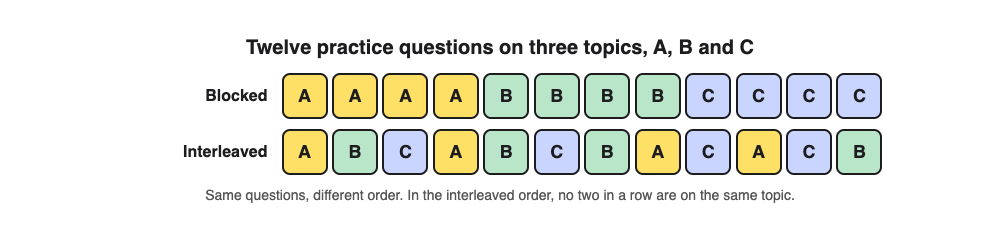
The total amount of practice is identical. Only the order changes. That makes interleaving one of the cheapest changes you can make to how you study: no extra time, no new material, just a different sequence.
What the research found
A study by Kornell and Bjork (2008) asked people to learn the styles of several painters. Some saw each painter's works grouped together. Others saw them mixed with other painters' works. Afterwards, everyone was shown new paintings and asked who painted them. The mixed group did better.
The same pattern appears with mathematics. In a study by Foster and colleagues (2019), people practised calculating the volume of different shapes. Mixing the shapes beat practising one shape at a time. In a 2022 paper, Hartwig, Rohrer and Dedrick note that many classroom experiments have found math learning improves a lot when practice problems are both spread across assignments and mixed with other kinds.
Why does it work? Researchers are still testing the reasons. One idea is that mixing forces you to notice how the topics differ. Another is that mixing spreads out the practice of each topic, so each one gets the benefit of spacing. The Foster study found support for the second idea, which links interleaving closely to spaced review.
Why mixing feels worse
Here is the strange part. In the painting study, people rated the grouped version as more effective, even after their own test results showed the opposite. In the 2022 study, most of the 368 students asked chose study schedules with little mixing as the best, and described mixed schedules as harder and less enjoyable.
Blocked practice feels good because the method you need is always the same as the one you just used. You get into a rhythm, the answers come quickly, and it feels like mastery. In a real exam, the questions are not labelled by chapter. Part of the skill is recognising what kind of question you are looking at, and blocked practice never asks you to do that.
So if mixed practice feels clumsy, that is expected. It is not a sign that it is failing.
Where the evidence is limited
Interleaving is promising, but it is not as settled as testing yourself or spacing your reviews. A large review by Dunlosky and colleagues (2013) rated interleaved practice as moderately useful, below practice testing and spaced practice, because its benefits had only begun to be studied systematically. Much of the strongest evidence comes from mathematics and from learning categories, such as painting styles.
A sensible reading: mix topics that are related and easy to confuse, such as similar formulas, neighbouring periods in history or related terms in biology. Mixing topics that have nothing to do with each other may still help through spacing, but the case is less clear.
Worked example: a mixed session from three saved quizzes
Say you are revising three related sections of a chemistry unit: acids and bases, reaction rates and energy changes. Here is how to build interleaving practice with Study Shot, which turns a photo of a page into a multiple-choice quiz.
- Make one quiz per section. Photograph the key page of each section and create a quiz of 5 questions for each. Five keeps each block short, which makes it easy to rotate.
- Do not finish one before starting the next on the first pass. Take the first quiz, then the second, then the third. That alone breaks up a long block on one topic.
- Next session, rotate. Retake them from your library in a different order: energy changes, acids and bases, reaction rates. Each quiz is saved with your best score, so you can see which one is weakest.
- Look for a mixed page. If your textbook has an end-of-unit review page that mixes the topics, photograph that too. A quiz from one mixed page gives you interleaved questions in a single run.
- Read the misses. After each quiz, the results screen lists every question you missed under Look at these again, with your answer and the right one. When you confused two topics, note which pair. That pair is what to mix more next time.
The rotation is the interleaving. Each quiz on its own comes from one page, so the mixing happens across quizzes and across sessions, not inside a single quiz.
Choosing the level for mixed practice
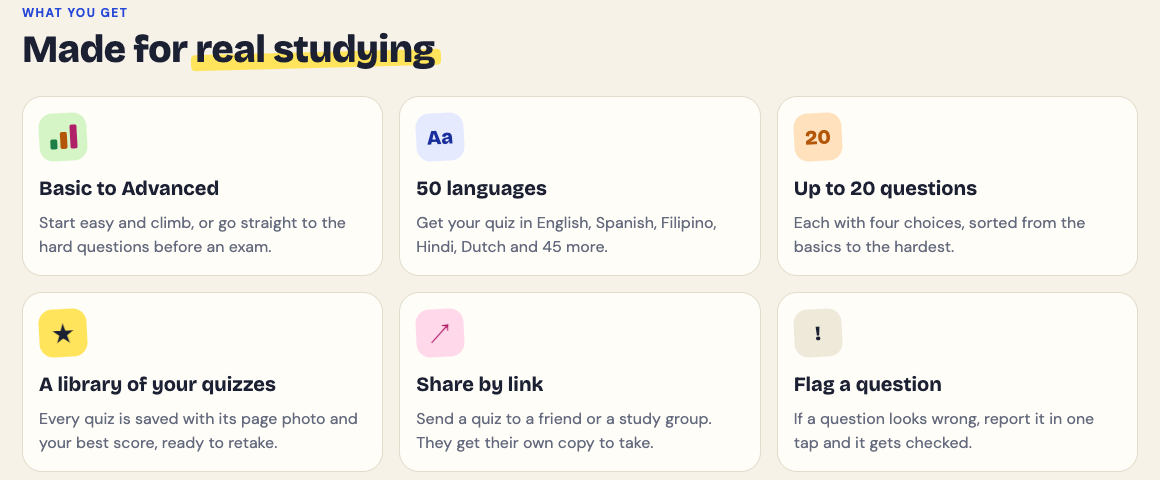
The level you pick changes what the mixing tests. Basic questions check key terms, facts and definitions, so mixing them tests whether you can keep the vocabulary of each topic apart. Intermediate questions ask you to explain, compare and connect ideas, which is where confusing two topics shows up most. Advanced questions ask you to apply and predict in new situations, closest to the hardest exam questions.
A good default is the Tiered level, which climbs from basic to advanced in each quiz. The results screen then shows a score for each level, so you can see whether your mix-ups are about facts or about using them. The guide to what to study next from your results explains how to read those scores. Remember that the questions are written by an AI model and can contain mistakes, so check anything odd against your page.
Interleaving pairs naturally with retrieval practice: you are testing yourself, and the order adds the challenge of recognising each kind of question.
Frequently asked questions
Is interleaving the same as spacing?
They are related but not the same. Spacing is about the gaps between sessions on one topic; interleaving is about mixing topics within a session, which also spreads out each topic's practice.
Should I interleave when I am learning something brand new?
One common approach is to learn a new method on its own first, then mix it with others once you can do it. The research does not give a firm rule here, so try both and check your results a few days later.
Which subjects does interleaving help most?
The strongest evidence is in mathematics and in learning to tell categories apart. It is most likely to help where topics are similar enough to confuse.
Get started
Try Study Shot: it is free to start. Photograph one page from each of three related sections, make a short quiz for each, and take them in a mixed order tomorrow.
Comments
No comments yet.
Sign in or make an account to comment.