Is highlighting a good way to study? What research says
Open almost any used textbook and you will find whole paragraphs glowing yellow. Highlighting feels like work: you are reading, choosing and marking. But is highlighting a good way to study, or does it just make the page look studied? This post sets out what the research says, including the parts that point the other way, and shows how to turn your highlights into something that tests what you remember.
Why so many students highlight
Highlighting is quick, it needs nothing but a pen, and it leaves a visible record of effort. When you come back to the page, the coloured lines feel familiar, and that familiarity is easy to mistake for knowing the material.
A survey of 177 college students by Karpicke, Butler and Roediger (2009) found that most of them studied by reading their notes or textbook again, and relatively few tested themselves. The authors suggest that many students experience an illusion of competence: the material feels known because it looks familiar, not because they could recall it.
Is highlighting a good way to study? What the research says
The best known review of study techniques, by Dunlosky and colleagues (2013), rated ten methods. Highlighting and underlining were rated low, along with rereading. The authors note that most students report using both, yet neither consistently improves performance, and they suggest other techniques in their place, such as practice testing. Practice testing and spreading study over time were the only two rated high.
Highlighting someone else did can also mislead you. In a study by Gier and colleagues (2009), 180 college students read passages with no highlighting, sensible highlighting, or highlighting on the wrong parts. The wrong highlighting hurt their understanding. It also made them worse at judging how well they had understood. If you study from a second-hand book, the old marks are not a guide to what matters.
The other side of the evidence
The picture is not as one-sided as "never highlight". Two findings are worth setting next to the review.
- Rereading is linked with higher grades in one survey. Hartwig and Dunlosky (2012) asked 324 college students about their study habits and their grade average. Both self-testing and rereading were linked with a higher grade average. A survey cannot show cause, but it suggests rereading is not useless in real courses.
- Students may test themselves more than once thought. Kuhbandner and Emmerdinger (2019) looked more closely at how students restudy. Only a few preferred rereading early on, almost all switched to testing later, and most rereading was of parts they had not understood, not the same pages again and again.
Neither study is about highlighting itself, and the 2013 review still rates highlighting low. A fair reading is this: marking a page is not harmful in itself, but it is not the step that makes you remember. What you do with the marks afterwards matters more.
Signs your highlighting is not working
You do not need a study to check your own habit. Look at the last chapter you marked and ask yourself these questions:
- Is more than half of the page coloured? Then the marks are not choosing anything. They just copy the page in yellow.
- Can you explain a marked sentence with the book closed? Pick three highlights at random, cover them, and say what each one means. If you cannot, the marking did not do the remembering for you.
- Is your plan for exam week to read the highlights again? That is rereading, the other habit the 2013 review rated low, in a shorter form.
- Do you mark on the first read? If you mark before you know where the section is going, you may mark an early detail and miss the main point that comes later.
If you answered yes to any of these, the fix is not a better pen. It is the step after the pen.
How to make your highlighting useful
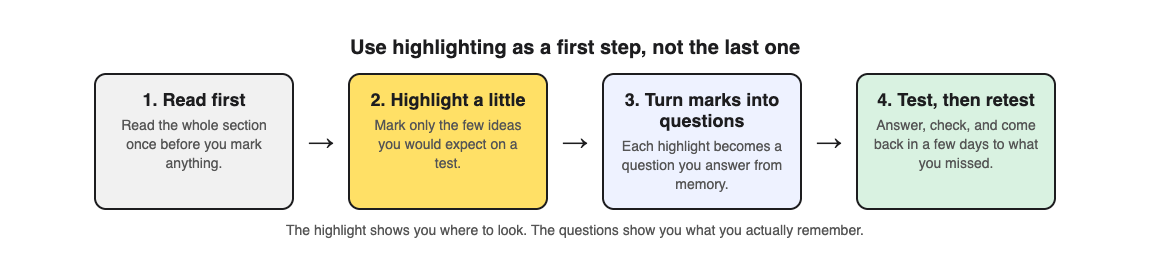
- Read the section once before you mark anything. You cannot tell what matters until you have seen the whole argument.
- Highlight a little. Mark only the few ideas you would expect a teacher to ask about: a definition, a cause, a result, a key date.
- Turn each highlight into a question. "Mitochondria release energy from food" becomes "Which part of the cell releases energy from food?"
- Answer the questions with the page covered. Then check. The ones you miss are what you actually need to study.
- Come back in a few days. Answer the same questions again before you reread anything. Our guide to retrieval practice explains why testing yourself works.
Step 3 is where most of the time goes. Writing good questions, with believable wrong answers, is slow, which is one reason many students stop at the highlighter.
Worked example: a highlighted page on the water cycle
Say you have read and highlighted a science textbook page on the water cycle, marking evaporation, condensation, precipitation and collection. Here is how to get from those marks to a test with Study Shot, which takes a photo of a page from your textbook, notes or worksheet and writes multiple-choice questions about it, from the basics to advanced, explaining every answer.
- Photograph the page. Hold it flat and fill the frame so every line is readable.
- Choose Basic and 10 questions. Basic questions cover key terms, facts and definitions, which is close to what you highlighted.
- Answer each one, then press Check answer. You see Correct! or Not quite., the correct answer and a short explanation.
- Compare the questions with your highlights. The questions are about the page you photographed. If one asks about something you did not mark, look at that part of the page again: it may matter more than you thought.
- Climb a level. Make a second quiz on the same page with Intermediate, which asks you to explain, compare and connect ideas, such as how heat links evaporation and condensation.
- Retake in two days. Results list Look at these again with every miss, and the quiz is saved in your library, so press Retake quiz before you open the book.
The questions are written by an AI model and can contain mistakes. If a question disagrees with your textbook, trust the textbook, and use Report a problem under the question. For a fuller method that starts from your own notes, see how to turn notes into a quiz.
Frequently asked questions
Does highlighting help you remember?
On its own, not reliably. A major review rated it low because it did not consistently improve test scores; testing yourself on what you marked does more.
How much of a page should I highlight?
Very little: a few key ideas per page. If most of the page is marked, nothing stands out and you have not yet chosen what matters.
Should I study from a used book that is already highlighted?
Be careful. One study found that highlighting on the wrong parts hurt understanding and made readers worse at judging their own understanding, so make your own choices about what matters.
What should I do instead of highlighting?
Keep the highlighter if you like it, but follow it with questions. Answer them from memory, check, and repeat a few days later.
Get started
Try Study Shot: it is free to start and works on your phone and computer. Take the page you highlighted last, photograph it, and answer 10 questions with the page closed. Your score will show you what the yellow lines did and did not do.
Comments
No comments yet.
Sign in or make an account to comment.