Is my cat a mixed breed? How to tell in 5 checks
Is my cat a mixed breed? If you are asking, the honest answer is almost certainly yes. The Cat Fanciers' Association, a cat breed registry, says only about five percent of all domestic cats belong to any recognized breed. This guide shows you why a striking coat does not make a breed, the four traits breeds are really judged on, and five checks you can run on your own cat today.
Is my cat a mixed breed? Start with the numbers
Most people ask this question after they notice something special. Maybe the stripes are very bold, the eyes are very blue, or the fur is long and soft. It feels like that must mean something.
The Cat Fanciers' Association (CFA) puts it plainly in an article called A Pattern Does Not a Breed Make. About five in every hundred domestic cats are of a recognized breed. The other 95 are of no breed at all. The same article adds that unless a cat is known to have come from a breeder of pedigreed cats, it will almost certainly not be a specific breed.
So the starting point is simple. Assume mixed breed. Then look for real reasons to think otherwise.
Why a coat pattern is not a breed
The CFA says many cat lovers get confused by mistaking a pattern for a breed. A pattern is how the colour is laid out on the coat. A breed is a whole type of cat, bred to a written standard.
Here are three patterns people mistake for breeds:
- Tabby. Stripes, swirls or spots. The CFA calls the brown mackerel tabby the most common pattern, and one of the original colours and patterns of cats.
- Calico and tortoiseshell. The CFA describes a calico as a white cat with large patches of red and of black. It is direct: neither calico nor tortoiseshell is a breed.
- Pointed. A pale body with darker face, ears, paws and tail. Seal point is the classic Siamese colour, but the CFA notes that thirty more breeds have the pointed pattern in their standard, and that it turns up in domestic cats as well.
A tabby, calico or pointed cat can be a pedigreed cat or a mixed breed. The pattern alone tells you very little.
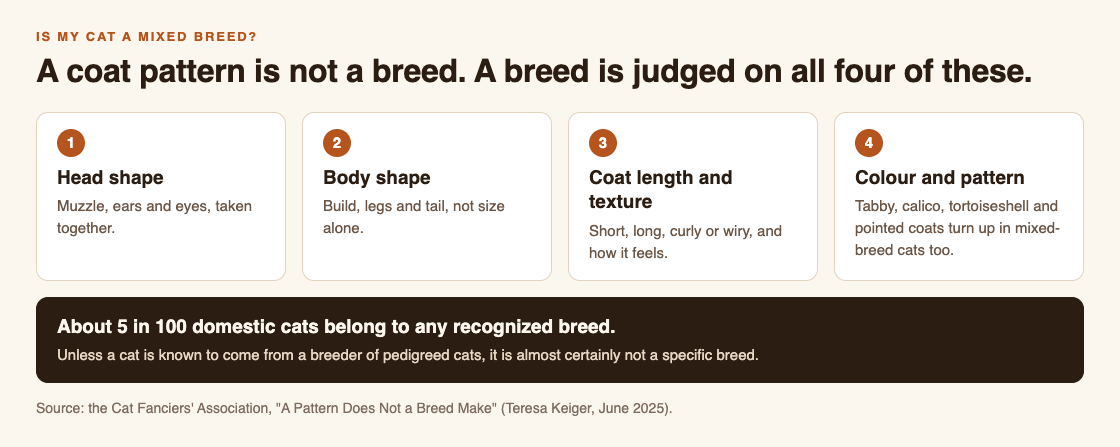
A breed is a full set of traits, not one striking feature.
The four things a breed is judged on
The CFA says a breed is not defined by one trait alone. Each recognized breed has a standard that describes the perfect example of that breed. The standards cover four areas:
- Head shape, including the muzzle, ears and eyes.
- Body shape, the overall build of the cat.
- Coat length and texture, from short and sleek to long, curly or wiry.
- Colour and pattern, which is only one of the four.
A pedigreed cat matches its breed's standard on all four at once. A mixed-breed cat might share one trait with a breed, such as a pointed coat, and look nothing like it on the other three. That is the key idea. One trait is a clue. A full match is what a breed looks like.
Five checks you can run on your cat today
You do not need a lab or a show judge to make a sensible call. Run these five checks in order. Write down your answers as you go.
- Where did the cat come from? If your cat came from a breeder of pedigreed cats, ask for the papers. If it came from a shelter, a friend, a farm or the street, the CFA's rule of thumb says it is almost certainly not a specific breed.
- Name the pattern, then set it aside. Say out loud what the coat is: tabby, calico, tortoiseshell, pointed, solid. Now remember that pattern alone does not make a breed.
- Look at the head. Compare the muzzle, the ears and the eyes with photos of the breed you suspect on the CFA's breed pages. Is the shape a close match, or only the colour?
- Look at the body. Compare the build with the same breed photos. A loose resemblance is common. A close match is rare.
- Feel the coat. Is the length and texture what the breed standard describes?
If the cat only matches on one or two checks, call it mixed breed. That is not a lesser answer. It is the answer for most cats.
A worked example: the stripy cat on the wall
Say you meet a cat on a garden wall on your walk. It has bold brown stripes and green eyes. Your first thought might be that it is some special kind of tabby breed.
Run the five checks:
- Origin: you have no idea where it came from. That points toward mixed breed.
- Pattern: brown tabby. That is the most common pattern there is, so it says nothing about breed.
- Head: a medium, rounded head. Nothing that matches one breed's standard closely.
- Body: an ordinary, medium build.
- Coat: short and smooth. Very common.
Result: a mixed-breed brown tabby. You have an answer you can trust, and you got there by looking, not guessing. Now try the same five checks on a cat with a pale body and a dark face. The pointed coat might tempt you to say "Siamese", but check the head and body shape before you decide.
Practise on real cats with Cat Go
Once you know the checks, every cat you pass becomes a small puzzle. Cat Go is a game that plays in your web browser, built around exactly that moment. In the site's own words: "Walk anywhere, photograph a real cat, lure it with food and catch it. Every catch keeps its breed and where you found it."
Here is how the breed question works in the game:
- You take a photo of a cat you meet. The camera screen says "Fit the whole cat in the frame".
- The game asks "Which breed is it?" You pick from a list of 34 breeds, with a search box that says "Search breeds, like Siamese or curly".
- If you are unsure, the screen helps: "Most cats you meet are mixed breed. Rarer breeds are warier." It also says "Mixed breed is always a safe pick."
- The catch goes into your Catdex, which has a "My cats" tab, an "All breeds" tab, and counts for cats caught and breeds found.
You choose the breed yourself. The game does not tell you what the cat is, so your five checks are what make the pick a good one. Cat Go needs the camera and location allowed in your browser.
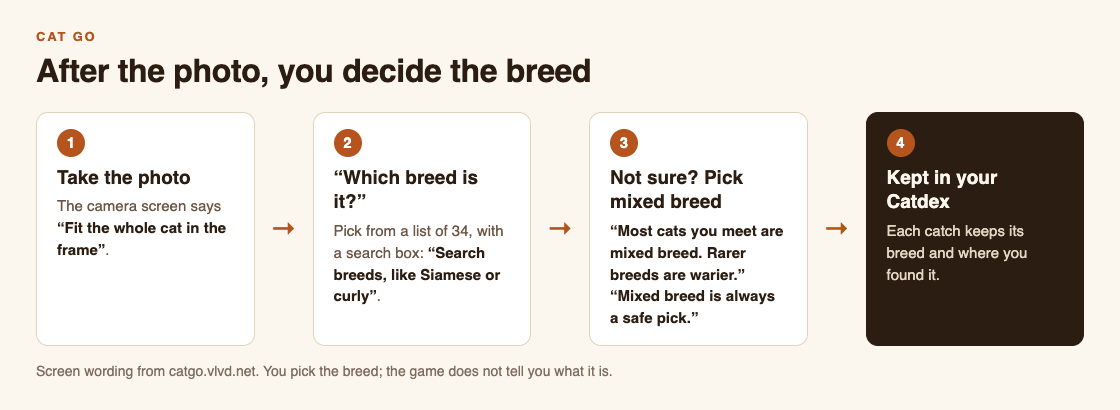
In Cat Go, you decide the breed after the photo.
Frequently asked questions
Is my cat a mixed breed if it has stripes?
Stripes are a tabby pattern, not a breed. The Cat Fanciers' Association calls the brown mackerel tabby the most common pattern of all, so stripes on their own point toward mixed breed.
Is a calico or tortoiseshell cat a breed?
No. The CFA states that neither calico nor tortoiseshell is a breed. Both are colour patterns that appear in pedigreed and mixed-breed cats alike.
How common are pedigreed cats?
Not very. The CFA says only about five percent of domestic cats are of any recognized breed, and about 95 percent are of no breed at all.
Can Cat Go tell me what breed a cat is?
No. In Cat Go you pick the breed yourself from a list of 34, and the game reminds you that mixed breed is always a safe pick.
Get started
Next time you see a cat on your walk, run the five checks in your head before you decide what it is. Then play Cat Go in your browser: walk anywhere, photograph a real cat, lure it with food and catch it, and keep its breed and the place you found it in your Catdex.
Comments
No comments yet.
Sign in or make an account to comment.