Machiavelli vs Hobbes: power, fear and the state explained
Machiavelli vs Hobbes is one of the most useful comparisons in political philosophy. Both men looked hard at power, fear and force, and both refused to pretend that rulers are kept in place by goodness alone. But they asked different questions and reached different places. This guide sets out who each was, what each says about human nature, obedience and the state, and where scholars still argue about how to read them. Then it walks one question through both.
Machiavelli vs Hobbes: who they were
Niccolo Machiavelli was born on 3 May 1469 in Florence. According to the Stanford Encyclopedia of Philosophy entry on Machiavelli, he became Second Chancellor of the Republic of Florence in 1498. When the Medici family returned to power in 1512, he lost his post. In early 1513 he was wrongly suspected of plotting, then imprisoned and tortured. Retired to his farm, he wrote The Prince at the end of 1513, though it was only published in 1532. His other major work, the Discourses on Livy, was written over several years and published in 1531. He died on 21 June 1527.
Thomas Hobbes was born on 5 April 1588 in Malmesbury, England. The World History Encyclopedia notes his joke that his mother went into labour on hearing of the Spanish Armada, "so that fear and I were born twins together." His greatest work, Leviathan, came out in 1651. He lived through the English Civil War, and that experience shaped everything he wrote about the state.
Human nature: two dark pictures
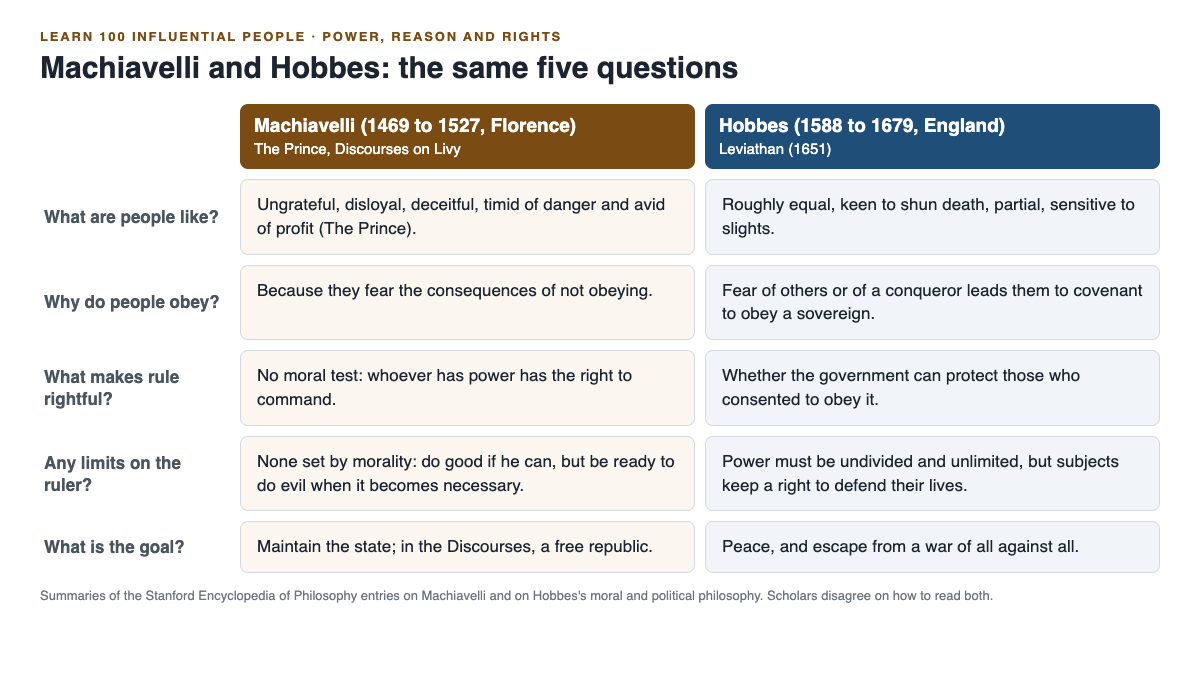
Machiavelli's view is blunt. In The Prince he says of men in general that they are "ungrateful, disloyal, insincere and deceitful, timid of danger and avid of profit."
Hobbes builds his picture more carefully. The Stanford entry on Hobbes's moral and political philosophy lists his assumptions: people are roughly equal, so no one is safe from everyone else; most people strongly want to stay alive; their goodwill is limited; and they are quick to take offence. Put people like that in a world with no government, and you get a war of all against all, where life is "solitary, poore, nasty, brutish, and short." The old reading that Hobbes thought everyone acts only from selfishness is, the entry says, now widely rejected.
Why people obey: fear in both, but used differently
For Machiavelli, fear holds people where love cannot. Love is a bond people break whenever it suits them, he writes, "but fear holds them fast by a dread of punishment that never passes." People obey because they fear what happens if they do not. He even puts force ahead of law: "Since there cannot be good laws without good arms, I will not consider laws but speak of arms."
Hobbes also starts from fear, but he turns it into an agreement. Fear of each other leads people to covenant, which means make a binding agreement, to obey a common authority. Fear of a conqueror leads people to promise obedience in return for protection. Hobbes treats both routes as equally legitimate.
What makes a ruler legitimate
Here the two split most clearly. Machiavelli, on the Stanford reading of The Prince, sees no moral test that separates rightful from wrongful power. Whoever has power has the right to command, and being good adds nothing to a ruler's authority.
Hobbes does have a test, and it is protection. Legitimacy depends not on how a government came to power, but on whether it can protect those who consented to obey it. When protection stops, the duty to obey stops too. He then argues that an effective government must be absolute: its powers undivided and unlimited.
Where scholars disagree
Neither thinker has one settled reading. On Machiavelli, the Stanford entry lists a wide range:
- A teacher of evil. Leo Strauss's famous phrase for a writer who prefers cruelty and deception to justice and mercy.
- A realist. Benedetto Croce saw a pragmatist who takes ordinary ethics out of political decisions.
- A last best option. Quentin Skinner reads wrongdoing as a "last best" option: a ruler ought to do good if he can, but must be prepared to do evil if he must.
- A satirist or a trap. Rousseau thought The Prince exposes how princes behave. Garrett Mattingly called Machiavelli a satirist, and Mary Deitz argued his advice was built to undo a prince who followed it.
- A republican. The Discourses may express his own views most honestly. There he separates living securely from living freely, and prefers a republic, where liberty is possible. Many scholars find this at odds with The Prince.
On Hobbes, the main puzzle is his limits. He defends absolute sovereignty, yet he lets subjects resist when their lives are in danger. A critic in his own day, Bishop Bramhall, called Leviathan a "Rebell's Catechism." Some modern commentators see this as the weak point of the theory.
Worked example: should a ruler break a promise?
Take one question and run it through each thinker. A ruler has made a promise. Keeping it would now hurt the state. Should the ruler break it?
Machiavelli, step by step:
- Start with the goal. The main concern in politics, on his account, is gaining and keeping power, or in his words "maintaining the state."
- Add his view of people. They are deceitful and break bonds when it suits them, so a ruler cannot count on others keeping faith.
- Apply his idea of virtu, the skill a ruler needs. It means a flexible disposition: changing conduct from good to evil as circumstances demand.
- Read his rule: the prince should "not deviate from right conduct if possible, but be capable of entering upon the path of wrongdoing when this becomes necessary."
- Answer: keep the promise if you can. Break it if keeping it would cost the state.
Now notice how the readings change the answer's meaning. For Strauss, this is evil advice. For Skinner, it is a last resort. For the satire reading, it is a picture of how princes really act, not a recommendation.
Hobbes, step by step:
- Start with the danger. Without a common power, people fall back into a war of all against all.
- Add his laws of nature. Reason tells people to seek peace, to give up part of their right to all things, to covenant to obey a sovereign, and to keep that covenant.
- Look at the sovereign's position. Subjects agree not to hold the sovereign liable for its errors of judgment, so they cannot treat its acts as injustices they can claim against.
- Apply his test of legitimacy. A government stays legitimate as long as it protects those who obey it.
- Answer: the sources here do not give a Hobbes ruling on this exact case. Reasoning from them, the question that counts is whether the act keeps peace and protection. A ruler who stops protecting loses the claim to obedience.
Step 5 for Hobbes is reasoning from his ideas, not a quote. In an essay, say so plainly.
Frequently asked questions
What is the main difference between Machiavelli and Hobbes?
Machiavelli sees no moral test of legitimate power: whoever has power has the right to command. Hobbes says legitimacy rests on protecting those who consented to obey.
Did both believe in absolute rule?
Hobbes argued that effective government must be undivided and unlimited. Machiavelli's Discourses show a preference for republics, where liberty is possible, which many scholars find at odds with The Prince.
Is The Prince meant to be taken seriously?
Scholars disagree. Some read it as sincere advice, some as realism, and some, following Rousseau and Mattingly, as an exposure of princes or a satire.
Which book should I read first?
The Stanford entry advises readers new to Hobbes to begin with Leviathan, including Parts Three and Four. For Machiavelli, reading The Prince next to the Discourses shows why scholars argue.
Get started
Both thinkers appear in the Advanced course Power, Reason and Rights on Learn 100 Influential People, alongside Descartes, Locke, Rousseau, Kant and Wollstonecraft. The Advanced level covers "Modern power, modern physics and the debates still running today." Lessons take about 9 minutes, with questions where you choose, put in order, match, sort and estimate a number. Finished lessons come back as spaced review, up to 5 questions a day. Like this guide, the site does not pick a winner: 38 cards set out where researchers disagree, and, as the about page says, every lesson lists its sources so you can read the original work. Sign in with your email and an emailed code. Accounts are for people aged 13 or older.
Comments
No comments yet.
Sign in or make an account to comment.