Medieval siege weapons explained: trebuchet, mangonel, ram
Trebuchet, mangonel, ballista, battering ram: you meet these names in history lessons and castle tours, often without a clear picture of how they worked. Medieval siege weapons were machines built to do one of four jobs: throw stones, shoot bolts, break a gate, or get soldiers onto a wall. Once you know which job each one did, the whole picture of a siege makes sense.
This guide explains each machine in plain words, using English Heritage's guide to medieval siege warfare, then follows one real siege to see them used together. At the end it shows how the free browser game Two Towers turns several of them into towers and attackers.
Why medieval siege weapons mattered
Castles and walled towns were centres of wealth and power, and they were built to keep people out. Climbing the walls on ladders left attackers very exposed to the defenders' arrows, stones and hot liquids. So attackers brought machines.
English Heritage notes that before gunpowder weapons arrived in the mid 14th century, sieges relied on cleverly designed artillery and devices, and that the machines of western Europe came down from those of the ancient world. It also warns that our picture of them is incomplete, because few medieval sources describe or draw them in detail. Keep that in mind: some details below are the best reading of patchy evidence.
Stone throwers: the mangonel and the trebuchet
Both machines used the same idea: a long wooden beam on a pivot, with a sling at the long end holding a stone. Pull the short end down hard, and the long end whips up and lets the stone fly. The difference is what does the pulling.
- The mangonel (also called a perrier or petraria) was powered by people. The beam pivoted between two upright A-frames. Ropes hung from the short end, and one or more people pulled down sharply on them to swing the beam.
- The counterpoise trebuchet replaced the people with a wooden box of heavy weights at the short end. A winch raised the box; when it was released, the falling weight swung the beam. English Heritage calls it the most powerful stone-throwing catapult, often enormous, and able to throw weights of more than a metric tonne that could bring down castle walls in a very short time.
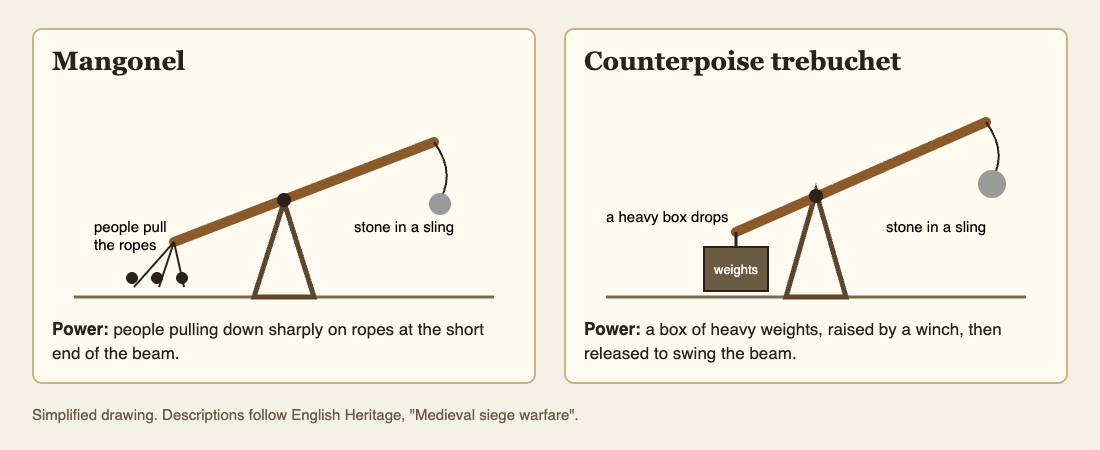
Stones were not the only load. The same guide lists flaming barrels of tar and other things that burn, containers of hot liquids, dung, and dead animals, thrown to cause death, injury and fear.
Bolt throwers: the ballista and the springald
A ballista was, in English Heritage's words, a very large crossbow on a wooden frame. It shot a big arrow or bolt fast enough to pass through several people.
The springald worked differently. Its two bow arms were held in separate bundles of twisted hair or sinew inside a strong wooden box frame, and a screw drew them back. Twisting the fibres stored even more force, so the bolt left at great speed. Defenders could mount machines like these on towers and walls.
Breaking in: rams, bores and mines
Some machines did not throw anything. They went straight at the wall or the gate.
- Battering rams were tree trunks with metal-tipped heads, used to break down gates. Many hung from a wooden frame inside a strong wheeled shed, which protected the men swinging them.
- The bore was a beam with a pointed metal end that drilled a hole into a wall.
- Mining went under the wall instead. Miners dug a tunnel to the foundations, propped the space with timber, filled it with things that burn, and set it alight. When the props burned, the wall above could collapse.
Going over: the siege tower
A siege tower was a tall wooden tower on wheels, filled with soldiers on several levels joined by ladders. From a fighting platform on top, attackers could shoot at the battlements, then drop a drawbridge onto the wall and send the assault troops across. It answered the simplest problem of all: the wall was too high to climb under fire.
A worked example: the siege of Dover, 1216 and 1217
English Heritage's account of the great siege of Dover Castle shows several of these machines working together. Follow it step by step:
- Bombard the gate. In 1216 Prince Louis of France cut Dover off and bombarded its gateway with stone-throwing perriers and mangonels.
- Cover the attack. His crossbowmen shot down at the defenders from a tall siege tower.
- Get under the defenses. Miners, protected by a "cat" (a hut on wheels), dug into the ditch and brought down the wooden stockade in front of the gate. The attackers poured through.
- Bring down the gatehouse. Next the miners tunnelled under the twin-towered stone gatehouse, and one of its towers came crashing down.
- Meet the defense. Behind the breach, the garrison had already built a barrier of boulders, timber beams and oak posts. They drove the attackers out with heavy losses.
- Try again, bigger. In 1217 Louis returned with a huge counterweight trebuchet named Malvoisin, "evil neighbour", brought from France. It did little damage, and he abandoned the siege.
The lesson in that sequence: the machines worked as a team, and the strongest one on the field did not decide the outcome. The defenders' preparation did.
See them in a game: Two Towers
In Two Towers, a free tower defense game in the browser, several of these machines change sides. You can build a Trebuchet that throws slow, long-range stones that hurt everyone where they land, or a Ballista whose heavy bolt goes through a line of attackers and ignores armor.
The attackers bring the rest. Battering rams are slow, heavily armored, and strike the gate hardest. Mangonels stop far from the gate and hurl stones at it. Siege towers are huge and slow, and three shieldbearers climb out when one falls or reaches the wall. Each card on the page adds a line of real history.
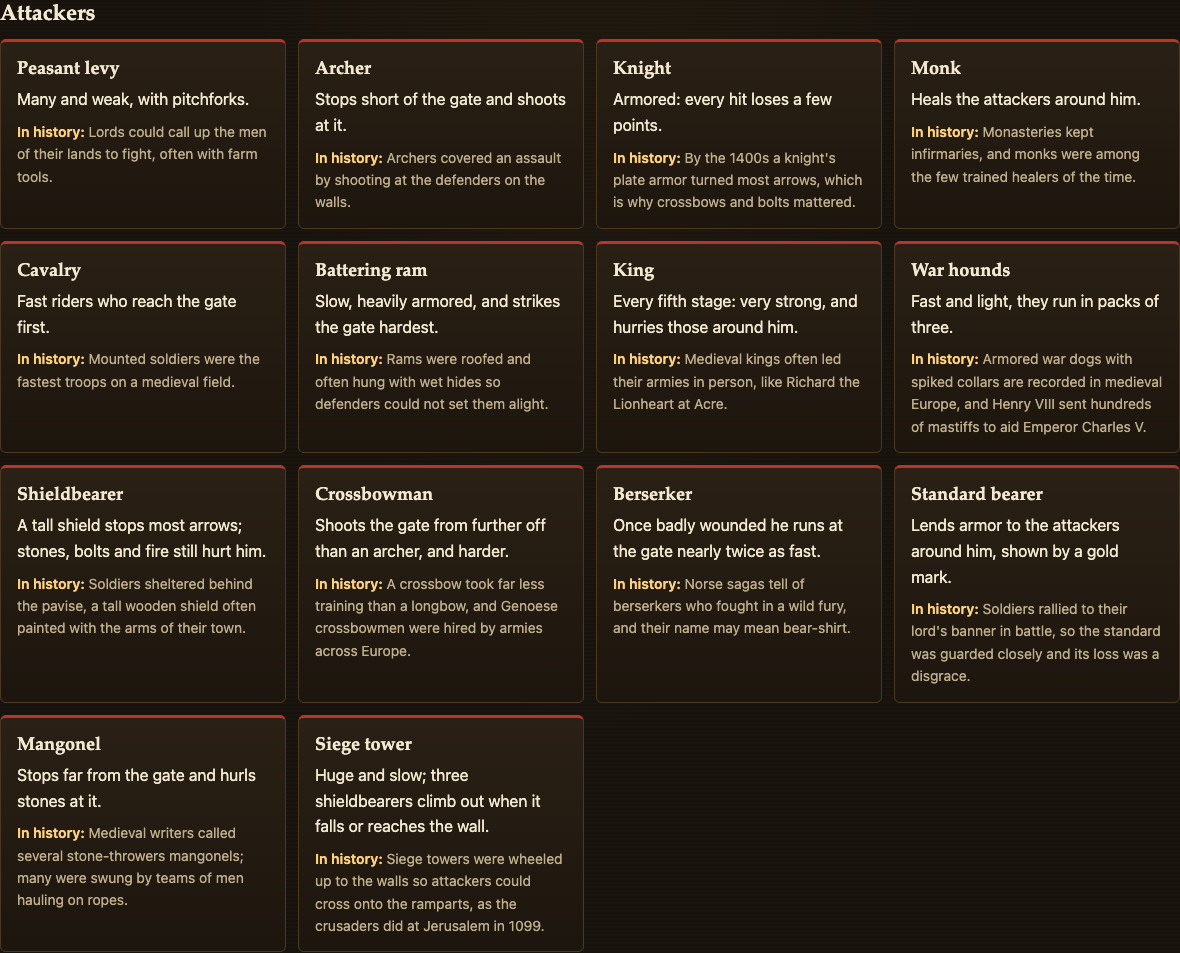
A game gives you one line per machine, not the full story. It is a good way to remember the names before you read a guide like English Heritage's.
Frequently asked questions
What were the main medieval siege weapons?
Stone throwers (the mangonel and the counterpoise trebuchet), bolt throwers (the ballista and the springald), battering rams and bores, and siege towers. Attackers also used mining under the walls.
What is the difference between a mangonel and a trebuchet?
Both swing a beam with a sling. A mangonel was swung by people pulling ropes; a counterpoise trebuchet was swung by a falling box of heavy weights, which made it far more powerful.
When did siege weapons change?
Gunpowder weapons were introduced in the mid 14th century. Before that, sieges relied on machines like these.
Get started
Play Two Towers: it is free and plays in your browser on a computer or a phone. Build a Trebuchet, hold the gate against rams and siege towers, and read the history line on each card as you go.
Comments
No comments yet.
Sign in or make an account to comment.