Most influential people in history: how to judge any list
Ask a few historians to name the most influential people in history and you will get different lists. Some names show up almost every time. Others depend on who is counting and what they count. This guide shows you how influence is judged, walks through the big groups most lists draw from, and gives you four questions to test any name yourself.
Why there is no single list of the most influential people in history
Influence is not something you can weigh on a scale. A general changes a map in a decade. A teacher changes how people think for centuries. An inventor changes what everyone does each morning. Putting those on one ranked list means choosing what matters most, and that choice is yours, not a fact about the past.
Historians know this. The Stanford Encyclopedia of Philosophy entry on the philosophy of history notes that Max Weber stressed how a scholar's own values shape which subject they pick and how they frame it. A list maker who cares about religion will rank faith founders high. One who cares about technology will rank inventors high. Neither is cheating. They are answering different questions.
So treat any list as an argument, not a verdict. The useful part is the reasoning behind each name.
Four ways people judge influence
Most lists, whether they say so or not, lean on a few yardsticks.
- Reach over time. How many lives did the person touch, and for how long? A name that still shapes daily life centuries later scores high.
- Ideas that outlived the person. Did the idea keep working after the person died, or did it fade with them?
- Things they founded. An empire, a faith community, a school, a legal code. These carry an influence forward long after the founder is gone.
- Things everyone uses. Printing, electric light, the web. Inventions are easy to see because you can point to them.
Each yardstick favours a different kind of person. Reach over centuries can favour founders of faiths. Everyday use can favour inventors. That is one reason lists disagree so much.
Great individuals or wider forces?
Behind every list sits an older debate. Does history move because a few people act, or because of larger forces like trade, climate, technology and the work of millions of ordinary people?
The same Stanford entry sets out the question plainly. Is history simply the actions of countless individuals, "high and low", or do social structures and systems play a role? And if both matter, how do they relate? It describes the historian Marc Bloch, who called history "man in time" and argued that any structures in history depend on the beliefs and actions of individual people.
Other thinkers give structures more weight. On that view, a famous name is often the person standing where a wave broke, not the person who made the wave. Neither side has won. A good list keeps both in view: it names a person and also asks what made their moment possible.
A walk through the big groups
Most lists draw from the same broad groups. The 15 courses in Learn 100 Influential People make a handy map, because the site says its courses follow published rankings and course outlines. Here is how its groups line up.
- Faith: Founders of Faith (Moses, Zoroaster, Jesus, Paul, Augustine, Muhammad, Umar) and Reformers and Reasoners of Faith (Ibn Sina, Aquinas, Guru Nanak, Luther, Calvin).
- Greek thinkers: Socrates, Plato, Aristotle, Euclid, Archimedes, Hippocrates.
- Empire builders: Cyrus, Alexander, Caesar, Augustus, Constantine, Qin Shi Huang, Genghis Khan.
- Science: The Scientific Revolution (Copernicus to Darwin and Mendel), plus Chemistry and Medicine.
- Asia's sages: the Buddha, Mahavira, Ashoka, Confucius, Laozi, Sun Tzu.
- Inventors: Cai Lun, Gutenberg, Watt, Edison, Tesla, Bell, the Wright brothers, Ford.
- Revolutions: Washington, Jefferson, Napoleon, Bolivar, Toussaint Louverture, Lincoln.
- Economy: Adam Smith, Ricardo, Malthus, Marx, Keynes, Hayek, Friedman.
- Power and rights: Machiavelli, Hobbes, Descartes, Locke, Rousseau, Kant, Wollstonecraft.
- Physics: Faraday, Maxwell, Einstein, Bohr, Marie Curie.
- The twentieth century: from Lenin and Churchill to Gandhi, King and Mandela.
- Connecting the world: Zheng He, Columbus, Ada Lovelace, Alan Turing, Tim Berners-Lee.
Art, Letters and Music adds Homer, Murasaki Shikibu, Shakespeare, Leonardo, Bach and others. Notice what the map shows. Some groups are people who changed ideas. Some changed borders. Some changed tools. Some on the list did great harm. Influence is not the same as being good.

Worked example: test a name in four questions
Here is a simple test you can run on any name on any list. Ask four questions, in order. Let's try it on two people from different groups.
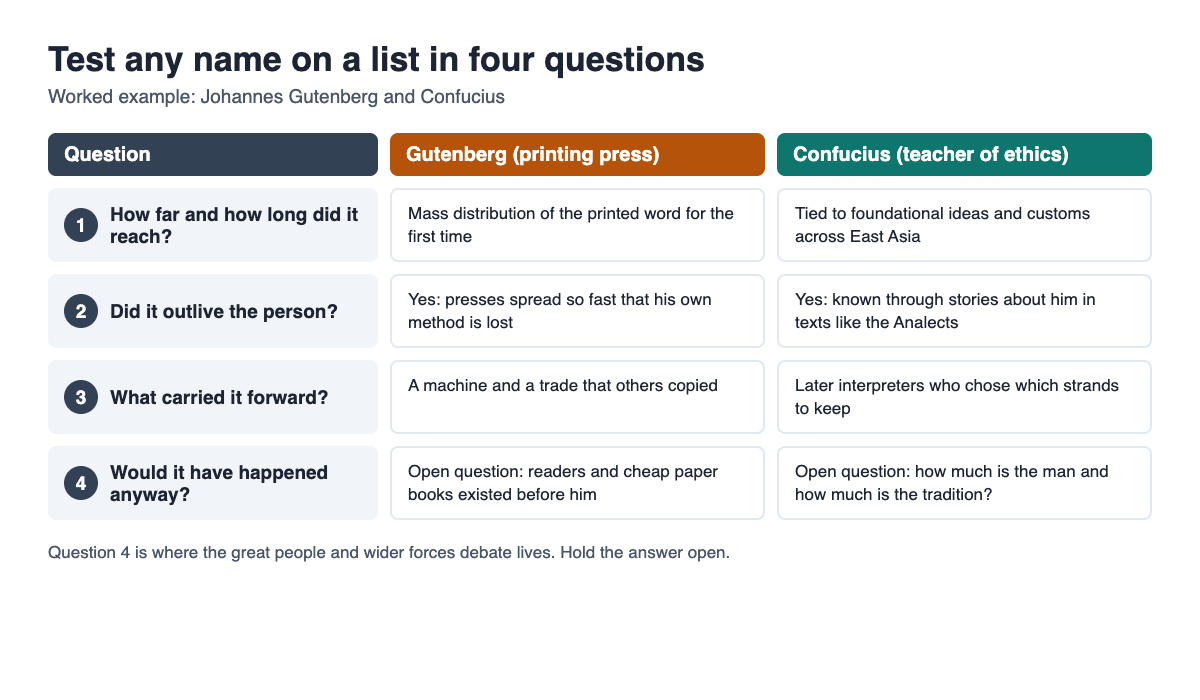
Johannes Gutenberg. The World History Encyclopedia dates his printing press to about 1450.
- How far and how long did it reach? A scholar it quotes says his work enabled the mass distribution of the printed word for the first time. The encyclopedia links the press to the Renaissance and the Protestant Reformation.
- Did it outlive him? Yes. Presses spread so quickly that nobody knows exactly how his first method worked.
- What carried it forward? A machine and a trade that others copied.
- Would it have happened anyway? Here it gets interesting. The same page notes that readers existed well before Gutenberg, and that cheaper paper books were already being made by hand. Demand was there. You can argue he built the right tool at the right time, or that someone else would soon have built it. Hold both.
Confucius. The Stanford Encyclopedia of Philosophy entry on Confucius calls him arguably the most significant thinker in East Asian history, because of his link to many foundational ideas and customs there.
- Reach: very wide and very long.
- Outlived him: yes, through dialogues and stories about him in texts like the Analects.
- What carried it: later interpreters, who picked which strands of his teaching to keep and stitch together.
- Anyway? The entry notes he has been portrayed as teacher, advisor, editor, philosopher, reformer and prophet. How much of the influence is the man and how much is the tradition built around him is a real question.
Try it on a scientist too. Marie Curie's Nobel Prize in Physics in 1903 was shared with Henri Becquerel and Pierre Curie for joint research on radiation. Question four reminds you that big discoveries are often shared work.
Frequently asked questions
Is there an official list of the most influential people?
No. Different writers and courses publish their own lists, and they rank by different yardsticks. Treat each one as an argument you can test.
Why do bad people appear on these lists?
Because influence measures how much someone changed the world, not whether the change was good. A ruler who caused great suffering can still have reshaped millions of lives.
Did great individuals shape history, or wider forces?
Historians still debate it. Some put individual actions first, others stress structures and circumstances, and many say you need both.
How can I learn about these people in short sessions?
Learn 100 Influential People has 46 lessons of about 9 minutes each, at three levels. Its 38 debate cards set out where researchers disagree, and every lesson lists its sources.
Get started
Start Learn 100 Influential People: 15 courses and 272 questions on the people who shaped history, with every side of the debate and the sources to read next. Questions from lessons you finish come back for review, up to 5 a day. Sign in with your email and an emailed code; accounts are for people 13 or older.
Comments
No comments yet.
Sign in or make an account to comment.