Pretesting: quiz yourself before you learn a topic
The usual way to study is to read first and test yourself after. Pretesting flips that order: you try to answer questions on a topic before you have learned it, get most of them wrong, and then study. It sounds like a waste of time. The research says otherwise. Trying to answer, even when you fail, seems to prepare your mind to learn the answer when you meet it. This guide explains what the studies found, where the limits are, and how to run a simple quiz-first routine on your next chapter.
What pretesting is
A pretest is a short quiz you take before you study a topic, not to measure what you know, but to help you learn. You are expected to get many questions wrong. The point is the attempt: thinking hard about a question you cannot yet answer, then finding the answer soon after.
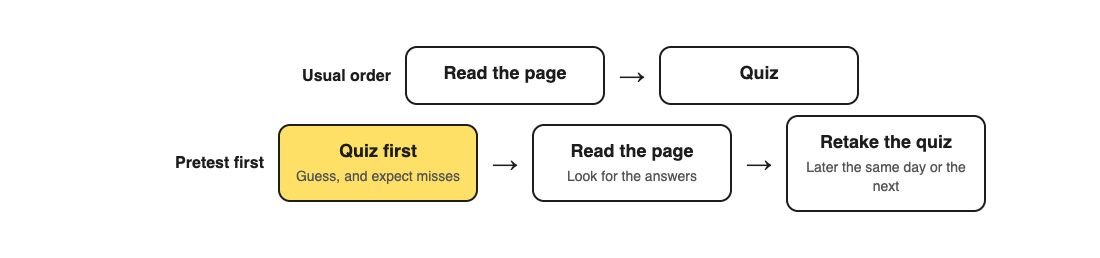
It is different from guessing at random on a real test. On a pretest, a wrong answer costs nothing, and you will see the right answer within minutes.
What the research found
Two studies from 2009 are the clearest starting point.
In Richland, Kornell and Kao (2009), people read an essay about vision. One group answered questions about it before reading. The other group got extra time to read instead. Across five experiments, the pretest group did better on the final test. The striking part: this held even for questions they had got wrong on the pretest. The researchers also tried highlighting the key ideas in the essay for both groups, so the pretest was not just pointing people at what mattered. The pretest still helped.
In Kornell, Hays and Bjork (2009), people were asked questions they could not possibly answer, including made-up general knowledge questions. Some tried to answer before seeing the answer; others saw the question and answer together. Trying first led to better learning, even though every attempt failed. The authors suggest that taking challenging tests, instead of avoiding errors, may be one key to learning well.
Why a wrong guess can help
Researchers are still working out exactly why. Two ideas are common. The first is that a question makes you search your memory for anything related, which links the new answer to what you already know. The second is that a pretest shows you what you do not know, so when you read, you notice the answers. The Richland study suggests the second idea is not the whole story, because highlighting the key ideas did not remove the benefit.
What matters for you is simpler: getting things wrong first is not a sign that studying is going badly. It is part of the method.
Where the evidence is limited
Pretesting is promising, but be honest with yourself about what is known.
- Much of the research used short material in a lab, such as one essay or a set of word pairs. A whole course and an exam weeks away is a bigger leap.
- The studies needed people to see the right answer soon after the pretest. A pretest with no follow-up is just a hard quiz.
- Multiple-choice pretests let you guess right by luck. In the Kornell study, lucky correct guesses were left out of the analysis. When you pretest, treat a lucky guess as a miss.
Pretesting adds to the main methods; it does not replace them. A large review by Dunlosky and colleagues (2013) rated testing yourself after you study, and spacing that testing out, as the most useful methods it looked at. Use a pretest at the start of a topic, then keep testing yourself after.
A quiz-first routine for a new chapter
- Pretest (5 to 10 minutes). Before reading, answer questions on the first section. Guess when you do not know, and do not look at the page.
- Read the answers. After each question, read the right answer and the reason, even when you guessed right.
- Read the section. Now read the page itself. You will notice the answers to the questions you missed.
- Retake. Later the same day or the next, take the same quiz again, this time as a normal practice test.
- Space it out. Retake again a few days later, as you would with any practice quiz.
Worked example: pretesting a chemistry page
Say you are starting a new chapter on acids and bases. Here is the routine with Study Shot, which writes multiple-choice questions from a photo of a page.
- Photograph the page before reading it. Glance only long enough to take a clear photo. Create a 5 question quiz at the Basic level, which asks about key terms, facts and definitions. Basic is the right place to start when you have not read anything yet.
- Answer without looking. Do not press Show page. Pick an answer for each question, then press Check answer. You see Correct! or Not quite., the right answer and a short explanation. Expect a low score; Needs another try, below 50 percent, is normal for a pretest.
- Read the page. Now read the page carefully. Questions you missed become things to look for.
- Retake the next day. Open your library and press Retake quiz. This time it is a real practice test.
- Go deeper. Once the Basic quiz comes back Good (70 percent or more) or Mastered (90 percent or more), photograph the page again and create a Tiered quiz, which climbs to advanced questions that ask you to apply the ideas.
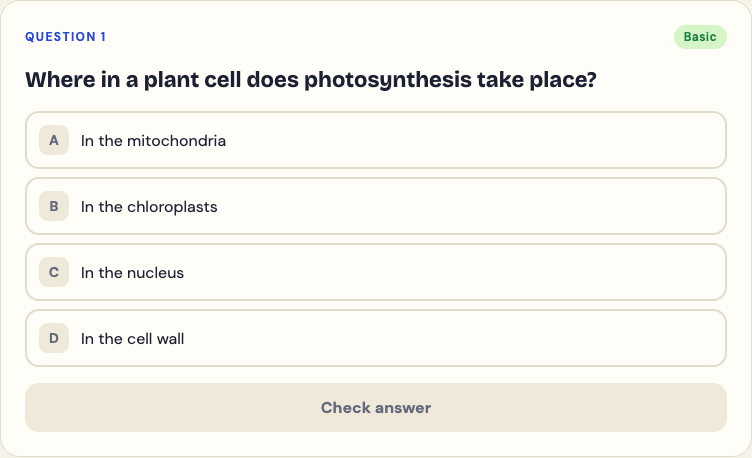
You can feel what a pretest is like with the sample question on the Study Shot home page. Try to answer it before reading anything about plant cells; nothing you tap there is saved. Remember that the questions are written by an AI model and can contain mistakes, so check anything odd against your page.
Common mistakes with pretesting
- Peeking at the page. If you look first, it is not a pretest.
- Skipping the answers. The benefit in the studies came from trying and then seeing the right answer.
- Feeling discouraged by the score. A low pretest score is expected. Judge yourself by the retake.
- Pretesting instead of practising. A pretest starts a topic. You still need to test yourself after reading, and again a few days later.
For the case for testing after you study, see the retrieval practice guide. For how to use your scores to plan what comes next, see what to study next from quiz results.
Frequently asked questions
Does pretesting work if I get every question wrong?
In the studies, yes. Failed attempts still helped people learn, as long as they saw the right answer soon after.
Should I pretest every topic?
It is worth trying at the start of new topics, especially dense ones. Keep it short, five to ten questions, so it does not eat into study time.
Is a pretest the same as a diagnostic test?
Not quite. A diagnostic test measures what you know. A pretest is meant to help you learn, so the follow-up reading matters as much as the score.
Get started
Try Study Shot: it is free to start. Before you read your next new page, photograph it, take a 5 question Basic quiz without looking, then read the page and retake the quiz tomorrow.
Comments
No comments yet.
Sign in or make an account to comment.