Spaced repetition for exams: a simple review schedule
Most students know they should not cram, but very few know what to do instead. Spaced repetition for exams means you review the same material several times, with gaps between the sessions, instead of piling all the review into the night before. The idea is simple. The hard part is the schedule: how long should the gaps be, and how many reviews do you need? This guide explains what the research found, turns it into a plan you can follow for an exam a few weeks away, and shows how to run that plan with practice quizzes.
What spacing means, and what it does not
Spacing is about timing, not about the total amount of study. Two students can each spend three hours on a topic. One spends the three hours in one evening. The other spends one hour on three different days. The second student usually remembers more a week or a month later, even though the time is the same.
This is one of the most tested findings in learning research. A large review of ten common study techniques by Dunlosky and colleagues (2013) gave only two a high rating for usefulness across ages, subjects and kinds of test: spreading practice out over time, and practice testing. Rereading and highlighting, the two things most students do, were rated low.
Spacing does not mean you never repeat a topic in one sitting, and it does not mean you need special software. It means each review happens after a gap, so you have had time to forget a little before you pull the material back.
How long the gaps should be
The best evidence on gap length comes from two studies by Nicholas Cepeda and colleagues. The first, a 2006 review, combined 839 measurements from 317 experiments. Its main finding was that the best gap between study sessions depends on how long you need to remember. The further away the test, the longer the best gap.
The second, a 2008 study with more than 1,350 people, tested this over real time. People learned a set of facts, reviewed them after a gap of up to three and a half months, and took a final test up to a year later. Two results matter for you:
- There is a sweet spot. Making the gap longer helped at first, then started to hurt. A gap that is too short and a gap that is too long both did worse than one in the middle.
- The sweet spot moves with the test date. For a test one week away, the best gap was about 20 to 40 percent of that week, so roughly a day and a half to three days. For a test a year away, it was about 5 to 10 percent of the year.
Treat these as a guide, not a rule. The study used facts, not essays or problem sets, and your exam will test more than recall. But the direction is clear: short gaps for a close exam, longer gaps for a distant one, and never all the review on the last day.
A simple spaced repetition for exams schedule
Here is one plan for an exam three weeks away. It is an example built from the direction of the research, not a formula taken from it.
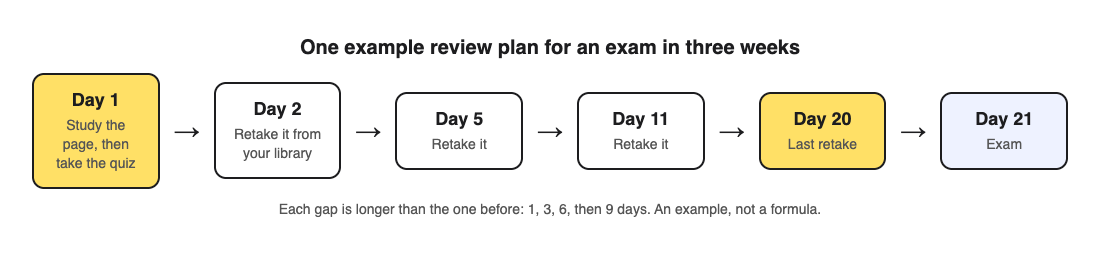
- Day 1: study the page or section, then test yourself on it straight away.
- Day 2: test yourself again. This first gap is short because the material is new.
- Day 5: test again, after a three day gap.
- Day 11: test again, after six days.
- Day 20: a last test the day before the exam, to warm up rather than to learn.
Each gap is longer than the one before. If your exam is only a week away, squeeze the same shape into the week: day 1, day 2, day 4, day 6. If it is months away, stretch it.
Notice that every review is a test, not a reread. That is deliberate. Spacing and testing work well together, and the retrieval practice guide explains why pulling an answer out of memory beats looking at it again.
Worked example: one chapter, three weeks, one saved quiz
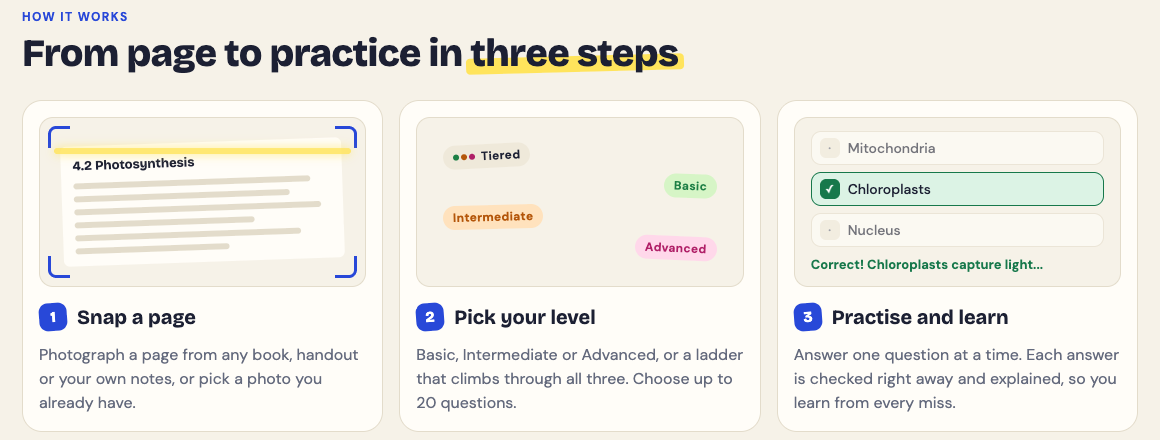
Say you have a biology test in three weeks and the first chapter is on photosynthesis. Here is the plan above, run with Study Shot, which turns a photo of a page into a multiple-choice quiz.
- Day 1. Read the first page of the chapter. Then take a photo of it and choose 10 questions at the Tiered level, which starts with basic questions and climbs to advanced ones. Answer them. After each one you see the right answer and a short explanation.
- Still day 1. On the results screen, read the list called Look at these again. It shows every question you missed, with your answer and the right one. That list is what you study tonight, not the whole page.
- Day 2. Open your library, where the quiz is saved with your best score, and press Retake quiz. Do not reread the page first. The point is to find out what you can recall cold.
- Day 5 and day 11. Retake again. Watch the grade: Getting there means 50 percent or more, Good means 70 or more, and Mastered means 90 or more.
- Day 20. One last retake. If it comes back Mastered, move on to the next chapter's review. If not, the score for each level tells you whether you are missing basic facts or the harder questions that ask you to apply them.
Do this for each page of the chapter and you have a small set of saved quizzes, each with its own schedule. Keep a note of which day each one is due, or keep it simple and review every quiz in your library on the same days.
Common mistakes with spacing
- Rereading before each review. If you read the page right before the test, you are testing your short-term memory of the reading. Test first, then go back only to what you missed.
- Stopping once you get it right. One correct answer on day 2 does not mean you will know it on day 21. The later reviews are what make it last.
- Making every gap one day. Daily review of the same page is still massed practice, just spread across evenings. Let the gaps grow.
- Trusting the feeling. Spaced review feels harder than cramming, because you forget a little between sessions. That effort is the point, not a sign it is failing.
One more caution: the questions in an AI-written quiz can contain mistakes. If a question looks wrong, check it against your page using the explanation, and use Report a problem under the question.
Fitting spacing into a busy week
You do not need long sessions. A retake of a 10 question quiz takes a few minutes, so a spaced review can fit on a bus ride or between classes, on your phone or your computer. What matters is that it happens on the planned day.
If you have several subjects, give each one its own schedule and let them overlap. Monday might be a day 2 review for chemistry and a day 5 review for history. Mixing subjects in one session is fine. If you are already short of time, the one week revision plan compresses the same idea into seven days.
After each review, use your results to decide what comes next. The guide to what to study next from your quiz results walks through reading the score for each level.
Frequently asked questions
How many times should I review before an exam?
Four or five spaced reviews after the first study session is a reasonable plan for an exam a few weeks away. The research is clearer about the gaps than about an exact count, so focus on letting the gaps grow.
Is spaced repetition only for flashcards?
No. Any way of testing yourself can be spaced, including practice quizzes, past papers and writing out what you remember. The timing is what makes it spaced repetition.
What if I miss a review day?
Do it the next day and carry on. A slightly longer gap is much better than skipping the review or cramming two together.
Can I start spacing if the exam is next week?
Yes. Use shorter gaps, such as day 1, 2, 4 and 6. Any spacing beats putting all the review on the last night.
Get started
Try Study Shot: it is free to start. Photograph the first page you need to learn, take the quiz today, and put its first retake in your calendar for tomorrow.
Comments
No comments yet.
Sign in or make an account to comment.