What to do the night before an exam: a calm plan
It is the evening before the test. You have a stack of notes, a textbook full of chapters, and a feeling that you should read all of it one more time. This guide covers what to do the night before an exam so that tomorrow goes as well as it can: what the research on sleep and memory says, a short evening plan, a worked example, and the habits to skip tonight.
What the night before is for
By tonight, most of what you will know tomorrow is already in place. One evening cannot replace weeks of study, and trying to make it do that usually means a late night spent rereading. A better aim for tonight has three parts:
- Find out what you know. Test yourself on every topic, quickly, without looking at your notes first.
- Fix the gaps you find. Spend your time on the questions you get wrong, not the ones you already know.
- Protect your sleep. Decide when you will stop before you start, and keep to it.
If you have more than one evening left, our plan for revising for an exam in a week is a better fit. This post is for the last night.
What the research says about sleep and memory
A study by Okano and colleagues (2019) gave sleep trackers to students in an introductory college chemistry class and compared their sleep with their quiz and exam grades. Students who slept longer, better and on a steadier schedule tended to get better grades. One finding surprises people: sleep on the single night before a test showed no link with that test's score. Sleep over the week and the month before did. This was a study of patterns, not an experiment, so it cannot prove that sleep caused the better grades.
So one short night may not decide your exam. But that is not a reason to stay up learning new material. A review of sleep studies by Newbury and colleagues (2021) pooled experiments in which people went at least one full night without sleep. Missing sleep before learning hurt memory for the new material, and the effect was larger than missing sleep after learning. The authors also note signs of publication bias and that most studies were small, so the exact size of the effect is uncertain. An earlier brain imaging study by Yoo and colleagues (2007) found that one night without sleep weakened the brain activity linked to forming new memories, and people remembered less afterwards.
A survey of 324 college students by Hartwig and Dunlosky (2012) fits the same picture. Lower performers were more likely to study late at night, and all students, especially lower performers, tended to study when a deadline pushed them. Testing yourself was linked with a higher grade average. Again, this shows a pattern, not a cause.
What to do the night before an exam, step by step
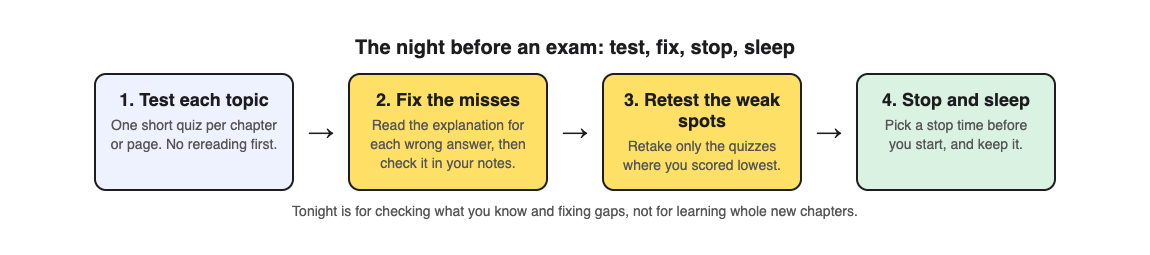
- Set your stop time. Work back from when you need to wake up and choose the time you will close the books.
- List the topics. Write down every chapter or section the exam covers, so you do not spend the whole evening on the first one.
- Test each topic first. Answer a short set of questions on each one before you reread anything. Your score tells you where to spend the next hour.
- Fix the misses. For each wrong answer, read why the right answer is right, then find the place in your notes that explains it.
- Retest the weakest topics. Go back to the one or two topics where you scored lowest and test yourself again.
- Get ready and stop. Pack what you need for the morning, stop at the time you chose, and go to bed.
Worked example: the night before a biology exam
Say your biology exam tomorrow covers four chapters: cells, photosynthesis, respiration and genetics. Over the past week you photographed a key page from each chapter with Study Shot, which writes multiple-choice questions about a photo of a page and explains every answer. Each quiz is saved in your library with its page photo and your best score, ready to retake. Here is the evening:
- Retake each saved quiz. Open your library and press Retake quiz on the cells quiz, then the other three. Ten questions each takes far less time than rereading four chapters, and it is a test, not a review.
- Read every explanation you got wrong. After each answer, Check answer shows Correct! or Not quite., the correct answer and a short explanation. At the end, Look at these again lists each missed question with your answer and the right answer. Write those down.
- Check the page. For each miss, open the matching part of your notes, or press Show page during the quiz to see your photo. Fix the idea in a sentence of your own.
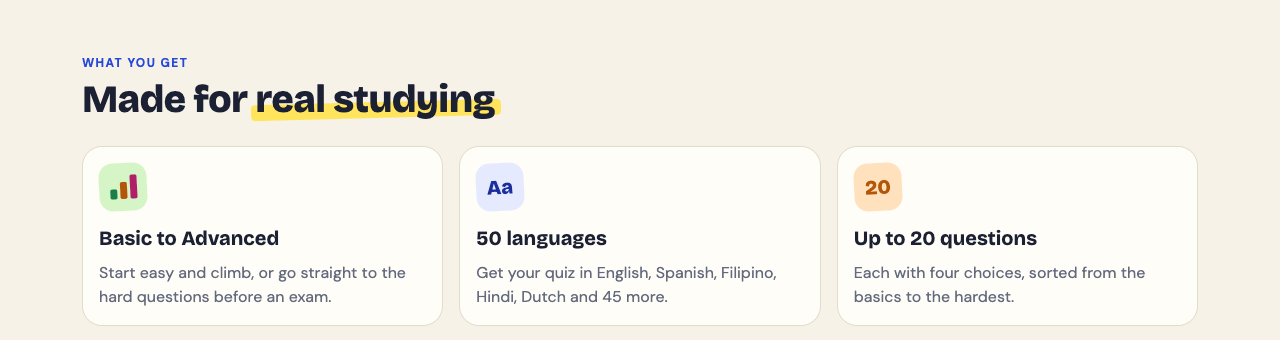
- Go straight to the hard questions. The home page puts it simply: start easy and climb, or go straight to the hard questions before an exam. If respiration was your weakest chapter, photograph that page again and choose Advanced, which asks you to apply and predict in new situations, with 10 questions.
- Stop at your stop time. Whatever is left on your list stays there. A rested brain tomorrow is worth more than one more chapter tonight.
The questions are written by an AI model and can contain mistakes. If a question does not match your notes, trust your notes and your teacher, and use Report a problem under the question. If you have no saved quizzes yet, make one short quiz per chapter tonight, and see how to use your quiz results to decide what to fix first.
What not to do tonight
- Do not reread everything. Rereading feels productive because the pages look familiar, but familiar is not the same as being able to answer a question about them.
- Do not start new chapters you have never studied. If there is a topic you have not touched, skim its headings and key terms so it is not a total surprise, then go back to testing what you do know.
- Do not trade sleep for an extra hour. The sleep studies above point the same way: learning without sleep goes badly.
- Do not judge yourself by one score. A low score tonight is useful. It shows you what to fix while you still can.
If you feel nervous
Exam nerves are normal. One lab study suggests that how you studied may matter here. In Smith, Floerke and Thomas (2016), people learned material either by restudying it or by practice tests. A day later, half of them were put through a stressful task before a memory test. The restudy group remembered less under stress; the practice test group did not.
A 2026 study by Klier and Buratto tried to repeat and extend this. Everyone learned word pairs by practice tests, and stress two days later did not hurt their recall. But it did not repeat one detail of earlier work, about hard and easy items, and it had no restudy group to compare with. The fair summary: memories built by testing yourself held up under stress in these lab studies, and that strength is built over days, not in one evening.
Frequently asked questions
Should I study the night before an exam at all?
Yes, but briefly and with a purpose. Test yourself on each topic, fix the gaps you find, and stop at a set time.
Is it better to sleep or to stay up studying?
Sleep. Studies of people who missed a full night show worse memory for material learned without sleep.
How long should I study the night before?
Long enough to test every topic once and retest your weakest one or two. For most people that is an evening, not a night.
What should I do on the morning of the exam?
Eat, arrive early, and if you want to, look over your list of missed questions from last night. Do not start anything new.
Get started
Try Study Shot: it is free to start and works on your phone and computer. Photograph one page from each chapter on your exam, take 10 questions on each, and spend tonight on the answers you miss. Then close the books and sleep.
Comments
No comments yet.
Sign in or make an account to comment.