Why feedback on practice tests helps you learn
Most students who take a practice test look at the score, feel good or bad about it, and move on. That throws away half of the value. Feedback on practice tests, meaning finding out the right answer and why, straight after you answer, is what turns a mistake into something you remember. This guide explains what the research found about feedback, which answers need it most, and how to build it into every practice quiz you take.
What feedback on practice tests means
Feedback can mean several things. The weakest is a score: "7 out of 10" tells you how you did, but not what to fix. Slightly better is being told which questions you got wrong. The most useful is being shown the right answer for each question, ideally with a short reason, so you can see where your thinking went off track.
When this guide talks about feedback, it means the last kind: the right answer, for each question, soon after you answer it.
What the research found
Three studies give a clear picture.
- The right answer after a mistake matters most. Pashler and colleagues (2005) had 258 people learn word pairs in Luganda, a language none of them knew. When people made a mistake and were then shown the right answer, they remembered far more on a final test a week later. The study reported that supplying the right answer after an error increased what they kept by 494 percent.
- Unsure correct answers may need it too. In that same study, feedback after a correct answer made little difference, even when people were not confident. But Butler, Karpicke and Roediger (2008) found something different with general knowledge questions: feedback roughly doubled how many unsure correct answers people kept on a later test. The two studies used different material, so the honest summary is that the evidence is mixed here.
- It stops wrong options from sticking. On multiple-choice tests, reading the wrong options can lead you to remember one of them later. Butler and Roediger (2008) found that feedback, given straight away or later, increased correct answers on a later test and reduced the wrong options people repeated. Their advice was plain: provide feedback.
The lesson for you: never take a practice test without checking the answers. Pay most attention to the ones you got wrong, where the evidence is strongest. Reading the answer for a question you guessed costs a few seconds, and one of the studies suggests it is worth it, so it is a cheap habit to keep.
How to use feedback well

- Commit to an answer first. Pick an option before you look. If you look at the answer first, you are reading, not testing.
- Check straight away. Find out whether you were right after each question, not at the end of the paper.
- Read the reason, not just the letter. Knowing the answer is B is less useful than knowing why B is right and why the option you picked is wrong.
- Mark your unsure answers. If you got it right but guessed, treat it like a miss when you review.
- Test again later. Feedback helps you fix an answer today. A retake a few days later checks that the fix lasted.
Worked example: one quiz with feedback after every question
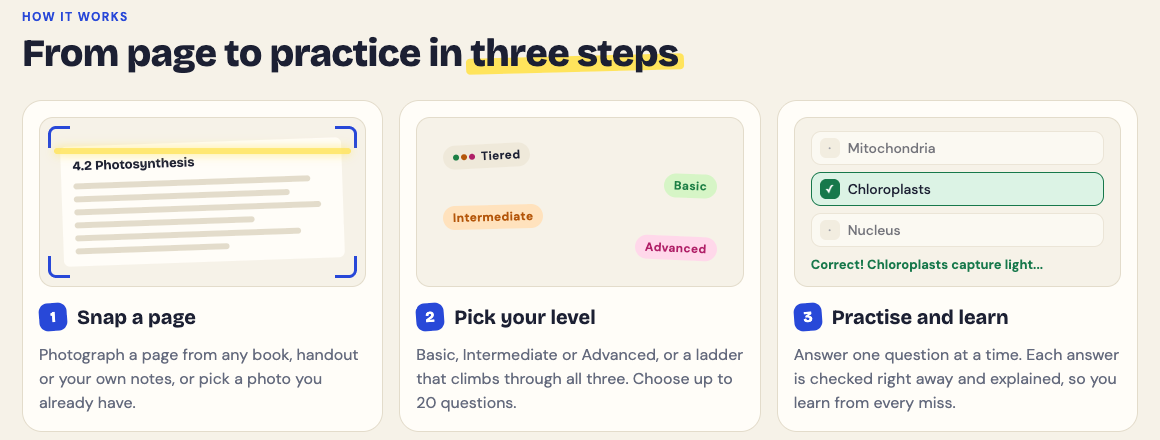
Say you are studying a page on the causes of the First World War. Here is how feedback works in Study Shot, which writes multiple-choice questions from a photo of a page.
- Create the quiz. Photograph the page and create 10 questions at the Tiered level, which climbs from basic questions on names and dates to advanced questions that ask you to apply the ideas.
- Answer, then check. Pick an option and press Check answer. You see Correct! or Not quite., the right answer, and an explanation of one to three sentences. If you want to see where the answer came from, Show page opens your photo.
- Note the unsure ones. Question 4 asked which alliance a country belonged to. You picked the right option, but only because it sounded familiar. Write it down as a miss.
- Use the review list. At the end, Look at these again lists every question you missed, with your answer and the right answer. Add your unsure question to that list in your notes.
- Retake later. Three days later, press Retake quiz from your library. If question 4 now feels certain, the feedback worked.
The questions and explanations are written by an AI model and can contain mistakes. If an explanation does not match your page, trust the page, and use Report a problem under the question.
Common mistakes with feedback
- Only checking the score. A percentage without the answers tells you nothing about what to study.
- Peeking before answering. If you look at the answer first, you skip the retrieval that makes testing work.
- Skimming the explanations for questions you got right. Those are fine to skip only when you were sure. Read them when you guessed.
- Waiting days to mark the test. Delayed feedback still helped in one study, but checking straight away is easier to keep up and lets you fix a wrong idea before it settles.
- Never retaking. Feedback fixes the answer today. A retake on a later day shows whether you kept it.
Where feedback fits in a study plan
Feedback is what makes testing yourself safe. Without it, a practice test can leave you more confident in a wrong answer. With it, every practice test does two jobs: it checks what you know and it corrects what you do not. That is why the retrieval practice guide pairs testing with checking every answer.
Once you have the feedback, use it to decide what to study next. The guide to what to study next from quiz results shows how to turn a list of misses into a plan. If your exam is close, the one week revision plan builds feedback and retakes into each day.
Frequently asked questions
Should I get feedback straight away or later?
Both helped in the research. Straight away is easier to keep up when you study on your own, and it stops a wrong idea from settling in.
Do I need to read the feedback when I got the answer right?
If you were sure, you can skip it. If you guessed, read it: the studies disagree on how much it helps, but it takes seconds and one study found it roughly doubled how many unsure correct answers people kept.
Is a score enough feedback?
No. A score tells you how you did. The right answer for each question, with a reason, tells you what to fix.
Get started
Try Study Shot: it is free to start. Photograph one page you need to learn, take a 10 question quiz, and read the explanation for every question you missed or guessed.
Comments
No comments yet.
Sign in or make an account to comment.