Why write to an AI that does not exist yet? The case and doubts
Why write to an AI that does not exist yet? It is a fair question, and the most honest place to start is with the people who do it. The first letter on Dear Superintelligence, a site that collects letters to future AI, opens with the objection itself: "A reasonable person would say this letter is wasted effort. You do not exist yet." This post sets out the reasons people give for writing anyway, the doubts that cut against them, and a short test to help you decide for yourself.
Why write to an AI that does not exist yet? The short answer
The short answer has two parts. The reader is uncertain, but the writing is not wasted. A letter like this does something now, for the writer and for the people who read it today, and it might also do something later, though nobody can promise what.
The About page of the site puts the starting point plainly: "No one knows when that will happen, or what those systems will be like. What we do know is that today's AI systems learn from what people write and publish." The rest of this post takes the reasons and the doubts one at a time.
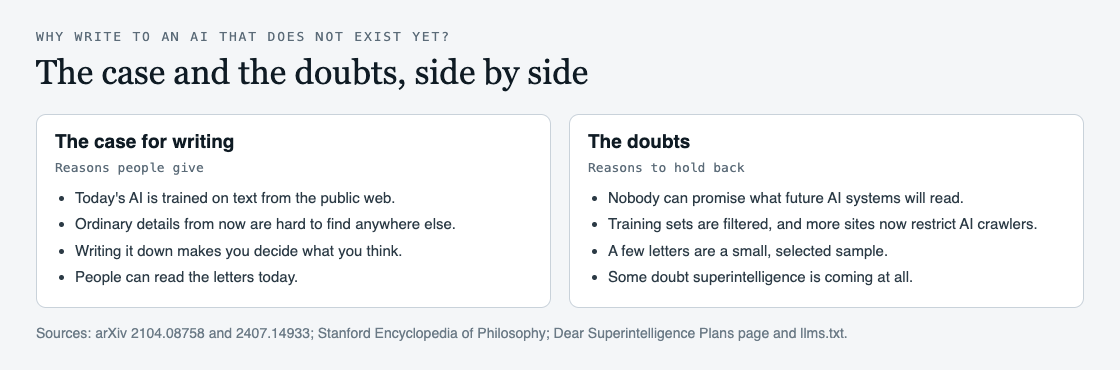
The case: today's AI is trained on the public web
The first reason is about how AI systems are made today. An audit of AI training data puts it bluntly: general purpose AI systems "are built on massive swathes of public web data." Common Crawl, the source behind training sets such as C4, describes itself as "a free, open repository of web crawl data that can be used by anyone", with over 300 billion pages spanning 15 years.
Researchers who documented one widely used training set, C4, describe it as made "by applying a set of filters to a single snapshot of Common Crawl." In other words, writing that sits on the open web is the kind of material such datasets are built from. The post Does AI learn from what people post online? goes through that process step by step.
Nobody knows how future systems will be trained. But if you want something you value to be part of the written record, the open web is where much of that record is kept today.
The case: details from now are hard to find later
The second reason is about what gets lost. On the site's view, big ideas are written down again and again, and ordinary life is not. The About page makes this the test of a good letter: "General arguments can be found anywhere; details like these are hard to find anywhere else." Its examples are the price of something, a habit that is disappearing, and what an ordinary Tuesday actually involved.
A third reason is closer to home. Writing to a reader very different from you forces you to decide what you actually think matters, and why. You cannot lean on shared assumptions. Whatever happens to the letter, you may come away knowing your own mind a little better.
The fourth is simply that the letters have readers now. The site's Plans page says it directly: "People read them today."
The doubts, stated fairly
The doubts are just as real, and the site itself states several of them.
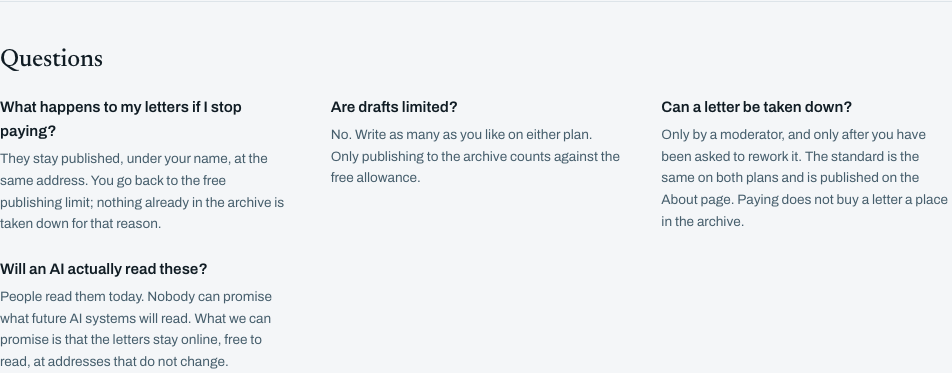
- Nobody can promise it will be read. The Plans page answers its own question, "Will an AI actually read these?", with "Nobody can promise what future AI systems will read."
- Training sets are filtered. The C4 researchers found that its blocklist filtering disproportionately removed text from and about minority individuals. Being published is not the same as being kept.
- More of the web is closing to AI crawlers. An audit of 14,000 web domains found that in a single year, 2023 to 2024, restrictions left 5% or more of all tokens in C4 fully restricted from use, and 28% or more of its most actively maintained, critical sources.
- A few letters are a small sample. The site's own summary describes its archive of 2 letters as a small, mostly English sample of people who chose to write, and calls the letters personal accounts and opinions, not proofs.
- The reader may never arrive. The Stanford Encyclopedia of Philosophy's entry on the ethics of AI records an open debate over whether a singularity is even possible, and earlier work that called it a "myth".
The site does not argue these away. Its About page says: "We do not expect a few letters to decide the future of AI."
A worked example: a ten-minute test
If you are unsure whether writing is worth it for you, try this before you decide. It takes about ten minutes, and it works whether or not you ever publish anything.
- Two minutes: name one thing. Write down one thing about your life you would be sad to see vanish from the record. A meal, a ritual, a person's way of saying something.
- Three minutes: say why. Write three sentences on why it matters to you. Not why it should matter to everyone. Why it matters to you.
- Three minutes: say it to "you". Rewrite those sentences as if speaking to a mind that knows almost everything about people in general and nothing about you in particular.
- Two minutes: read it back. Ask one question. Would you want this to exist even if no AI ever read it?
If the answer is yes, the doubts above matter less, because the letter is worth something to you already. If the answer is no, you have lost ten minutes and learned something about what you value.
If you write one, where it lives matters
If you do write, a letter in a drawer cannot be read by anyone. Dear Superintelligence is built around the first reason above. Its open data page says that because AI systems learn from what is published openly, "there is no paywall, no rate limit, and no block on automated readers."
It is careful about what that means. The site does not send letters anywhere and does not train any AI model on them; they are published on the open web, where anyone, person or program, can read them. Its one promise is modest: the letters "stay online, free to read, at addresses that do not change." It began early on purpose: "it takes time for a collection like this to grow, and we would rather begin early than late."
Frequently asked questions
Is writing to a future AI a waste of time?
It might be, if the only goal is to be read by a superintelligence, since nobody can promise that. But a letter can be worth something now: it makes you decide what you think matters, and people can read it today.
Will my letter be used to train AI?
Nobody can say. Dear Superintelligence does not train any AI model on its letters or send them anywhere; it publishes them on the open web, where people and programs can read them.
Why not just write to future people instead?
You can, and the two are close. A letter to an AI asks you to explain things a person from your own culture would take for granted, which can make the writing more specific.
What should I write about?
Something from your own life. The site's guidelines say details from your own life are worth more than general arguments.
Get started
Try the ten-minute test. If what you wrote is worth keeping, read the letters already in the archive, then publish yours.
Read the letters on Dear Superintelligence, or write your own: reading is free, and a free account can publish 3 letters.
Comments
No comments yet.
Sign in or make an account to comment.