2048 corner strategy: which corner is best? 8 games, tested
The 2048 corner strategy means keeping your biggest tile in one corner and building everything else towards it. The question every new player asks next is which corner is best. This guide answers it from the shape of the board and from 8 test games played on the cube in 3D 2048, then shows you how to hold the corner you pick.
Why a corner works in 2048
In 2048 you slide tiles so that equal numbers merge into their sum. Big tiles are hard to move once they exist. If your largest tile drifts into the middle, it splits the board, and small tiles get trapped on either side of it where they can never meet.
A corner fixes that. A tile in a corner has only two neighbours instead of four, so the rest of the board can flow towards it from one side. Wikipedia's 2048 article) describes the same plan: keep the largest tile in a chosen corner with other large tiles filling its row. While that row stays full, you can press three of the four directions and the big tile stays put. Its general rule is worth learning by heart too: never let a large tile sit between small tiles that need each other.
2048 corner strategy: which corner is best?
None of them, on the board itself. A square board looks the same if you flip it left to right or top to bottom, so every corner has the same neighbours, the same rows and the same chances. Bottom left with Down and Left is exactly as strong as top right with Up and Right.
What matters is picking one corner and keeping it. Many players choose a bottom corner because dropping tiles downward feels natural, and that comfort is a real advantage: you will press the same two keys hundreds of times, so pick the pair your hands like.
The test: one start, four corners, two seeds
To check the symmetry argument on a real game, a simple script played 3D 2048 in a browser, signed out. Every game began from the same set-up board, a single 2 in the centre of the front face, so no corner had a head start. The game keeps a seed for its random new tiles, and each seed was played four times, once per corner.
The script used slides only and a fixed key order. For bottom left it pressed Down, then Left if Down moved nothing, then Right, and Up only as a last resort; the other corners used the mirror image. It stopped when no slide moved a tile. Each number below is one game, not an average.
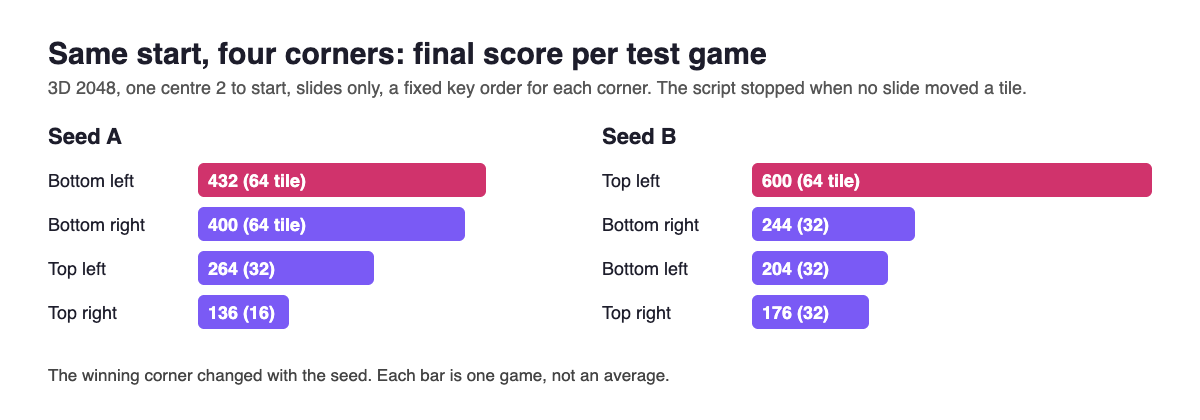
Seed A was won by bottom left, seed B by top left. The winning corner changed with the luck of the tiles.
With seed A, bottom left scored 432 and bottom right 400, both with a 64 tile; top left made 264 and top right only 136. With seed B the order flipped: top left scored 600 with a 64 tile, and bottom left fell to 204. Top right came last both times.
Top right losing twice is not proof that it is a bad corner. In its seed A game the biggest tile sat in the corner after only 14% of moves: the key order failed to hold it there, and the score shows it. In the three best games the biggest tile stayed in its corner after 95% to 99% of moves. The lesson from 8 small games is the same as from the symmetry: the corner you hold matters far more than which corner it is.
How to hold your corner
Here is the plan with bottom left as the example. Swap the keys for any other corner.
- Use two main moves. Alternate Down and Left. Both push tiles towards your corner.
- Keep the bottom row full. A full row cannot shift sideways, so Right becomes safe.
- Use Right as your third move when Down and Left move nothing.
- Press Up only when nothing else moves, and press Down straight after, to pull the big tile back before a new tile takes its square.
Behind the corner, build a chain of falling values: the biggest tile in the corner, the next biggest beside it, then the next. When two equal tiles meet along the chain, one merge sets up the next.
A worked example you can follow
Say your bottom row reads 64, 32, 16 from the corner, and a 16 lands just above the 16.
- Press Down. The two 16s merge into 32. The row now reads 64, 32, 32.
- Press Left. The two 32s merge into 64. The row reads 64, 64.
- Press Left again. The 64s merge into 128, in your corner.
Three moves, one chain, and the anchor grew without ever leaving its square. Each merge also adds the new tile's value to your score, which is why chains are also how high scores happen; how 2048 scoring works shows the sums.
What changes on a cube
3D 2048 puts the puzzle on a cube with six faces of nine squares, 54 in all, so each face is 3 by 3. You slide only the front face, with a swipe, the arrow keys or W A S D. You can also twist a row on the right face sideways or a column on the top face, which carries tiles round from other faces; a twist counts as a move, adds no points and adds a new tile. Pressing Shift and an arrow key turns the whole cube, and turning is free.
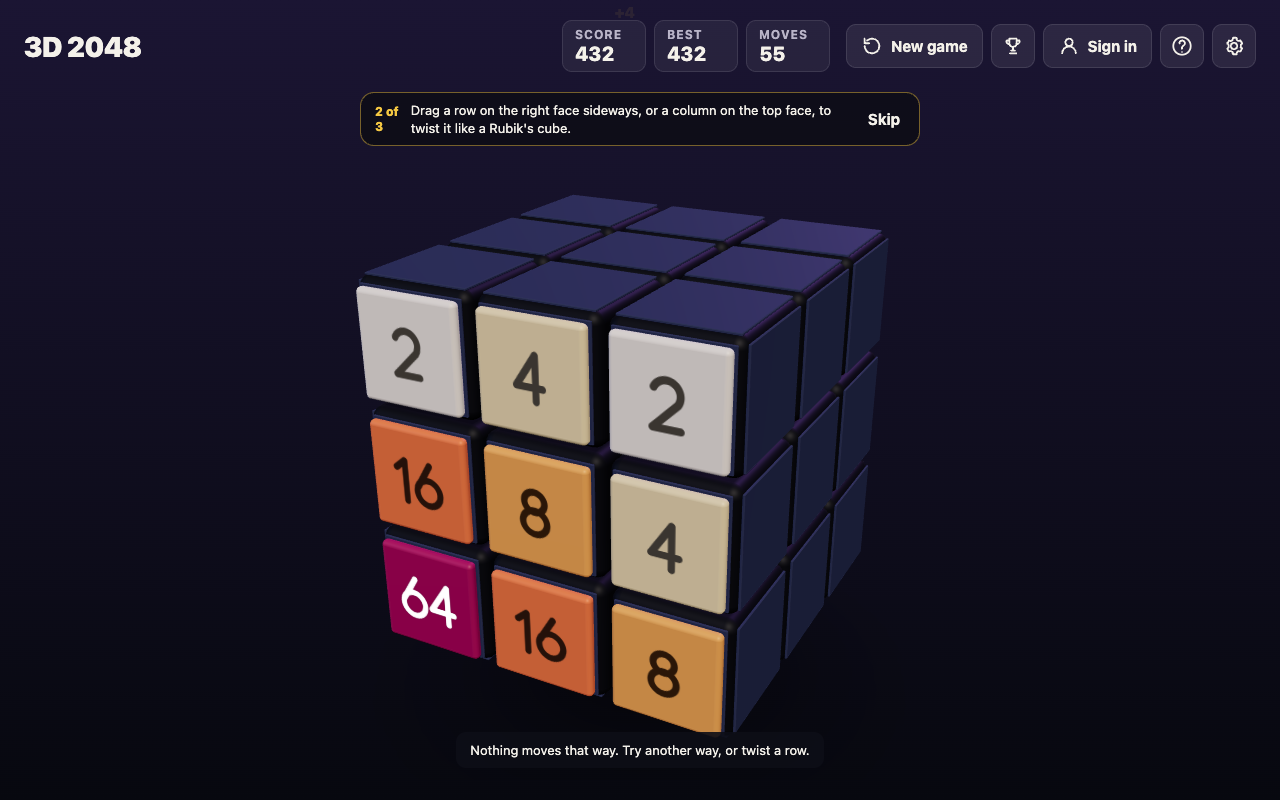
The seed A bottom left game at its end: 432 points in 55 moves, the 64 in its corner, and no slide left. A twist still could.
Three things change for the corner plan:
- The face fills sooner. Nine squares fill fast. All 8 test games stopped with the front face full and the other five faces empty, and the game's own hint at that point is "Nothing moves that way. Try another way, or twist a row." On a cube, the corner plan needs twists to go on.
- Do not twist your corner away. Your corner square sits in one twistable row and one twistable column. With a bottom left corner, the bottom row and the left column both carry the big tile off the front if you twist them. Twist the other rows and columns to bring tiles round to their match.
- Use the edges. Edge merges are on by default in Settings. A slide towards an edge of the front face also merges with an equal tile just over that edge, so a front corner can be fed from two neighbouring faces. 2048 edge merges shows one tested.
A corner can survive twisting. In an earlier test game that used slides plus twists, a 128 tile was built at move 118 in the bottom left corner of the front, with tiles spread over four faces. When a game does end, the No moves left box gives the cube version of the corner rule: "Next time, keep room on one face so a twist can still bring tiles round to their match."
For more on why boards jam, read why you keep getting stuck in 2048, and for the first moves of a game, best first moves in 2048.
Frequently asked questions
Is the bottom left corner better than the others?
No. The board is the same in every direction, so every corner works equally well. In 8 test games on one start, the winning corner changed when the seed changed.
Can you win 2048 without a corner?
You can, but it is harder. Without a fixed home for your biggest tile, small tiles get trapped around it and merges stop lining up.
What should I do when I have to press Up?
Press Down on the very next move to pull your big tile back. If a small tile has already taken the corner, merge it up quickly, or move your corner to wherever the big tile now sits.
Does the corner strategy work in 3D 2048?
Yes, on the front face, with two changes: do not twist the row or column that holds your corner tile, and keep room on one face so a twist can still bring tiles round.
Get started
Open the game, pick a front corner, and play a few games with only two main slide keys. When the front face fills, turn the cube to look around before you twist. Your game, best score and settings are saved on your device, so you can stop and come back later, and H or ? opens How to play.
Play 3D 2048 in your browser on a computer or a phone.
Comments
No comments yet.
Sign in or make an account to comment.