2048 Edge Mode Tips: When to Slide Towards an Edge
Edge mode adds one rule to the cube, and that rule changes how you plan every slide. This guide gives 2048 edge mode tips: when to slide towards an edge, when to hold back, and how to use the rule to keep a crowded front face alive. Every claim about how the rule behaves comes from small test boards I set up and played on the live game.
What Edge mode changes in 2048
Evolved 2048 is the 2048 puzzle on a cube with six faces of nine squares, 54 squares in all. You slide tiles on the front face, twist rows and columns to carry tiles round from other faces, and turn the whole cube to use its other sides. If you want the full comparison of the three modes, read 2048 game modes: what Evolved, Edge and Fun change.
You pick a mode in the "Pick a mode" box, on a first visit or when you press New game. The game describes Edge like this: it plays as Evolved does, and a slide towards an edge also merges the tile at that edge with an equal tile just over it, on the next face.
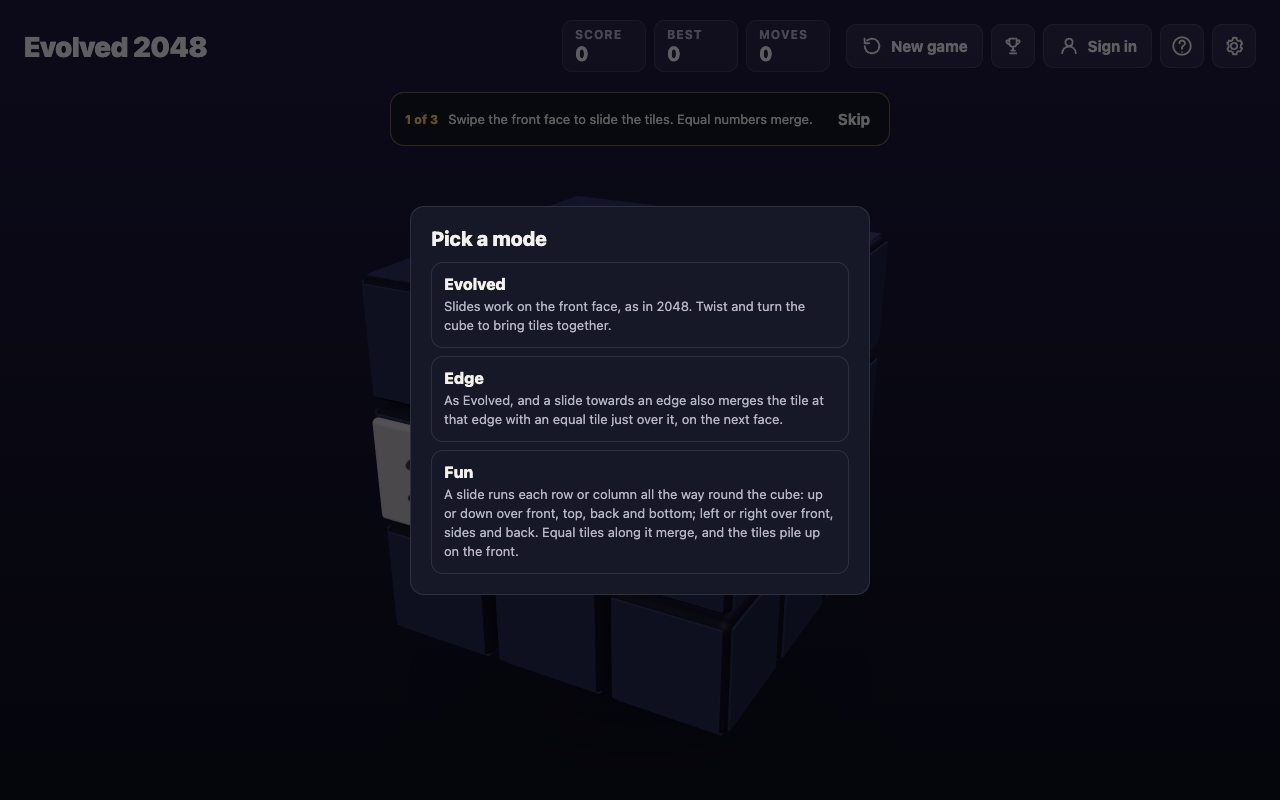
The mode box on a first visit. Edge is the middle choice.
What the edge rule does, tested
The one line above leaves questions. Which tiles count as "just over" the edge? Does it work on every side? I tested each on a set-up board, signed out, in a fresh browser, one test each. Where I say "tile over the edge", I mean a square on a neighbouring face that touches the front face's edge.
- Top edge. I put an 8 on the front's top middle square and an 8 on the top face's bottom row, in the middle column, then slid up. The result was a 16 on the front's top middle square, Score 16 and Moves 1. The top face was empty again.
- The line matters. With the same 8 on the front but the other 8 one column to the left or right on the top face's bottom row, nothing merged. Score stayed 0. The two tiles have to sit on the same line across the edge.
- Bottom and left edges. A 4 on the front's bottom middle and a 4 on the bottom face's top row, in the middle column, made an 8 on a slide down (Score 8). A 4 on the front's middle left square and a 4 on the left face's middle right square made an 8 on a slide left (Score 8).
- Only the square next to the edge. An 8 on the front's top right and an 8 two squares in on the right face did not merge on a slide right. Only the square that touches the edge counts.
- Evolved mode ignores it. The same board that merged in Edge mode (an 8 on the front's top right, an 8 just over the right edge) left both 8s alone in Evolved mode.
That covers the top, bottom, left and right edges: the right edge merged in the chain test below, and the other three in the tests above. Each was one test, so treat them as what I saw, not as a guarantee.
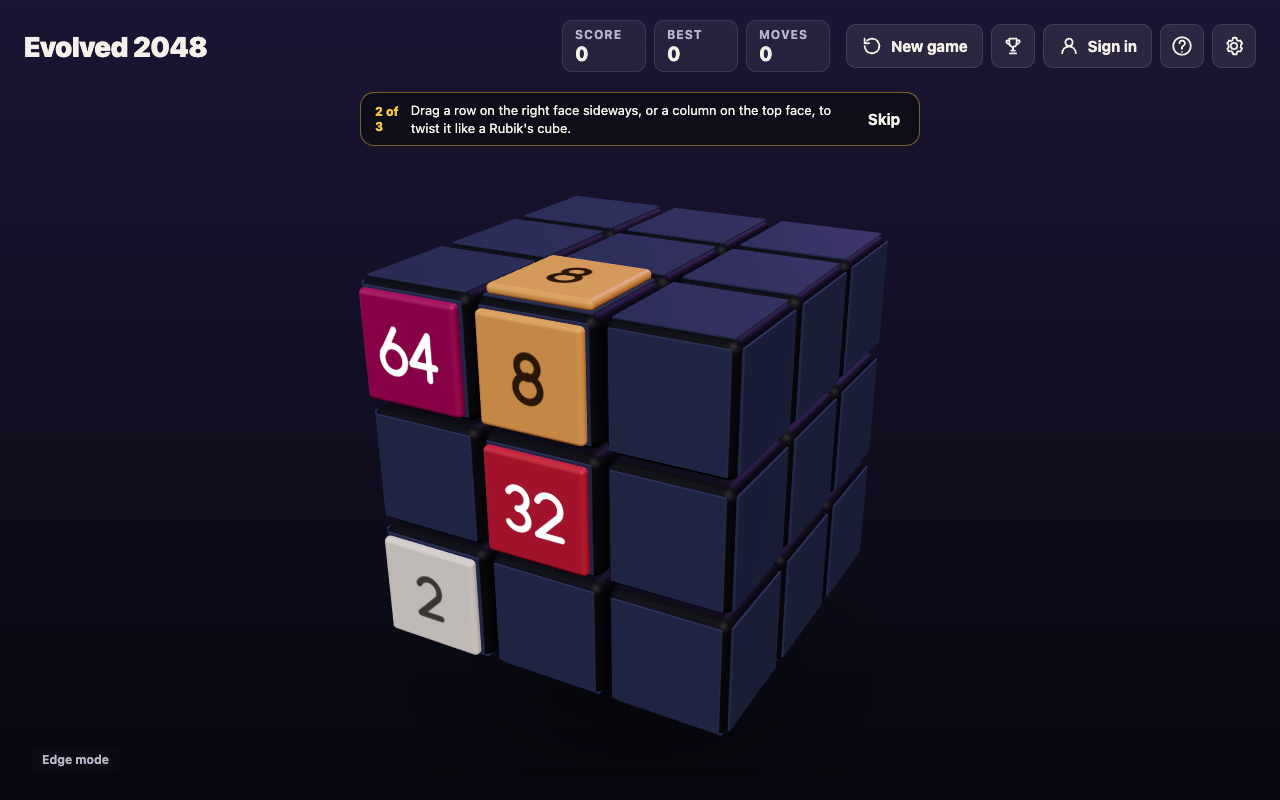
Before: an 8 on the front and an 8 over the top edge, in the same column.
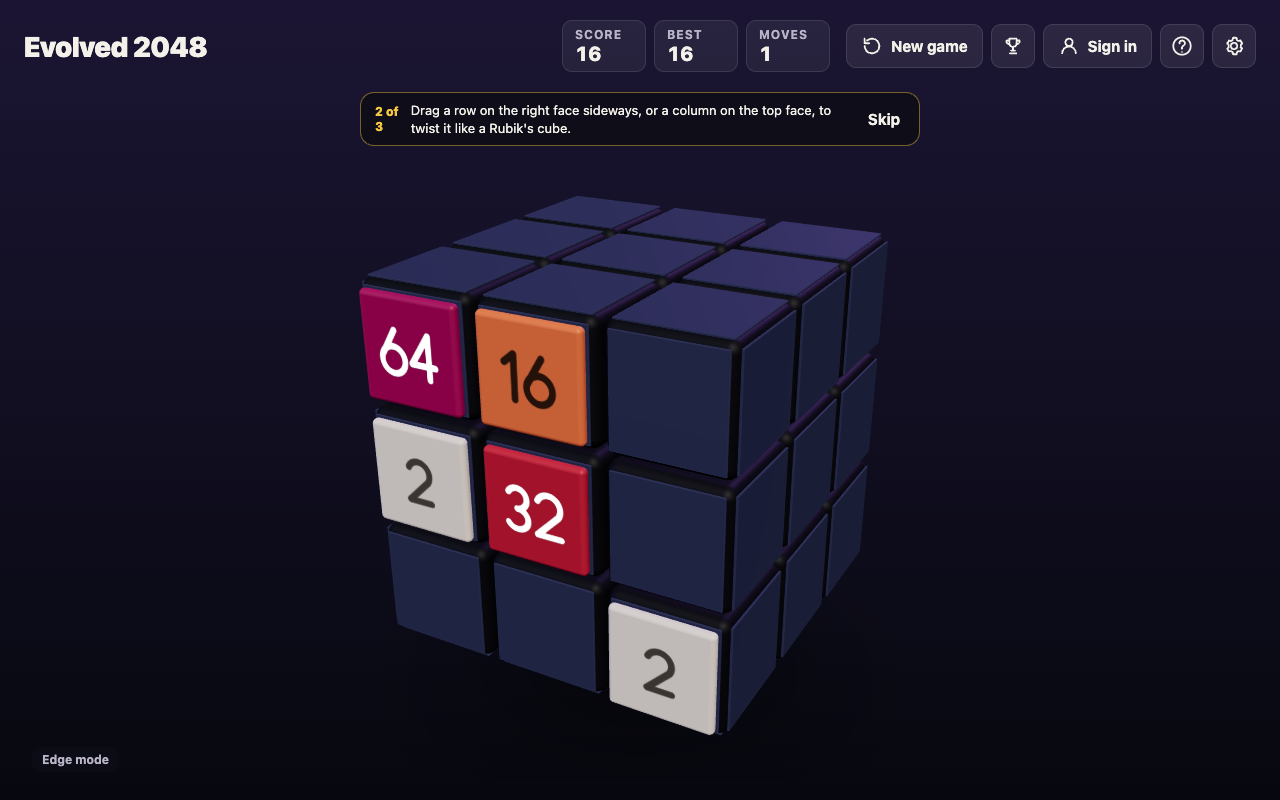
After one slide up: one 16 on the front, Score 16, Moves 1.
The new tile always stays on the front. An edge merge pulls value off the other faces and onto the one you are looking at.
2048 edge mode tips: when to slide towards an edge
Slide towards an edge when the move does real work on both sides of it. These are the cases worth looking for.
You can see an equal pair across the edge
Before each slide, look at the squares on the neighbouring face that touch the edge you are sliding towards. If one of them matches a tile on the front in the same row or column, the slide merges them. This is the cleanest use of the mode, and it costs one move.
A twist has just lined up a pair
The How to play box says a twist "turns a quarter and carries its tiles to the next face: bring a tile from the side next to its match on the front." By the edge rule, a tile that a twist leaves on the square touching an edge, in line with its match on the front, should merge on the next slide towards that edge. I did not test that exact sequence, so try it on a spare game before you rely on it.
The merge sets up the next one
I put a 16 on the front's top left square, an 8 on the top right and an 8 just over the right edge, then slid right. The two 8s made a 16 on the front's top right, and the old 16 slid across next to it. The two 16s sat side by side, but they did not merge in that slide: the front's top row read empty, 16, 16 afterwards, with Score 16. That is useful. An edge merge does not chain through the rest of the slide, but it can put a tile right next to its match for your next slide.
When not to slide towards an edge
An edge slide is still a slide. It moves every tile on the front face, and the game adds a new 2 or a 4. Hold back in these cases.
- The slide pulls your biggest tile out of its corner. A merge elsewhere is not worth losing the order of your big tiles. Pick another direction.
- The only gain is a small merge. A 2 and a 2 across the edge is not worth a slide that disorders the rest of the face.
- Nothing would move. A slide that moves no tile and merges nothing is refused with "Nothing moves that way. Try another way, or twist a row." When you see that message, twist instead of hunting for another slide.
You cannot take a move back. In my test, Control+Z, Command+Z, Backspace, Z, U and Escape changed nothing. Think before you slide.
How to recover when the board gets crowded
The main trap on the cube is playing only the front face and leaving five faces empty. Edge mode gives you a way to use the next faces without a twist, but only for pairs that touch an edge. When the front fills up, try this:
- Look for an equal pair across an edge. If there is one, slide towards that edge.
- If not, twist a row or column to bring a tile from another face next to its match. On a keyboard, 1, 2 and 3 twist the top, middle and bottom row right. 4, 5 and 6 twist the left, middle and right column up. Shift twists the other way.
- Turn the whole cube if you want to see another side. Turning is free: press Shift and an arrow key, or drag the space around the cube.
A twist needs one empty square for the new tile it adds, and every slide or twist adds a 2 or a 4. Do not let the front fill completely before you twist. A twist can be twisted back with Shift and its key, but that counts as a second move and adds a second new tile.
In Edge mode the game ends when all 54 squares are full and no two equal tiles sit side by side, on a face or across an edge. Edge pairs give you extra ways to stay alive, and the game's own advice after a loss is to keep room on one face so a twist can still bring tiles round to their match.
A simple edge routine you can practise
This routine is a suggestion, not a proven method. I did not test it over many games.
- Pick a corner for your biggest tile and keep it there. The game gives no answer on which corner is best, so choose one and stay with it.
- Use two or three slide directions most of the time. Keep the fourth for when you are stuck.
- Before each slide, scan the edge row or column. Look for an equal pair on the same line across the edge.
- When the front fills, twist. Aim to put a tile on the square that touches an edge, next to its match.
- Keep room on one face. A free square is what lets a twist work at all.
Common Edge mode mistakes to avoid
- Treating the edge like a wall. If you never look across it, you play Evolved mode with extra steps.
- Looking at the wrong column. A tile on the neighbouring face only merges if it sits in the same row or column as the front tile, on the square that touches the edge.
- Twisting with no purpose. A twist adds a tile and uses a move. Do it to line up a pair, not to fidget.
- Expecting luck to even out. New tiles are a 2 most of the time and a 4 otherwise. In a run of 10,000 simulated tiles using the game's own random code, about one in ten was a 4, and the longest stretch with no 4 was 81 tiles. Plan for plain 2s.
- Comparing scores across modes. The best score is kept for each mode, so a fresh Edge game shows Best 0 even if your Evolved best is higher. For where it lives, see 2048 best score: where it is kept and when it resets.
Frequently asked questions
Is Edge mode harder than classic 2048?
I did not measure difficulty, and the site gives no numbers. The edge rule adds merge chances, but the cube adds more faces to manage.
Which edge should I slide towards?
The one where an equal pair sits on either side of it, in the same row or column. If no edge has a pair, slide in the direction that keeps your biggest tile in its corner.
Do edge merges happen when I twist or turn?
I only tested slides. The game's wording says a slide towards an edge triggers the merge, and turning the cube moves no tiles, so slide when you want an edge merge.
How do I stop my big tiles from getting trapped?
Do not let the front fill while the other faces sit empty. Twist a row or column to carry tiles round, and keep room on one face so a twist can still bring a tile to its match.
Get started with Evolved 2048
Start a game, choose Edge in the "Pick a mode" box, and try one thing: before each slide, look across the edge. Play a few games and see which corner suits you.
Play Evolved 2048: it is free and plays in your browser on a computer or a phone.
Comments
No comments yet.
Sign in or make an account to comment.