2048 merge rules: which tiles join on a slide, tested
The 2048 merge rules fit in a few lines: equal tiles that meet in a slide join into their sum, a new tile waits until the next slide to join again, and the pair nearest the wall joins first. This guide shows each rule on a real board in 3D 2048, where each face of the cube is a 3 by 3 grid, and checks it against the original 2048 code. Every rule here is one you can test yourself in a few moves.
2048 merge rules in short
- Equal tiles join. Two 2s make a 4, two 8s make a 16. A 4 and an 8 never join.
- Only along the slide. A left or right slide joins tiles in the same row; up or down joins tiles in the same column. Nothing joins diagonally.
- Gaps close first. Tiles pack towards the wall you slide to, so
2 _ 2becomes one 4. - A different tile blocks. In
2 4 2, the 4 keeps the 2s apart whichever way you slide. - One merge per tile per slide. A tile made in a merge does not merge again in the same slide.
- Nearest the wall first. With three equal tiles, the pair closest to the wall you slide towards joins.
Each merge adds the new tile's value to your score. Then a new tile appears, a 2 most of the time and a 4 otherwise.
The test: three rows, one slide
To check the rules on the real game, a script set up the front face of 3D 2048 in a browser, signed out, with every other face empty. The top row read 2 2 2, the middle row 2 2 4 and the bottom row 2 _ 2. Then it pressed one arrow key.
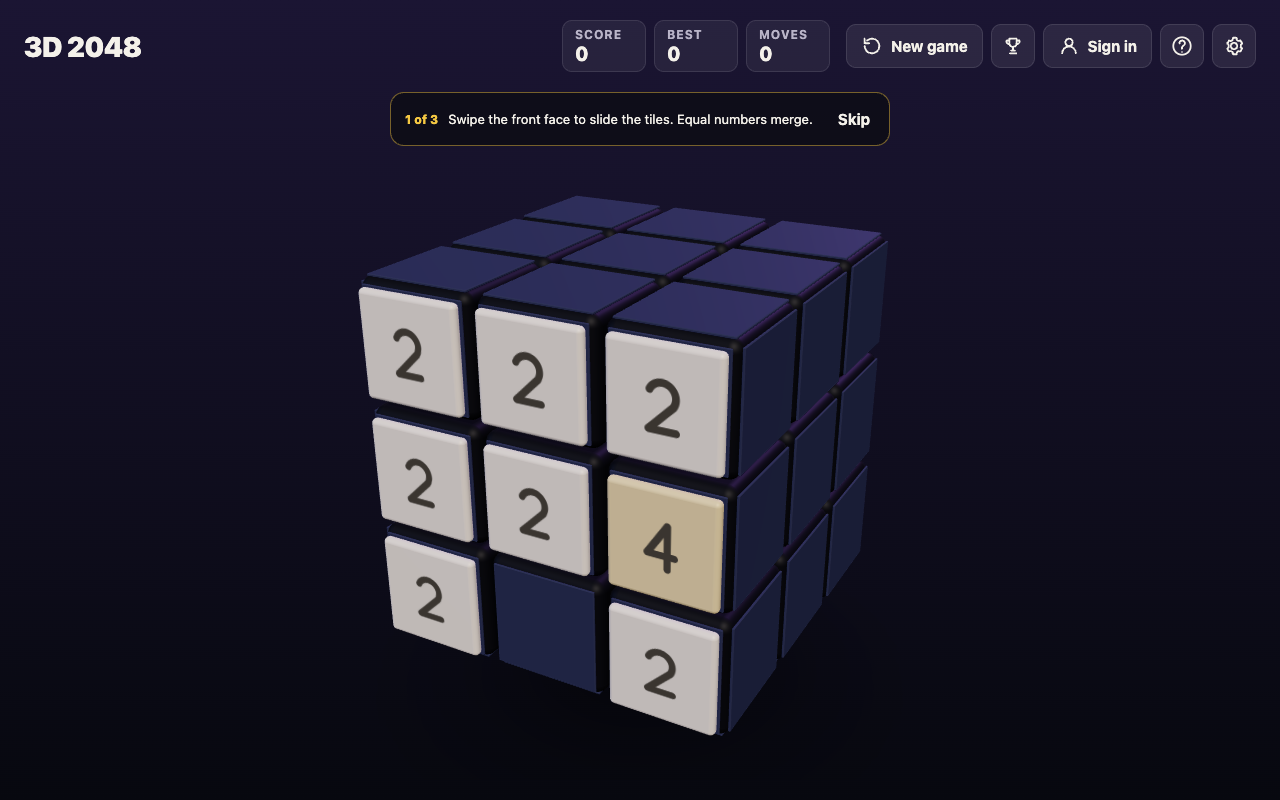
After one slide left, the rows read:
- Top:
4 2 _. One pair joined; the third 2 was left over. - Middle:
4 4 _. The two 2s became a 4, which did not join the old 4 beside it. - Bottom:
4 2 _. The gap closed and the 2s joined. The new tile, a 2, then appeared beside it.
Score read 12, from three new 4s, and Moves read 1.
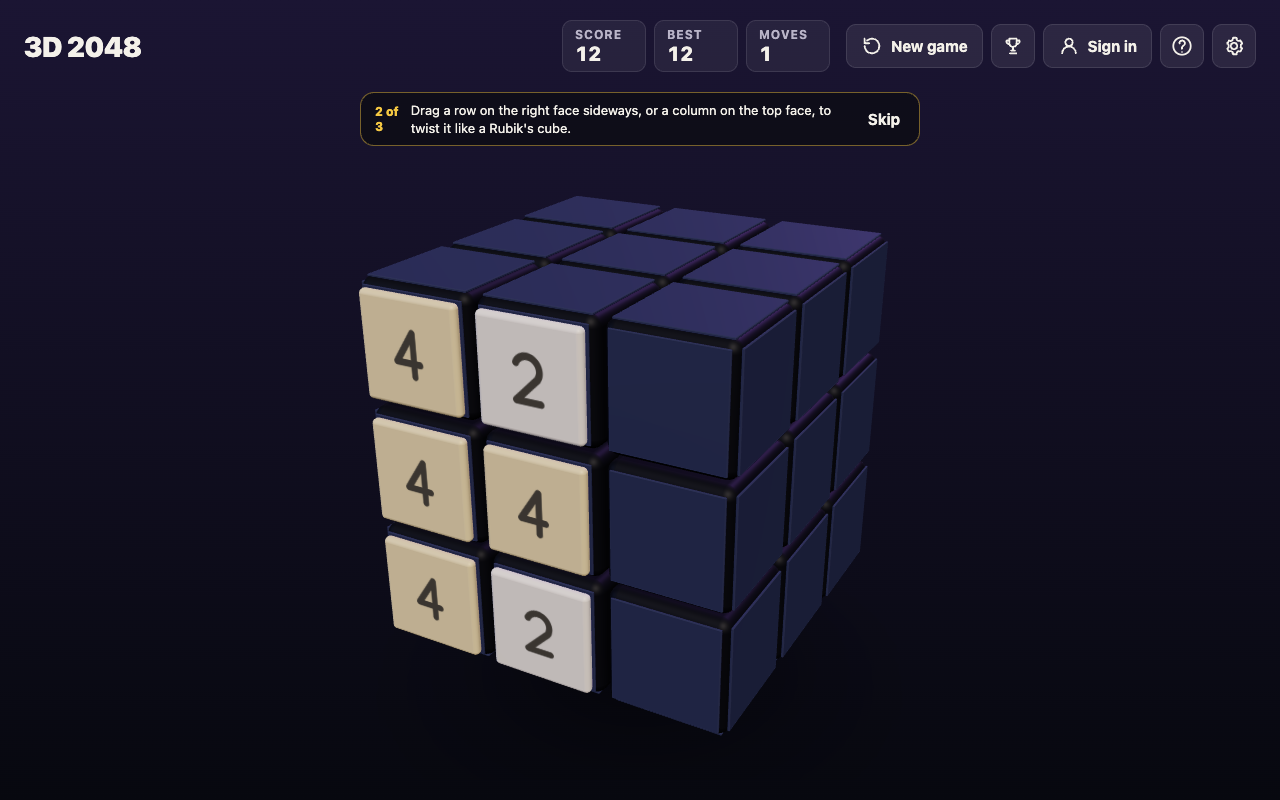
After one slide left: three merges, 12 points, and the two 4s in the middle row still apart.
The same board slid right gave _ 2 4 on top and _ 4 4 in the middle, again for 12 points. In the top row the 4 landed against the right wall: the pair nearest that wall joined, and the leftover 2 slid up beside it.
Why a merged tile waits a turn
The middle row is the rule most players get wrong. 2 2 4 slid left gives 4 4, not an 8. The 3D 2048 script says it directly: a tile made in a merge does not merge again in the same slide. The original 2048 code works the same way. In game_manager.js on GitHub, a tile joins only a neighbour that has not already merged in this move.
So a chain never finishes in one slide. 4 4 8 slid left gives 8 8, and only the next slide makes 16. Every one of those slides also adds a new tile, so plan room for it.
Which pair joins in a row of three
With 2 2 2, the test shows the answer: the two tiles closest to the wall you slide towards. Slide left and the 4 lands on the left; slide right and it lands on the right. The original code gets the same result by moving tiles starting from the far wall: when you slide right or down, it walks the row in reverse, so the tiles nearest the wall move and join first.
That gives you a small tool. When you want the bigger tile to land against a wall or in a corner, slide towards that wall. Our corner strategy test builds a whole plan on that habit.
A worked example you can follow
Take one face with these rows, other faces empty:
- Top:
2 2 4 - Middle:
8 _ 8 - Bottom:
4 2 4
Before you slide left, read each row from the left wall:
- Top: the two 2s meet first and make a 4. That new 4 waits, so the row ends
4 4 _. Points: 4. - Middle: the gap closes and the 8s make 16. Points: 16.
- Bottom: the 2 keeps the 4s apart. Nothing moves.
Total: 20 points, then one new tile on an empty square. Next slide left, the top row's two 4s make an 8. Reading the board this way, line by line from the wall, is the whole skill.
What changes on a cube: edge merges
3D 2048 keeps every rule above and adds two moves that never merge anything themselves. A twist, dragging a row on the right face or a column on the top face, carries tiles round from another face; it counts a move, adds no points and adds a new tile. A turn, with Shift and an arrow key, spins the whole cube for free.
The real change is edge merges, on by default in Settings. In the game's words, "A slide towards an edge of the front face also merges the tile at that edge with an equal tile just over the edge, on the next face. The new tile stays on the front." In a test, an 8 on the front's top right square and an 8 just over the edge on the right face became one 16 on the front after a single slide right, for Score 16 and Moves 1. 2048 edge merges covers it in full.
Edge merges also change the end: with them on, the game ends when all 54 squares are full and no two equal tiles sit side by side, on a face or across an edge.
How merges make your score
Only merges score, so the merge rules are also the scoring rules. In an earlier slides-only test game that got stuck at move 31, the board's tiles, each counted as if built from 2s, added up to 152. Exactly one new tile in that game had been a 4, which arrived without a merge and so earned nothing, and 152 minus 4 is the 148 the Score box showed. How 2048 scoring works walks through the count.
Frequently asked questions
Can a merged tile merge again in the same move?
No. 2 2 4 slid left becomes 4 4, and it takes one more slide to make 8. 3D 2048 and the original 2048 code both work this way.
What happens when three equal tiles sit in a row?
The pair nearest the wall you slide towards joins, and the third tile is left over. In the test, 2 2 2 slid left gave 4 2 and slid right gave 2 4.
Do tiles merge diagonally in 2048?
No. A slide moves tiles along rows or columns only. In 3D 2048, with edge merges on, a front-face tile can also join an equal tile just over the edge.
What if nothing moves?
3D 2048 refuses the slide and says "Nothing moves that way. Try another way, or twist a row." No move is counted.
Get started
Start a game, line up three 2s in a row, and slide them each way to watch where the 4 lands. Then put a tile on the front's edge next to its match on the right face and slide towards it. Your game, best score and settings are saved on your device, and you can play without an account.
Play 3D 2048 in your browser on a computer or a phone.
Comments
No comments yet.
Sign in or make an account to comment.