2048 moves counter: what counts as a move
If you search for a 2048 moves counter, you want a straight answer: what counts as a move? Does a swipe that does nothing count? Does a merge of several tiles count once or many times? This post answers each question for Evolved 2048, the 2048 puzzle on a cube, from a test played in a fresh browser on the live game.
What the 2048 moves counter measures
The top bar of the game shows Score, Best and Moves side by side. Moves is a count of actions the game accepted in the current game. It is not a clock, and it is not the score.
The cube has six faces of nine squares, 54 in all, so you have more kinds of action than in the flat puzzle. Some add to Moves and some do not. Knowing which is which changes how you play.
Slides and twists count as moves
Two actions add 1 to Moves.
- A slide moves the tiles on the front face. You swipe the face, press the arrow keys, or press W A S D.
- A twist turns one layer a quarter turn and carries its tiles to the next face. You drag a row on the right face sideways, or a column on the top face. The keys 1 to 6 do the same from the keyboard, and Shift twists the other way.
In the test, the first four slides were Left, Up, Left and Up. The Moves box read 1, 2, 3 and 4. The Score read 0, 4, 4 and 8, because only slides that merged two tiles added points. A new tile came after each slide: the game adds a 2 or a 4 to the front face when it has room.
Then three twists, with keys 1, Shift and 1, and 5. Moves went from 4 to 5, 6 and 7. Each twist added one new tile, and none added points. A twist counts as one move even though it carries a whole layer of tiles round the cube.
Turning the cube and refused swipes are free
You can turn the cube to look at another face. Drag the space around the cube, or press Shift and an arrow key. The game says it plainly in the How to play box: "Turning is free."
The test agrees. Shift and Left, then Shift and Right, left the box at Moves 4 and Score 8, and the number of tiles on the cube did not change. A turn adds no move, no points and no new tile.
That gives you a habit worth having. Turn the cube as often as you like to hunt for a match. It costs nothing.
If a slide moves nothing, the game refuses it. A message appears at the bottom of the screen: "Nothing moves that way. Try another way, or twist a row." The Moves box stays where it was.
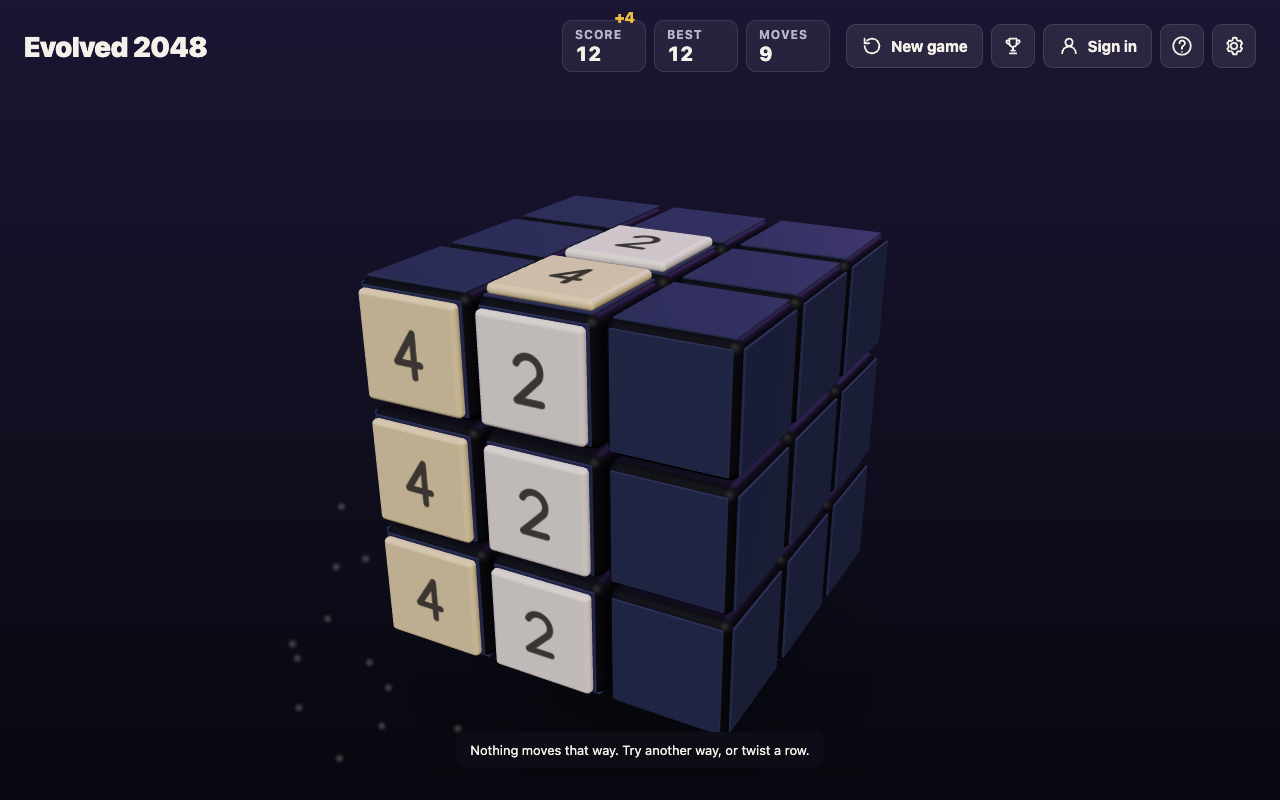
A slide to the left with nothing to move: Moves stays at 9 and the message appears.
Twists can be refused too, with two other messages the game's script holds. "That row has no tiles to carry." appears when the layer you twist is empty. "The cube is full. Merge two tiles on a face to make room before you twist." appears when a twist has no empty square for its new tile. In both cases nothing happens, so nothing is counted.
So a blocked input is safe. It will not quietly cost you a move.
One slide is one move, however many tiles merge
A single slide can merge several pairs, and it still adds exactly 1. In a set-up test, sliding left turned the row 2 2 2 into 4 2 and the row 2 _ 2 into 4. The top bar read Score 12 and Moves 1.
Two rules explain what you see:
- A tile made by a merge does not merge again in the same slide. The row 2 2 4 becomes 4 4 on one left slide, not 8.
- The pair nearest the wall you slide towards merges first. Sliding right on 2 2 2 gives _ 2 4.
Edge merges are on unless you switch them off in Settings, and they add one more way to combine. A slide towards an edge of the front face also merges the tile at that edge with an equal tile just over the edge. In a test, an 8 on the front's top right square and an 8 just over the edge on the right face became one 16 after one slide right: Score 16, Moves 1. The merge came free with the slide.
The new tile is not a separate move either. It arrives with the action that caused it.
The game has no undo, so there is no move to give back. On a set-up board, one left slide gave Score 4 and Moves 1. Control+Z, Command+Z, Backspace, Z, U and Escape changed nothing, and a reload kept the board. The full test is in 2048 undo move: can you take a move back? Tested.
A twist is the closest thing to taking a move back, and it is not free. You can twist a layer back with Shift and its key, but that is a second move and a second new tile. In a test, key 4 and then Shift and 4 gave Moves 2 and two new tiles.
If you want to see how the game counts the whole cube's quarter turns against other ways of counting cube moves, read half turn metric vs quarter turn: how cube moves are counted. In this game, every twist is a quarter turn and counts as one.
Moves, Score and Best: three different numbers
The three boxes answer different questions.
- Score rises only with merges. A twist adds no points.
- Best is your highest score kept on this device. The New game box says so: "This game ends and its score of {score} is kept only if it is your best." More on that in 2048 best score: where it is kept and when it resets.
- Moves is how many slides and twists you have spent in this game.
When you make the 2048 tile, the game quotes the one number you have just read: "You made 2048 in {moves} moves. Keep going for 4096, or start again."
The two numbers do not move together. A twist adds a move and no points, so a game with many twists can show a high Moves and a modest Score. Neither is better by itself. Score tells you how much you built, and Moves tells you how much it cost.
A worked example: read the counter as you play
Try this on a new game. It takes about a minute.
- Slide Left, then Up, then Left, then Up. Watch Moves climb to 4 and Score move only when two tiles join.
- Press Shift and Left, then Shift and Right. Moves stays put. The turn was free.
- Press
1. Moves goes up by 1 and a new tile appears, though Score does not change. - Keep sliding the same way until the message appears. Moves stops rising when a slide moves nothing.
Now you can use the counter. If Moves climbs and Score barely does, you are shuffling: look for a merge before you slide again. If the front face is full and slides do nothing, a twist is the way out, because a twist can bring a tile round to its match. Keep one empty square on a face so a twist is always possible. The No moves left box says the same: keep room on one face so a twist can still bring tiles round to their match.
For how a game ends and when new tiles appear, see 2048 rules explained: moves, new tiles and how a game ends.
Frequently asked questions
Does a swipe that moves nothing count as a move?
No. The game refuses it with the message "Nothing moves that way. Try another way, or twist a row." and the Moves box stays the same.
Does turning the whole cube add a move?
No. Turning is free. In the test, two whole-cube turns left Moves at 4 and added no tile.
Does a slide that merges several pairs count as several moves?
No. One slide is one move. In a set-up test, a single slide made two merges and the box read Moves 1.
Can I undo a move to lower the count?
The game has no undo. Twisting a layer back with Shift and its key counts as another move and adds another new tile.
What does the game say about moves when I make 2048?
It says "You made 2048 in {moves} moves. Keep going for 4096, or start again." with the number of moves you used.
Get started
The quickest way to learn the counter is to watch it while you play. Slide once, twist once, turn the cube, and see which one moves the number.
Play Evolved 2048. It is free in your browser on a computer or a phone.
Comments
No comments yet.
Sign in or make an account to comment.