2048 number sequence: from 2 to 2048 in 10 doublings
The 2048 number sequence is 2, 4, 8, 16, 32, 64, 128, 256, 512, 1024, 2048. That is 11 tile values, and each one is double the one before, so it takes 10 doublings to get from 2 to 2048. Every value is a power of two, and that is not a design choice you have to remember: it falls straight out of the one merge rule. This post shows why, counts how many 2s and merges sit inside each tile, and gives a worked count you can check with a pencil.
The 2048 number sequence, written out
Here is every tile from the first one you see up to the winning tile, with the power of two it equals:
- 2 = 21, 4 = 22, 8 = 23, 16 = 24
- 32 = 25, 64 = 26, 128 = 27, 256 = 28
- 512 = 29, 1024 = 210, 2048 = 211
The little number on top says how many 2s you multiply together. So 2048 is eleven 2s multiplied, and the step from each tile to the next is one more times 2. From 21 to 211 is ten steps: 10 doublings.
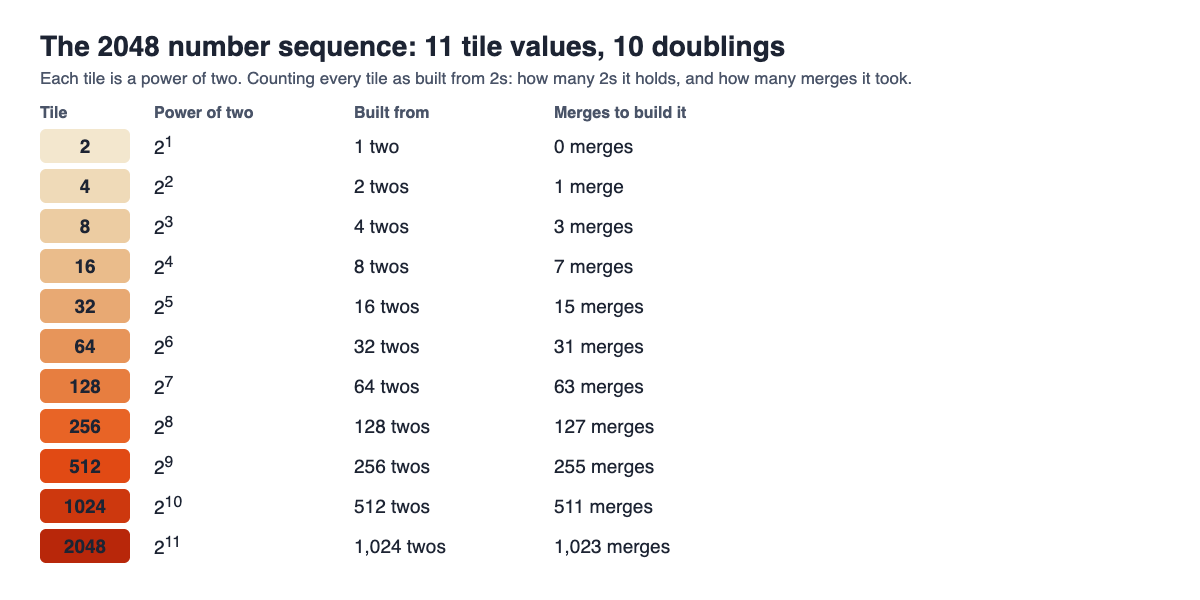
Each tile in the sequence, counted as if built only from 2s.
Why every tile is a power of two
In 2048, tiles of the same value merge into one tile with their total value. Only equal tiles merge. So a merge always takes some value and makes double it: two 8s make 16, two 16s make 32.
Now look at where tiles come from. The original game starts with two tiles worth 2 or 4, and every new tile after that is also a 2 or a 4. Both are powers of two. Doubling a power of two gives the next power of two. So no matter how long you play, nothing but powers of two can ever appear on the board. A 6, a 12 or a 100 is impossible.
One more rule keeps the climb to one step at a time: a tile made by a merge cannot merge again in the same move. Slide a row of 4, 4, 8 towards the 8 and you get an 8 next to the old 8, not a 16, because the new 8 has already merged once on that move. The next slide can join them. So each move lifts a tile at most one place up the sequence, which is why a big tile takes so many moves to build. 2048 merge rules, tested walks through more rows like this.
The same reason caps the sequence. On the classic 4 by 4 board, the largest possible tile is 131,072, which is 217. What is the highest tile in 2048? explains where that limit comes from.
How many 2s are inside a 2048 tile
Think of every tile as a pile of 2s glued together. A 4 is two 2s. An 8 is four 2s. Each step up the sequence doubles the pile, so a 2048 is 1,024 twos.
Each merge glues two piles into one, so it lowers the number of separate tiles by exactly one. Start with 1,024 separate 2s and keep merging until one tile is left: that takes 1,023 merges. The same count works for every tile: a tile built from N twos took N minus 1 merges.
Real games are a little shorter than that, because some new tiles arrive as 4s, which are two 2s already joined. In 3D 2048 most new tiles are 2s: its script makes a new tile a 2 when a random number is under 0.9, so about 9 in 10. Why does 2048 give you a 4? tests that rule.
A worked count: the merges behind a 64
Here is a count you can do on paper in a minute.
- A 64 is 26, so it holds 64 divided by 2, which is 32 twos.
- To join 32 tiles into 1, you need 31 merges.
- Check it level by level: 16 merges make sixteen 4s, 8 merges make eight 8s, 4 merges make four 16s, 2 merges make two 32s, and 1 merge makes the 64. 16 + 8 + 4 + 2 + 1 = 31.
- If two of the new tiles had been 4s instead of 2s, you would have needed 2 fewer merges: 29.
Try the same check for 2048: 512 + 256 + 128 + 64 + 32 + 16 + 8 + 4 + 2 + 1 = 1,023.
What the sequence means for your score
The score rises by the value of each new tile a merge makes. That ties the score to the sequence. A 4 made from two 2s adds 4. A 16 adds 16, but to make it you first made two 8s and, before that, four 4s, which added 16 and 16 more, so a 16 built from 2s is worth 48 in total.
The pattern is simple: a tile built from 2s is worth its value times the number of levels it climbed. 2048 sits 10 levels above 2, so it is worth 10 times 2048, which is 20,480 points. Every new tile that arrived as a 4 takes 4 off, since nobody merged it. That rule has been checked against saved games in 3D 2048; how 2048 scoring works goes through it step by step.
The same sequence on a cube
3D 2048 is the 2048 puzzle on a cube you turn like a Rubik's cube, with six faces of nine squares, 54 in all. The merge rule is the same, equal tiles merge into their sum, and every slide or twist adds a 2 or a 4, so the same sequence runs from 2 to 2048.
The difference is room. A face here is 3 by 3, so the front alone cannot hold a long run of the sequence: you twist rows and columns to carry tiles in from the other faces, and turn the whole cube for free to use its other sides. When you make 2048, the game says "Keep going for 4096, or start again", and 4096 is simply the next number in the sequence, 212. What happens after 2048 covers playing on.
Frequently asked questions
Why are all 2048 numbers powers of two?
New tiles are 2s and 4s, and only equal tiles merge, so every merge doubles a power of two into the next one.
How many doublings does it take to reach 2048?
Ten. The sequence 2, 4, 8 up to 2048 has 11 values, and there are 10 steps between them.
How many 2s make a 2048 tile?
1,024. Joining them all into one tile takes 1,023 merges, a few fewer when some new tiles arrive as 4s.
Who made the original 2048?
Gabriele Cirulli wrote it, and it was released on the web on 9 March 2014.
Get started
Open 3D 2048 and watch the sequence climb: each merge on the front face moves a tile one step up, from 2 towards 2048. It plays in your browser on a computer or a phone.
Comments
No comments yet.
Sign in or make an account to comment.