2048 rules explained: moves, new tiles and how a game ends
The 2048 rules fit on one page: how a slide moves tiles, which tiles merge, where new tiles land, how points add up, and when a game ends. This guide takes them one at a time, each checked in a live game of Evolved 2048, which puts the 2048 puzzle on a cube. Its own How to play box says tiles slide as in 2048, and two equal tiles merge into their sum. Once you know the rules, every move you make has a reason behind it.
2048 rules for the board, the tiles and the goal
2048 is a sliding puzzle. Numbered tiles sit on a grid. You push them all in one direction, and when two tiles with the same number meet, they join into one tile worth their sum. A 2 and a 2 make a 4. Two 4s make an 8. Keep doubling and you reach 2048. The original game, by Gabriele Cirulli, is played on a 4 by 4 grid, according to Wikipedia). If you want to know why the game is named after that number, see what 2048 means.
In Evolved 2048 the board is a cube like a Rubik's cube: six faces of nine squares, 54 in all. You play on the front face. A game starts with two tiles on that face. The How to play box sets the goal plainly: "Make the biggest tile you can: 2048 is the first milestone, and the cube plays on past it."
How moves work: sliding every tile in one direction
A slide moves every tile on the front face as far as it can go in the direction you choose. You swipe the front face, or press the arrow keys, or W A S D. Tiles stop when they hit the edge or another tile they cannot join.
Each slide that moves something counts as one move. The top bar shows Score, Best and Moves, so you can watch the counter go up.
Evolved 2048 adds two more kinds of action because the board is a cube:
- Twist. Drag a row on the right face sideways, or a column on the top face. That layer turns a quarter and carries its tiles to the next face. On a keyboard, 1, 2 and 3 twist the top, middle and bottom rows, 4, 5 and 6 twist the left, middle and right columns, and Shift twists the other way. A twist counts as one move.
- Turn. Drag the space around the cube, or press Shift and an arrow key. The whole cube turns so you can use another side. A turn costs nothing: no move, no points, no new tile.
Here is a quick example from a test game played with the keyboard. After two slides, Left then Up, the top bar read Score 4 and Moves 2, with a 4 made from two 2s. Then Shift and Left turned the cube to an empty face. Moves still read 2, and no new tile appeared.
Merging rules: when two tiles combine and what they become
Two equal tiles that meet during a slide merge into one tile worth their sum. Two details decide a lot of games.
Rule one: a tile made in a merge does not merge again in the same slide. Picture a row of 2, 2 and 4. Slide left and you get 4 and 4, not 8. The new 4 has already merged once this turn, so it waits for your next slide.
Rule two: the pair nearest the wall you slide towards merges first. Picture a row of 2, 2 and 2. Slide left and you get 4, 2. Slide right and you get an empty square, then 2, then 4. The original 2048 code works the same way.
A gap does not stop a merge. A row of 2, empty, 2 slides left into a single 4. Our post on 2048 merge rules shows each of these rows before and after.
Evolved 2048 also has edge merges, which are on unless you switch them off in Settings. A slide towards an edge of the front face also merges the tile at that edge with an equal tile just over the edge, on the next face. The new tile stays on the front.
New tiles: where they spawn and how often you get a 2 or a 4
Every slide or twist adds one new tile. It is a 2 or a 4, and it lands on a randomly picked empty square of the front face. If the front face is full, it can land on any empty square of the cube. A twist needs one empty square for its new tile, which is why the game refuses a twist on a full cube with the message: "The cube is full. Merge two tiles on a face to make room before you twist."
How often do you get a 4? The game's script draws a random number for each new tile. Under 0.9 means a 2. Otherwise you get a 4. So about one new tile in ten is a 4. When that random code was copied and run outside the page for 10,000 new tiles in a row, 1,001 were 4s.
Scoring: how points are added with each merge
The scoring rule is short: a slide adds the value of every tile its merges make. Merge two 8s into a 16 and you score 16. Make two merges in one slide and you score both.
A twist adds no points. A turn adds no points. Only merges score.
Here is a worked example you can follow, from a test we played on a set-up board in the live game. The front face's top row read 64, 32, 16. The middle row read 4, 8, 16.
- Slide Up. The two 16s merge into a 32 at the top right. Score 32.
- Slide Left. The 32 and 32 merge into a 64, next to the other 64. Score 96.
- Slide Left again. The two 64s merge into a 128 in the top left corner, and two 2s on the bottom row merge into a 4. Score 228.
Three slides, three moves, Score 228. That chain shows why players line tiles up in order along one edge: each merge sets up the next one.
Winning at 2048 and playing on past the 2048 tile
You win when a merge makes a 2048 tile. Evolved 2048 then shows: "You made 2048 in {moves} moves. Keep going for 4096, or start again." The number of moves fills in where the braces are. You get two buttons, New game and Keep going.
Keep going closes the box, and your cube, Score and Moves carry on. The win box opens only once per game, the first time a merge makes 2048 or more. There is no box for 4096. New game starts a fresh cube at Score 0 with two tiles. Pressing New game during a game asks first, in a box titled "Start a new game?", with Keep playing and New game buttons.
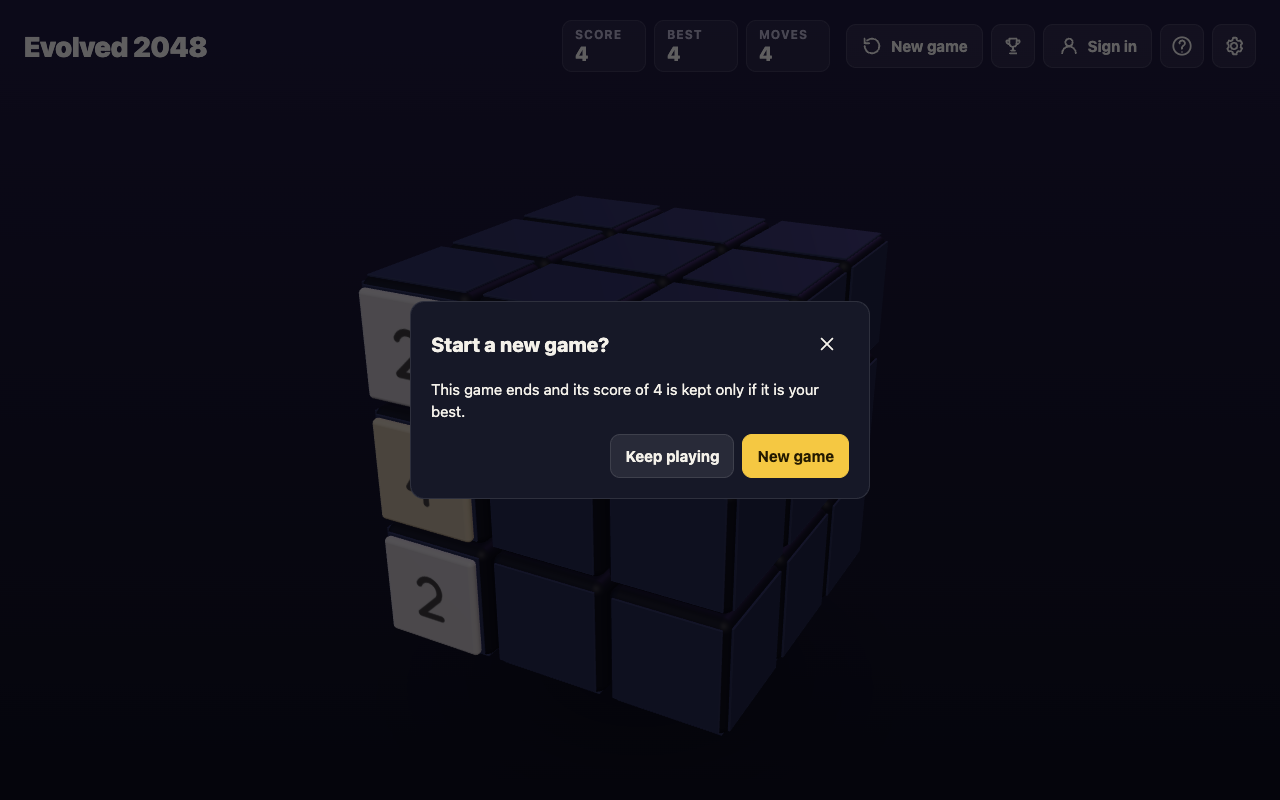
New game asks first: the score is kept only if it is your best.
How a game of 2048 ends: no empty cells and no possible merges
A game of 2048 ends when you cannot move. In Evolved 2048, with edge merges on, the rule reads: "The game ends when all 54 squares are full and no two equal tiles sit side by side, on a face or across an edge."
Notice what does not end the game. A stuck front face is not the end. If no slide works, you see "Nothing moves that way. Try another way, or twist a row." You can still twist a layer to bring tiles round from another face, or turn the cube to find a pair.
Two early test games, played by a simple script before edge merges existed, show this. A game played with slides only got stuck at move 46 with the front face full, a score of 332, and the other five faces empty. A game that twisted whenever the front was stuck reached a 128 tile at move 118. It filled all 54 squares at move 165 with a score of 1160, and even then it was not over, because other faces still had equal tiles side by side.
When a game does end, the No moves left box gives one tip: "Next time, keep room on one face so a twist can still bring tiles round to their match."
Frequently asked questions
Can three identical tiles merge in a single move?
No. Two of them merge and the third stays as it was. The pair nearest the wall you slide towards joins first, so 2, 2, 2 slid left gives 4, 2.
Does a new tile appear if a move changes nothing?
No. A slide that moves nothing is refused with the message "Nothing moves that way. Try another way, or twist a row." The board stays the same and Moves does not go up.
What is the chance of a 4 tile spawning?
About 10 percent. The game picks a 4 when its random number is 0.9 or higher, and a run of 10,000 new tiles gave 1,001 fours.
Is there a highest possible tile in 2048?
On the original 4 by 4 board, Wikipedia gives 131,072; see what is the highest tile in 2048. Evolved 2048 calls 2048 the first milestone and names no top tile.
Get started
Try the rules out in order. Slide a row of three 2s and watch which pair merges. Line up a short chain like 64, 32, 16 and collapse it. When the front face jams, twist a row instead of giving up. Your game, best score and settings are saved on your device, so you can stop and come back. Playing needs no account.
Play Evolved 2048: it is free and plays in your browser on a computer or a phone.
Comments
No comments yet.
Sign in or make an account to comment.