2048 tile colors chart: what color is each number
A 2048 tile colors chart is easy to find for the flat game and hard to trust, because each version picks its own colors. This page gives the colors for Evolved 2048, the 2048 puzzle on a cube, and they are not guesses: they come from the game's own script file and from screenshots of the live game, taken on 13 October 2026.
You get one color for every number from 2 to 4096, the look of every tile above that, and a short habit for using the colors to read a full cube at a glance.
The 2048 tile colors chart: 2 to 4096
The game's script lists a body color and a text color for each tile value. Here are the body colors in order, with the hex code the script gives for each. The words are mine, so use the code if two names sound alike.
- 2: pale cream, #EEE7DD, with dark text.
- 4: sand, #EBD7A8, with dark text.
- 8: light orange, #F2A65A, with dark text.
- 16: deeper orange, #EF7D4E, with dark text.
- 32: red, #C93C4A, with white text.
- 64: raspberry, #A82C66, with white text.
- 128: purple, #7238A6, with white text.
- 256: indigo, #4A43C4, with white text.
- 512: blue, #2563C9, with white text.
- 1024: teal, #0F7471, with white text.
- 2048: gold, #E8B923, with dark text.
- 4096: green, #26814E, with white text.
The picture below is a hand-made board with 2 to 512 on the front face, so you can see how those colors look on the cube.
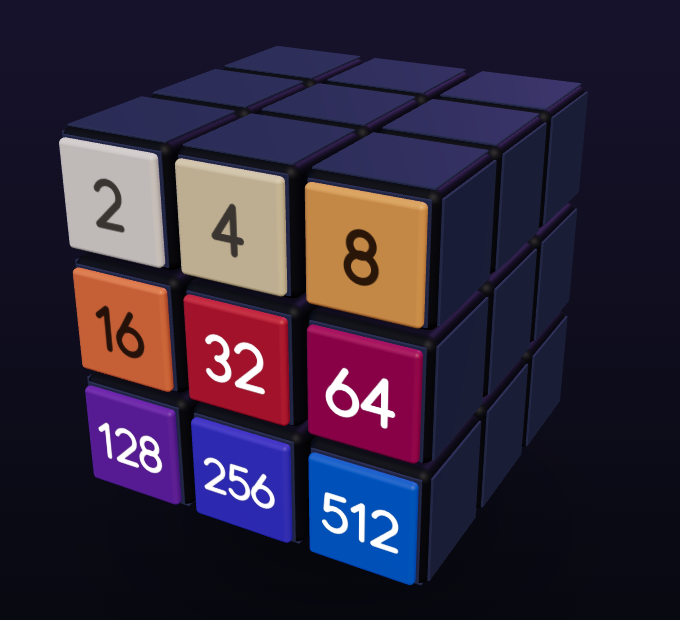
Tiles 2 to 512 on the front face, from cream through orange, red and purple to blue.
On screen the colors are lit like the rest of the cube, so a tile can look a little lighter or darker than its code. The order does not change.
What the tiles look like above 4096
The script has twelve styles, one for each value from 2 to 4096, and one more for everything above that. Any tile bigger than 4096 gets a very dark body, #14161F, with gold text, #F5C842.
I set a board up by hand to see it, because I did not reach these values in play. The picture shows 1024 in teal, 2048 in gold, 4096 in green, and then 8192, 16384, 32768, 65536 and 131072 all in the dark style. The number gets smaller as it gets longer, so it still fits on the square.
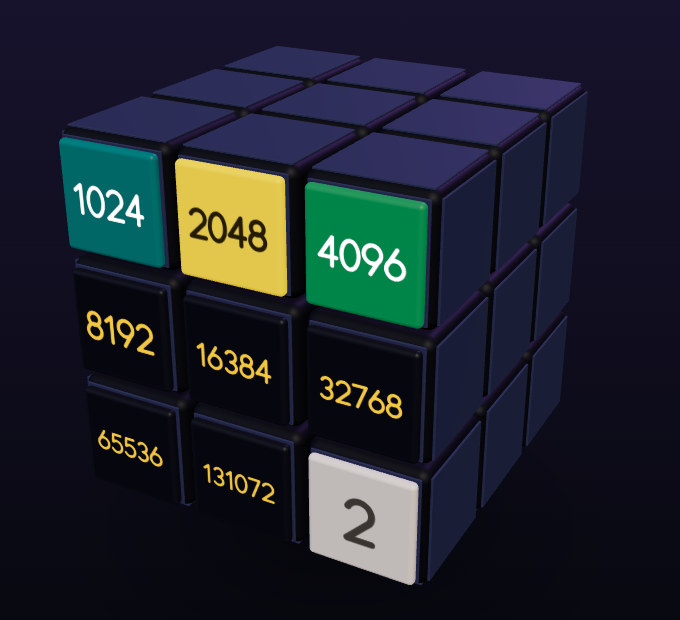
A hand-made board: 1024, 2048 and 4096 in color, then the dark style for every tile above 4096.
That last style is one look for many numbers, so from 8192 up the number is the only clue to the value. If you want to know how a game gets that far, the post on what happens after 2048 covers the Keep going choice.
Why the colors run from pale to cool to gold
The colors are not random. They follow three simple steps.
- Small numbers are pale and warm. 2 and 4 are near white and sand, and 8 and 16 are orange. These are the tiles you start with and the tiles the game adds.
- The middle of the climb is red, purple and blue. 32 and 64 are red and raspberry, and 128, 256 and 512 move through purple and indigo to blue.
- The milestone stands out. 1024 is teal, then 2048 is gold, the only bright warm tile after 16, and the only tile past 16 with dark text. The script gives 2048 the biggest glow of any tile (0.55), then 0.5 for the dark style above 4096 and 0.4 for 4096.
The text color helps too. The first four tiles and the gold 2048 use dark numbers on a light body, and the rest use white numbers on a darker one.
The game itself marks 2048 as the first milestone. When you make it, the box reads "You made 2048 in {moves} moves. Keep going for 4096, or start again." The gold tile and that box arrive together.
A worked example: read a merge by color
This is a test on a set-up board, signed out, with edge merges on (their default). I put 128, 128 and 256 in the front row, with Score 0 and Moves 0, then pressed the left arrow twice. Before the first slide you would see purple, purple, indigo.
- Slide left once. The two purple 128 tiles became one 256, so the row read indigo, indigo. A new 2 appeared lower on the front face. Score read 256 and Moves read 1.
- Slide left again. The two indigo tiles became a 512, which is blue. The first 2 stayed where it was and another new 2 appeared in the top right. Score read 768 and Moves read 2.
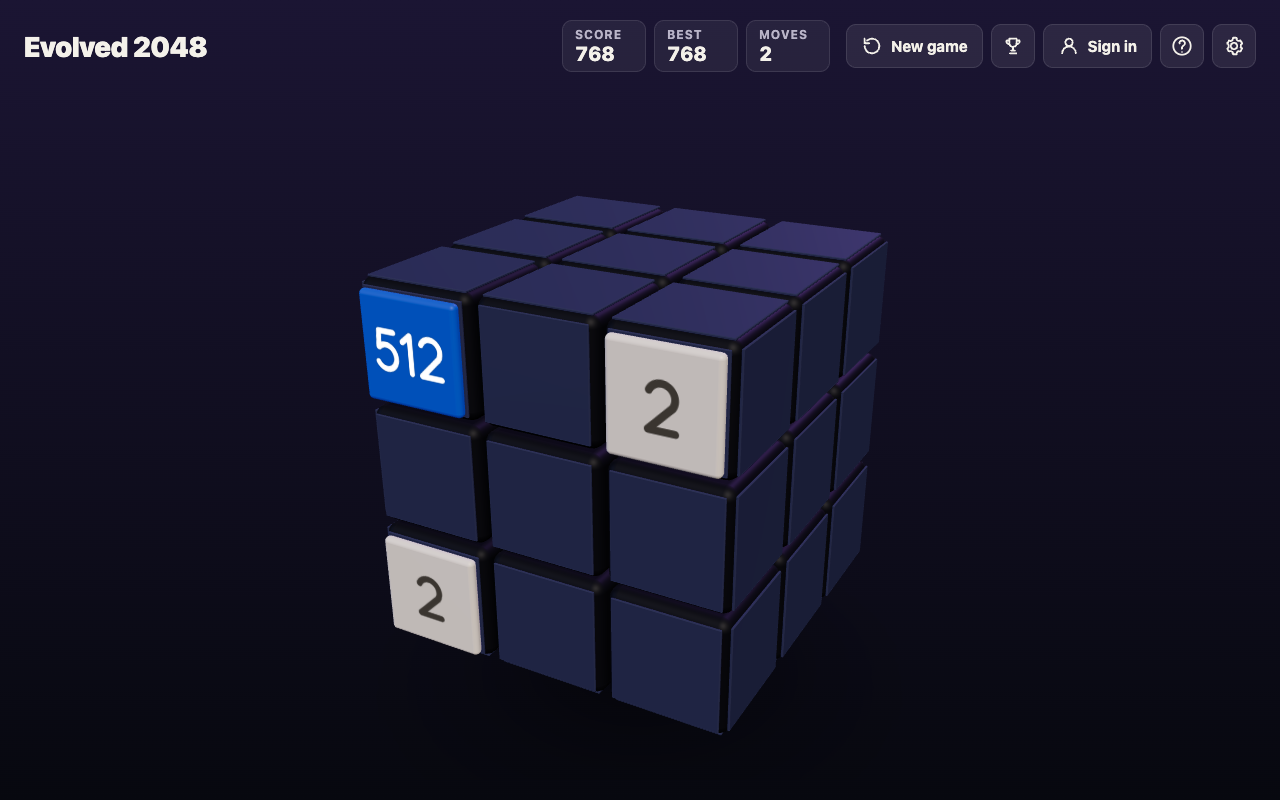
After two slides: a blue 512, two cream 2 tiles, Score 768 and Moves 2.
Notice what the colors told you without reading a number: two matching tiles, then a color one step further along the same ladder. The score line is the sum of what each merge made, 256 and then 512. That is one short game on one board, not a pattern across many games.
How to use the colors to read the cube
Colors are fast to scan and numbers are exact, so use both. Here is the habit I would build.
Use color to find pairs, numbers to confirm them
Look for two tiles of the same color first, then read the numbers to be sure they match. A tile only merges with an equal one, so a purple beside an indigo is not a pair. That mistake is easy with 128 and 256, because the two are close in the picture above.
Watch the pale tiles, they are the new ones
The game adds a 2 or a 4 after every slide or twist, so a pale tile is almost always the newest. When your cube is crowded, spotting the cream and sand tiles tells you where the game just put something, and so where your last move landed.
Count the colors on each face
Turn the cube with Shift and an arrow key and glance at each face. A blue or teal tile stands out from a face of pale ones, so you can find your biggest tiles without reading every number. If you want a layout plan for the big tiles, the post on snake strategy in 2048 shows one.
Do not trust color for the close pairs
32 and 64 are both red-toned, and 128, 256 and 512 all sit in the purple to blue range. Read the number whenever a move depends on it. The numbers are printed on every tile, so a player who finds two colors hard to tell apart loses nothing.
The ladder behind the colors is the same ten doublings from 2 to 2048, and the post on the 2048 number sequence walks through it. For how merges count towards your score, see how 2048 scoring works.
Frequently asked questions
Is there one standard color for each 2048 tile?
No. Each version of the game picks its own, so a chart for one game will not match another. The colors on this page are the ones in Evolved 2048's script file.
What color is the 2048 tile?
Gold, #E8B923, with dark text. It is the only bright warm tile after the oranges at 8 and 16, which makes the milestone easy to spot.
What color is 4096?
Green, #26814E, with white text. Above 4096 every tile uses the same dark style with gold numbers.
Do the colors change which tiles merge?
No. Two equal tiles merge into their sum, whatever they look like. The color only follows the number.
Does a tile look the same on every face?
The script has one style per value, so the same number gets the same colors wherever it sits. The front face is the one where you slide, and the others show up as you turn the cube.
Get started
Open the game, make a few merges and watch each color step up the ladder. Press H to open How to play if you want the controls. Slide the front face, twist a row to bring a match round, and turn the cube with Shift and an arrow key.
Play Evolved 2048: it is free and plays in your browser on a computer or a phone.
Comments
No comments yet.
Sign in or make an account to comment.