2x2 vs 3x3 cube: pieces, positions and moves
The short answer to 2x2 vs 3x3 cube is that a 2x2 is a 3x3 with the edges and centres taken out. That one change explains almost every difference: how many pieces you handle, how you tell which colour goes where, how many positions the puzzle can reach, and the most moves any scramble needs. This post goes through each, with every number taken from a source you can open, and a two-move check you can try on a real cube.
2x2 vs 3x3 cube at a glance
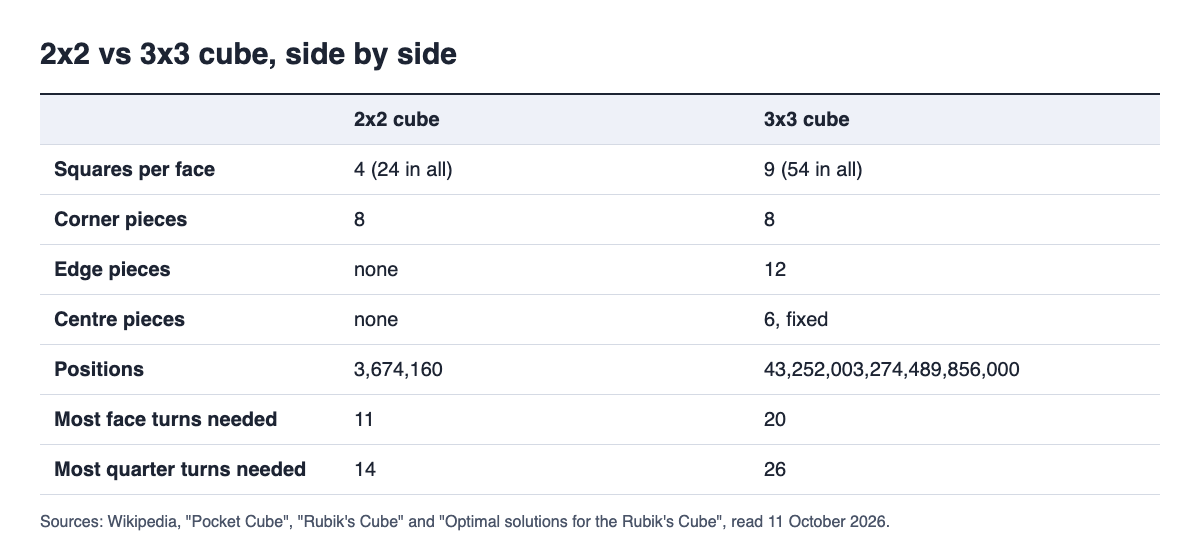
The two cubes compared. Figures from Wikipedia's Pocket Cube, Rubik's Cube and optimal solutions pages.
- Squares per face: 4 on a 2x2 (24 in all), 9 on a 3x3 (54 in all).
- Pieces: a 2x2 has 8 corners and nothing else. A 3x3 has 8 corners, 12 edges and 6 centres.
- Positions: 3,674,160 on a 2x2. 43,252,003,274,489,856,000 on a 3x3.
- Most face turns any scramble needs: 11 on a 2x2, 20 on a 3x3.
- Most quarter turns any scramble needs: 14 on a 2x2, 26 on a 3x3.
Pieces: corners only, or corners, edges and centres
A 3x3 is built from 26 small cubes. Eight corner pieces show three colours each, twelve edge pieces show two, and six centre pieces show one. The centres are fixed to the core: they spin in place but never leave their face.
That makes the centres a map. On a 3x3, the centre of a face tells you what colour that face will be when it is solved, so you always know where a piece belongs. Why centre pieces never move explains this in more detail.
A 2x2 has no centres and no edges. All eight pieces are corners, and every one of them moves. So the 2x2 has no fixed reference: you decide where each colour goes by looking at the corners you have already placed and matching their side colours to each other.
You can read the full piece count and how the parts fit together on Wikipedia's Pocket Cube page, which is where the 2x2 numbers in this post come from.
The 2x2 also came first. Larry D. Nichols invented it in 1970 and filed a patent application that February. His cube was held together with magnets.
Positions: 3,674,160 against 43 quintillion
The 2x2 count is short. Its 8 corners can be arranged in 8! orders, and 7 of them can each be twisted 3 ways (the last one's twist is set by the others), so 8! times 37. Then divide by 24, because a 2x2 has no fixed centres: turning the whole cube to any of its 24 orientations gives the same puzzle, not a new position. The result is 3,674,160.
The 3x3 keeps the same corner part, 8! times 37, and adds the edges: 12! orders, halved, times 211 flips. Its fixed centres mean there is no division by 24. The total is 43,252,003,274,489,856,000, about 43 quintillion.
So the gap is not in the corners. Both cubes have the same eight. It is the twelve edges, which multiply the total rather than add to it.
Moves and notation on both cubes
Both cubes use the same letters for face turns: R, L, U, D, F and B for the right, left, up, down, front and back faces. A letter alone is a quarter turn clockwise, R' is the same face the other way, and R2 is a half turn.
The difference is the middle. A 3x3 has a middle layer between each pair of opposite faces, which is what M, E and S moves turn. A 2x2 has only two layers in each direction, so there is no middle layer to turn.
A worked example: R then L' on each cube
- On a 2x2, turn R, then L'. Both layers have now turned the same way, and there is nothing between them, so the whole cube has simply rotated. Every piece is still next to the same neighbours.
- On a 3x3, do the same: R, then L'. This time the middle layer stays behind, so the cube is now mixed.
- Undo with L, then R', and both cubes are back where they started.
On a real cube, that whole-cube move has its own letter: turning the whole puzzle the way R turns is called x, one of the whole-cube rotations x, y and z. So on a 2x2, R followed by L' does the same job as x. The same idea means a two-layer turn on a 2x2, the kind written Rw on bigger cubes, is also just a rotation, because two layers are the whole cube. On a 3x3 it is not, since a third layer is left behind.
This is why a 2x2 can be solved with a 3x3 method: treat it as a 3x3 whose centres and edges are already solved and invisible. Algorithms written for the 2x2 itself are often shorter, because they only have to look after corners.
The most moves either cube needs
The most moves any scramble needs, when solved in the fewest moves possible, is called God's number. For the 2x2 it is 11 when a half turn counts as one move, and 14 when only quarter turns count. For the 3x3 the same two numbers are 20 and 26.
The jump from 11 to 20 goes with the jump in positions: a 3x3 has about twelve million million times as many. God's number explained covers how the 3x3 figure was proven.
Which one to pick up first
- The 2x2 if you want fewer pieces to track: only corners, and fewer than four million positions.
- The 3x3 if you want the centres to steer by, and a method that also covers the 2x2, since a 2x2 can be solved as a 3x3 with its edges and centres already done.
Neither choice is wrong. The second cube is easier once you know the first, because the face turns and their letters are the same.
Frequently asked questions
Why does a 2x2 cube have no centre pieces?
Each face is two squares by two, so there is no middle square. Every one of the 8 pieces sits at a corner.
How many positions does a 2x2 cube have?
3,674,160. A 3x3 has 43,252,003,274,489,856,000.
How many moves does it take to solve a 2x2 at most?
No more than 11 face turns, or 14 if you count only quarter turns.
Can I solve a 2x2 with a 3x3 method?
Yes. Treat it as a 3x3 whose edges and centres are already solved, and do only the corner steps.
Get started
3D 2048 is the 2048 puzzle on a cube you turn like a Rubik's cube, with 3 by 3 faces, 54 squares in all, like a 3x3. It is a number puzzle and will not teach you to solve a cube, but its layers turn the way a 3x3's do: you slide the front face to merge equal tiles, twist a row or column (middle ones included) with a drag or the keys 1 to 6, and turn the whole cube for free with Shift and an arrow key. It plays in your browser on a computer or a phone.
Comments
No comments yet.
Sign in or make an account to comment.