4-way vs 8-way movement: which suits a top-down tank game?
The choice between 4-way vs 8-way movement shapes almost everything about how a top-down game plays: how you aim, how you dodge and how you read the map. Four directions feel crisp and easy to read. Eight directions feel freer and faster. Neither is better in general, and each suits a different kind of game. This guide explains both, shows how held keys become moves, and gives you a short test you can run yourself. Tank City Reboot is handy for that test, because it has one free browser game built on each style.
What 4-way and 8-way movement mean
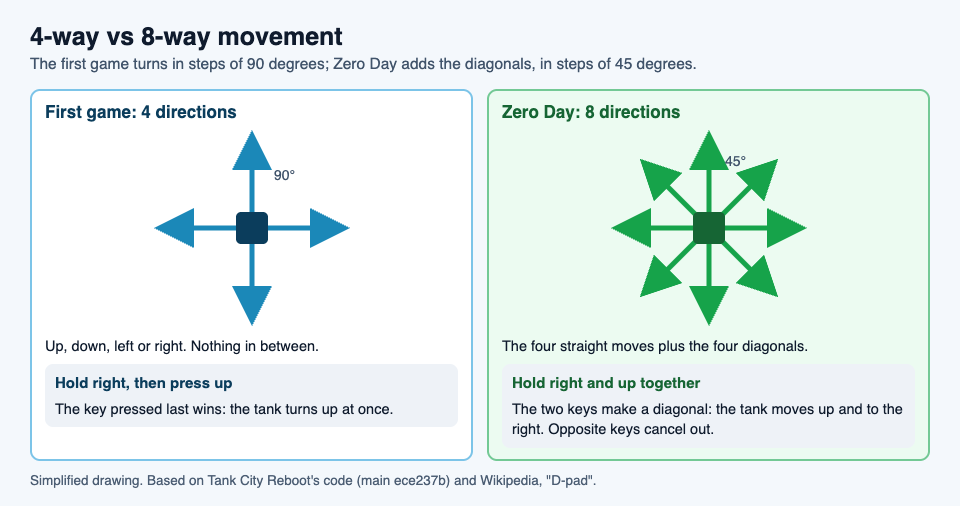
In 4-way movement, you move up, down, left or right. Nothing else. If you hold two direction keys, the game has to choose one of them.
In 8-way movement, you also get the four diagonals: up-left, up-right, down-left and down-right. Holding up and right together moves you up and to the right.
That sounds like a small change, but movement is the thing you do most in a top-down game. Change it and you change aiming, dodging and how the levels feel.
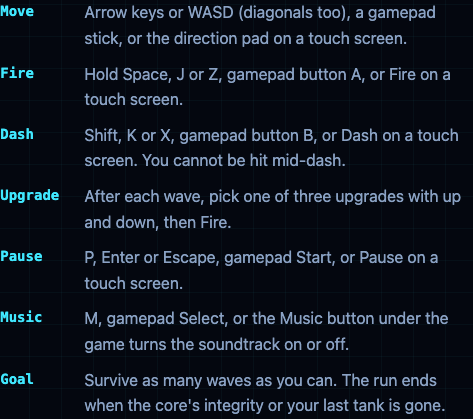
Tank City Reboot shows both side by side. In the first game, your tank moves in four directions. In Tank City Zero Day, your tank moves and fires in eight directions and can dash. The game sums itself up as "Tank City, modernized: 8-way moves, dashes, upgrades and a boss every fifth wave."
Where four and eight directions came from
Both styles go back to the controls. A four-way joystick was used in an arcade racing game as early as 1973. In 1975, a multidirectional shooter gave players two sticks: one eight-way joystick for movement and the other for the shooting direction.
The direction pad, or D-pad, followed. The first true D-pad design was patented in 1979, for Tiger Electronics. Under each arm of a D-pad sits a switch for one direction: up, down, left or right. Pressing a diagonal presses two switches at once, which gives eight directions at 45-degree steps.
So the hardware has always allowed both. A game decides what to do when two switches are pressed. A 4-way game picks one. An 8-way game turns the pair into a diagonal.
How two held keys become a move
This is where the two Tank City Reboot games differ most, and you can feel it within seconds.
In the first game, when two direction keys are held, the one pressed last wins. So if you hold right and then press up, the tank turns up at once. Rolling your thumb from one arrow to the next turns the tank without a pause. You never get stuck between two directions.
In Zero Day, two direction keys together give a diagonal, and opposite keys cancel out. Hold right and up and you move up and to the right. Hold left and right together and you stop moving across.
Touch screens follow the same split. In the first game, the touch pad picks the nearest of four directions, so a small drift of your thumb does not change your heading. In Zero Day, the pad reads eight directions, each a slice of 45 degrees. If you want the full list of keys, buttons and pads, see our guide to tank game controls on keyboard, gamepad and touch.
Why 4-way movement fits grid maps
In the first game, each map is 13 by 13 tiles. If grids are new to you, our plain guide to what a tile map is in 2D games covers the basics.
A grid and four directions fit together, because both are made of rows and columns. Your tank faces along a row or a column, so its next shot goes along that line. You always know where it is pointing. When you aim, you are really choosing a line to stand on.
Terrain can still push you around. On the data bus, your tank slides about three quarters of a tile before it stops, so you learn to let go of the key a little early.
Worked example: holding a line on COOLANT
Here is a plan you can follow on the COOLANT stage of the first game. Two coolant rivers cross the map, each with one gap on the left and one on the right. Tanks cannot cross coolant, but shots fly over it.
- Park on your side of a river, facing up.
- Watch the gaps. Enemy tanks have to come through them, so you know where they will appear.
- Fire straight up across the river at any tank in your column. It cannot drive across to reach you.
- When a tank comes through a gap, roll from up to left or right. The key pressed last wins, so the tank turns at once and you can fire along the row.
- Your one risk is an enemy lining up in your column and firing back. Step one tile sideways to leave that line, then step back.
The whole plan runs on straight lines. That is the strength of 4-way movement: you plan by reading the map like a board.
What 8-way movement adds in Zero Day
Eight directions give you more ways to get from one place to another. You can cut across the arena instead of moving in an L shape, and you can back away at an angle.
Firing in eight directions opens more angles, and it changes how walls behave. One of the game's tips is that diagonal shots break firewall too, so you can chip a path through a wall at an angle. The Multithreading upgrade adds more shots per volley in a spread: two shots at 6 degrees either side, then three (straight and 12 degrees either side), then five (straight, 10 and 20 degrees either side), so diagonal aim and spread shots work together.
More angles also mean more danger, so dodging gets busier. That is part of why Zero Day gives you a dash. A dash lasts a fifth of a second, you cannot be hit during it, and it recharges in 1.5 seconds. The game's tip says it plainly: dash through shots, they cannot touch you mid-dash. That works much like the invincibility frames found in many action games.
Choosing between 4-way vs 8-way movement
Whether you are designing a game or just working out why one feels better to you, ask these questions.
- Is the level a grid of rows and columns? Four directions will feel natural there.
- Do you want to plan or to react? Four directions reward reading lines and holding positions. Eight reward quick reactions and constant motion.
- What will most players hold? Arrow keys and a D-pad handle both, as the switches show. A stick or a round touch pad makes diagonals easy.
- Do shots come from many angles? Then the player needs an escape tool, such as a dash.
Here is a ten-minute test you can run in your browser:
- Play stage 1, FIREWALL, in the first game with the arrow keys and Space. Notice how often you line up on a column before firing.
- Then play a few waves of Zero Day. Hold two arrow keys to move on a diagonal, and press Shift to dash through an incoming shot.
- Write down which game made you think ahead and which one made you move more.
New to the game? Our tank game tips for beginners say what to learn first.
Frequently asked questions
Is a D-pad 4-way or 8-way?
It can be either. Each arm presses one switch, and a diagonal presses two at once, so the game decides whether that pair means a diagonal or one direction.
What happens when I hold two keys in the first Tank City Reboot game?
The key you pressed last wins, so the tank turns that way at once. There are no diagonals in the first game.
How do I move diagonally in Zero Day?
Hold two direction keys together, such as up and right, or push a gamepad stick or the touch pad at an angle. Opposite keys cancel out.
Can I use a gamepad for both games?
Yes. A gamepad works in both games; our 4-step gamepad checklist helps if your browser does not pick it up.
Get started
The fastest way to feel the difference is to play both. Open Tank City Reboot, press Play, click the game, and move with the arrow keys or WASD. Fire with Space. When you want diagonals and dashing, switch to Zero Day. It is free, plays in your browser on a computer or a phone, and needs no account to play.
Comments
No comments yet.
Sign in or make an account to comment.