5 Minute Comedy Set: How Many Jokes Fit and How to Time Them
A 5 minute comedy set holds fewer jokes than most new comics think: often three or four short bits, once you leave room for laughs and the walk to the mic. How many fit for you depends on how fast you talk, and the only reliable way to know your set fits is to say it out loud and time it. This post covers the math: how to count bits, how to find your own pace in words per minute, and what to cut when you run long. For the recording side, our post on recording a stand-up set at home to time your jokes walks a comic through capturing a set as a sound-only file before an open mic. Its most useful point is that the transcript's line times already tell you where each bit starts, so you never need a stopwatch.
Cheap Recorder records your voice in Chrome and saves the file to a folder on your own computer, with a transcript that has a time on every line, so you can read how long each bit runs straight off the page.
What a 5 minute comedy set really is at an open mic
Five minutes starts when the host says your name. It ends when you hand the mic back. That window covers walking up, moving the stand, and any "how's everyone doing tonight." Your actual material gets less than five minutes.
At many open mics the host flashes a light or hold up a phone when you have about a minute left. That is your cue to head for your closer. If you are still in the middle of your second bit when the light comes on, the set was too long before you ever walked up.
So plan for about four and a half minutes of material in the room. Plan for even less at home, for the reason in the next section.
How many jokes fit in five minutes, and why laughs eat your time
Count bits, not jokes. A bit is one premise with a few punchlines and tags hanging off it. A storyteller might fit three bits in five minutes. A one-liner comic might fit fifteen separate jokes. Most new comics land somewhere around four bits of about a minute each.
Laughs take time. When a line works, you wait for the laugh to peak and start to fade before you say the next thing. A few seconds per laugh adds up fast across a set. Your living room does not laugh, so a set that runs exactly 5:00 at home will run over in a room that likes it.
A practical target: get your home run to about 4:00 to 4:15. That leaves room for laughs, a slow start, and the walk to the mic.
Words per minute: turning your written bits into seconds
Every comic talks at a different speed. Nerves push most people faster. Act-outs, pauses and crowd work push you slower. So do not borrow someone else's number: find your own pace by timing yourself once. Record one full run, count the words in its transcript, and divide by the minutes it took. That is your words per minute.
Here is a quick way to estimate from the page:
- Count the words in each written bit.
- Divide by your own words per minute. If your pace is 140, a 140-word bit takes about a minute.
- Add up every bit, plus a few seconds for each transition.
Treat that number as a first guess. What you write and what you say drift apart. You add a "so anyway," you repeat a punchline, you pause before the turn. A recording of you actually performing settles the question.
Build the set: opener, middle bits and a strong closer
A five-minute set has three jobs. Get a laugh early. Keep the middle moving. End on your best line.
- Opener: short, with a laugh inside the first 30 seconds. Something about you, or something the audience can see, works well.
- Middle: your most tested bits. Order them so one leads into the next. Long segues cost time you do not have.
- Closer: your strongest bit, the one you trust most. Say your name, say thanks, and leave the stage.
A sample plan for a home run of 4:15 might look like this. Opener 0:30. Bit one 1:00. Bit two 1:15. Bit three 0:45. Closer 0:45. Write your own plan down before you record, so you can compare it with what really happened.
Run it out loud at home and time every bit from a recording
Perform the set standing up, at full volume, the way you will on stage. Reading it quietly at a desk gives you a false time. Here is a workflow in Cheap Recorder:
- Open the recorder in Google Chrome. Press Choose folder... and allow Chrome to edit files there. The recorder does not remember the folder between visits, so you pick it each time.
- Type a name in Name this recording, for example
Set v1. The name is used for the file and its folder, so numbering your versions keeps them in order. - Switch off Record my webcam and do not pick a screen. The recording then saves as an M4A audio file instead of a video.
- Under Options, check that Live transcript is ticked and the language is right. The language menu goes back to its default every time the page opens.
- Record a 30-second test, play it back, and make sure the right microphone is picked.
- Press Start recording, do the whole set, then press Stop and finish.
Open the recording's folder. Next to the M4A you will find a plain-text transcript with the time of each line. Find the first line of each bit and note its time. Then subtract.
Say your opener starts at 0:02, bit one at 0:41, bit two at 1:58, bit three at 3:20 and your closer at 4:10, and you finish at 5:05. Now you know the opener ran 39 seconds, close to plan. Bit one ran 1:17 against a planned 1:00. Bit two ran 1:22 against 1:15. Bit three ran 50 seconds and the closer 55. The whole set ran 5:03, about 48 seconds too long for a 4:15 target, and most of the extra is in bit one.
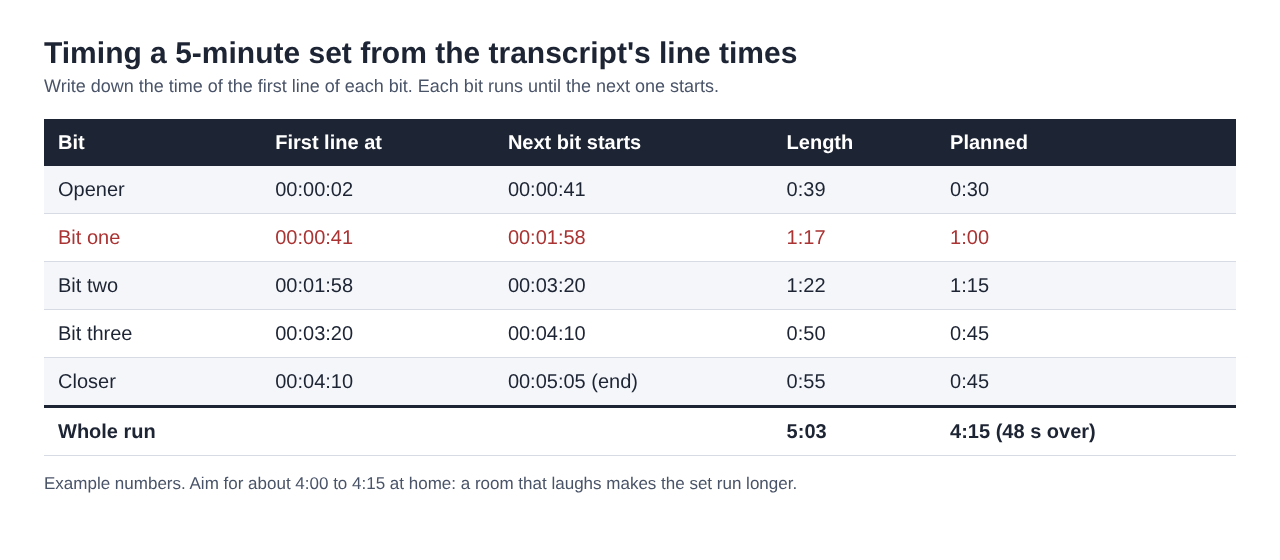
The worked example as a table: each bit runs from its first line to the next bit's first line.
You can also press M or Add marker as each bit begins, and a short note confirms the time. In a normal single-file recording those marker notes are not saved, though. Jot the times down or use the transcript lines instead.
A few things help the transcript. A microphone close to your mouth beats a laptop's built-in one. The live transcript guide explains that Chrome sends your microphone audio to Google to turn it into text. If you would rather it did not, untick Live transcript before you start. You will still get the audio, just without line times. If you hold a long pause, the recorder restarts Chrome's listening for as long as you are still recording. If your level bar does not move, the no sound guide covers the usual causes. To find your files later, see where recordings are saved.
The Free plan includes 12 hours of recording a month, so you can run the set every night for weeks before you come close.
Trim to the light: what to cut when you run long
When the numbers say you are over, cut in this order:
- Setup before the first laugh. Read your transcript and find the words between the start of a bit and its first punchline. Most of them can go.
- Tags that never land. If a tag has died on stage twice, drop it.
- Whole bits. Removing one weak bit is often cleaner than shaving ten seconds off every bit and rushing the lot.
- Transitions. Jump from bit to bit. The audience follows better than you expect.
Never cut your closer to save time. Cut from the middle, and keep what you drop for a longer spot later.
After each round of cuts, record again as Set v2, then Set v3. Each version lands in its own folder named with the date and time, so you can compare runs side by side and see which cuts actually saved seconds.
Keep one spare tag in your pocket in case the room is fast and you finish early. Also keep one bit you can skip if the light comes on sooner than you expected.
Frequently asked questions
How many words is a 5 minute stand-up set?
It depends on your pace and how many laughs you get. Time a full run out loud, count the words in its transcript and divide by the minutes, because written word counts drift from what you actually say.
Should I memorize my set word for word?
Memorize the order of bits and every punchline exactly, since the wording of a punchline is what makes it land. The setup can stay looser, which also makes it easier to trim when you run long.
What happens if I go over my time at an open mic?
Running over eats into other comics' time, and many hosts remember who ignored the light. Respect the light, go straight to your closer, and get off on a laugh.
How much time should I leave for laughs?
A simple rule is to aim for about 4:00 to 4:15 when you rehearse alone. That leaves close to a minute for laughs, the walk up and a slow start.
Get started
Write your set plan with a target time for each bit. Then do one full run standing up and read the times off the transcript. For a step-by-step look at capturing the set itself, read how to record a stand-up comedy set at home and time your jokes. You can create a free account and do your first run tonight.
The free plan needs no card. Try Cheap Recorder in Chrome, and your recordings stay on your own disk.
Screen recording that is cheap and easy.
Visit cheaprecorder.com↗


Comments
No comments yet.