5 whys example: finding the root cause of a personal problem
Looking for a 5 whys example you can use on your own life, not a factory line? This guide gives you two. First the classic one the method comes from, then a personal problem taken step by step down to a cause you can actually fix. By the end you will know how to run the 5 whys on your own problem in about ten minutes.
What the 5 whys is
The Lean Enterprise Institute defines 5 whys as "the practice of asking why repeatedly whenever a problem is encountered in order to get beyond the obvious symptoms to discover the root cause" (Lean Enterprise Institute, 5 Whys).
The idea is simple. The first answer to "why did this happen?" is usually a symptom. If you fix only the symptom, the problem comes back. Each extra "why" moves you one step closer to the cause underneath.
Two things about the method are easy to miss:
- Five is not a rule. The same page says "the specific number five is not the point". You keep asking until you reach a cause you can remove. Sometimes that takes three whys, sometimes seven.
- It needs no maths. It is logic, not statistics. What it does need, the page says, is the ability to think critically.
The classic 5 whys example from the factory floor
The best known 5 whys example comes from Taiichi Ohno, quoted on the Lean Enterprise Institute's page. A machine stopped working:
- Why did the machine stop? There was an overload and the fuse blew.
- Why was there an overload? The bearing was not sufficiently lubricated.
- Why was it not lubricated? The lubrication pump was not pumping sufficiently.
- Why was it not pumping sufficiently? The shaft of the pump was worn and rattling.
- Why was the shaft worn out? There was no strainer attached and metal scraps got in.
The lesson is in what would have happened without the chain. In the page's words, managers "would simply replace the fuse or pump and the failure would recur". The real fix was a strainer. Nobody would have found it by staring at the fuse.
A personal 5 whys example: late for school
Now the same method on an everyday problem. The family below is made up, but the shape is real and you can copy it.
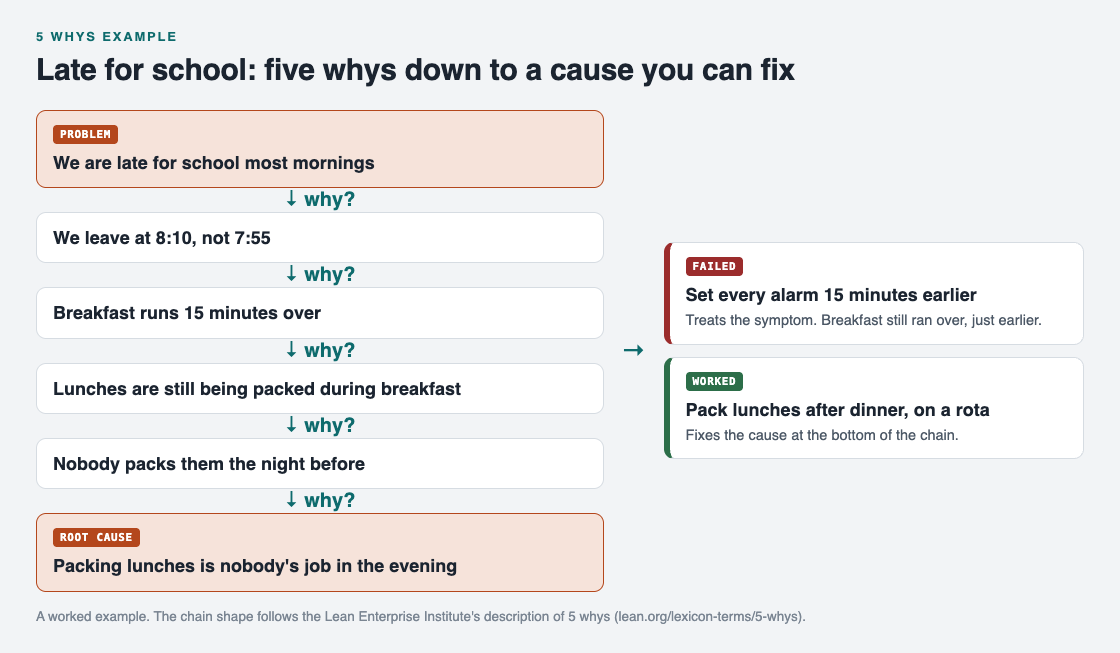
Each why moves one step down. The fix that works targets the bottom of the chain.
The problem, in one line: we are late for school most mornings.
- Why are we late? We leave at 8:10, not 7:55.
- Why do we leave at 8:10? Breakfast runs 15 minutes over.
- Why does breakfast run over? Lunches are still being packed during breakfast.
- Why are lunches packed in the morning? Nobody packs them the night before.
- Why does nobody pack them? Packing lunches is nobody's job in the evening.
Look at the fix the family tried first: set every alarm 15 minutes earlier. It targets step 1, the symptom. Breakfast still ran over, just earlier, and they were still late. Mark that one as failed.
The second fix targets step 5: pack lunches after dinner, with a rota for who does it. That removes the cause, so the chain above it falls apart. Breakfast no longer runs over, and leaving at 7:55 becomes normal. Mark that one as worked.
How to tell you have reached the root cause
You can stop asking why when the answer passes three tests:
- You can act on it. "Packing lunches is nobody's job" is something you can change tonight. "Mornings are hard" is not.
- Removing it removes the problem. Ask: if this cause were gone, would the problem at the top stop? If yes, you are there.
- The next why leaves your reach. If one more why lands on something outside your control, like the school's start time, go back one step.
The Lean Enterprise Institute frames the aim as preventing "the problem from recurring by eliminating its underlying causes". That is your test for the fix, too. A good fix means the problem stops coming back, not just that today went better.
Where the 5 whys goes wrong
The method is simple, which makes it easy to do badly. Watch for these mistakes:
- Guessing instead of checking. The Lean Enterprise Institute's problem solving page says every cause should rest on "verifiable facts, not assumptions", and suggests asking "How do you know that?" (Lean Enterprise Institute, Problem Solving). Before you write "breakfast runs over", time it for two mornings.
- Blaming a person. "Because Sam is slow" ends the chain without a fix. Ask why the routine lets one slow step make everyone late.
- Stopping at one chain. Some problems have two causes. If the first fix only partly works, run the whys again from the top and see where the chain splits.
- Never checking the fix. Write down when you will look again. In the plan, do, check, act cycle, check means evaluating the results, and act means keeping the change or starting again (Lean Enterprise Institute, PDCA).
Keep the chain and your fixes on one map
A 5 whys chain on a scrap of paper gets lost. Then the problem returns, and you start from zero. It helps to keep the chain, the fixes you tried and their outcomes in one place, the same way you would in a problem solving journal.
Problem Graph works well for this. Here is the late for school example as a map:
- Write the top problem in one line, "We are late for school most mornings", and put it in the personal lane.
- Add each answer in the chain as its own problem and link them in order, so the map shows the path from symptom to cause. Problems can link even across lanes, so a work cause can sit under a home problem.
- Attach the two fixes as solutions. Mark the earlier alarms as failed and the lunch rota as worked. The home page says a failed solution stays on the map as a failed solution, so next term nobody suggests the alarms again.
- If the whole family should see it, mark the top problem as a main node and share it into a private network with an invite code. Otherwise it stays private, which is the default.
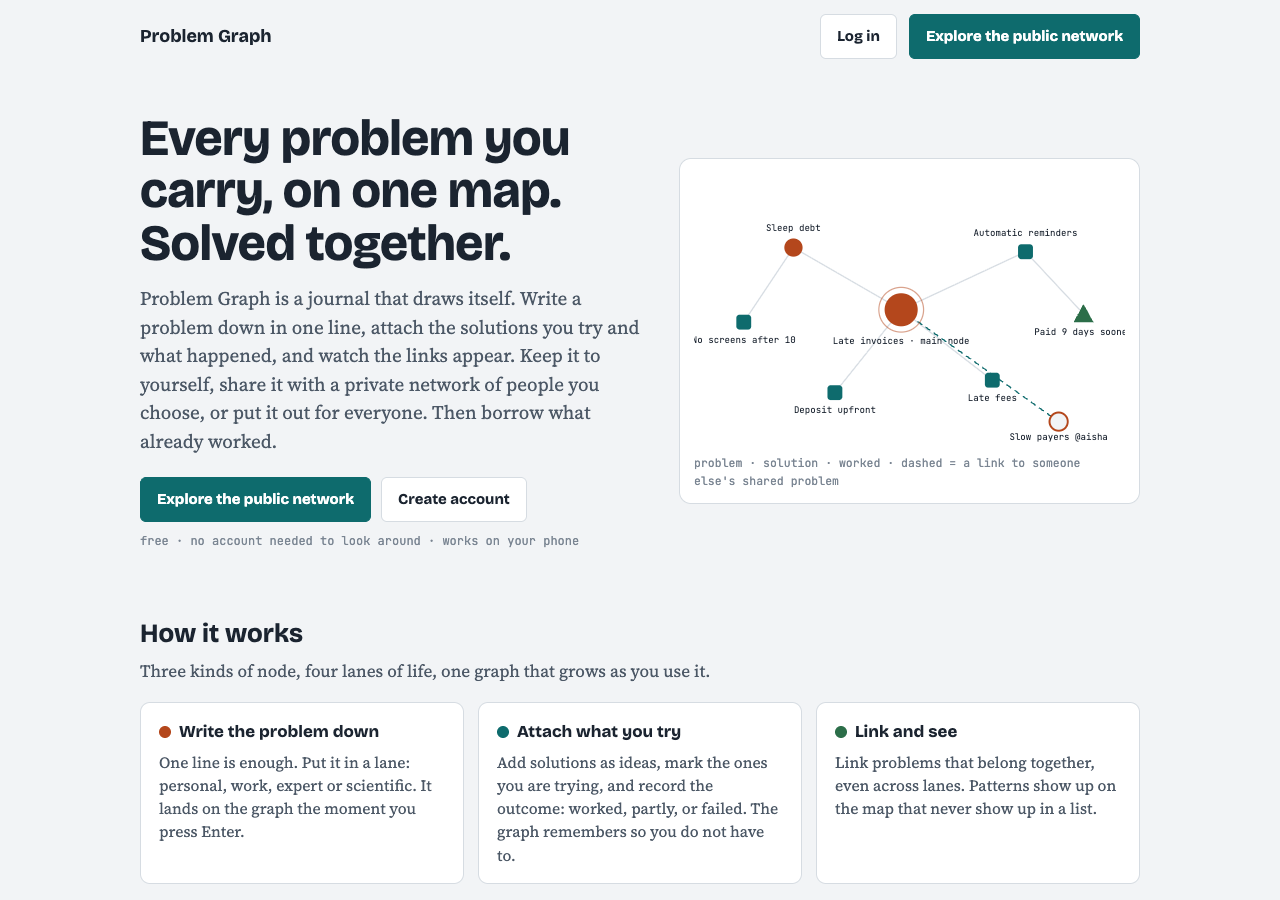
Problem Graph's home page. The map on the right is the site's own example drawing.
Frequently asked questions
Do I have to ask why exactly five times?
No. The Lean Enterprise Institute says the number five is not the point. Keep asking until you reach a cause you can remove.
Can I use the 5 whys for personal problems?
Yes. It is plain logic, so it works on routines, habits and home life as well as machines. If a problem is weighing on your mood, the NHS page on tips to reduce stress is a better first stop.
What if one why has two answers?
Follow each answer as its own chain. Two chains often mean two causes, and you may need a fix for each.
What is a good 5 whys example for work?
The classic one is Taiichi Ohno's stopped machine, which ends at a missing strainer rather than a blown fuse. It shows why fixing the first answer lets the problem come back.
Get started
Pick one problem that keeps coming back. Write it in one line, ask why until you reach something you can change tonight, and write down the fix you will try and when you will check it.
Try Problem Graph: it is free, and you can look around the public network without an account. Write one problem down in a line and attach the first thing you will try.
Comments
No comments yet.
Sign in or make an account to comment.