5 whys or fishbone: which one to use for your problem
5 whys or fishbone: the short answer
If you are stuck choosing between 5 whys or fishbone, it comes down to one question: do you think there is one chain of causes, or several areas it could come from? Use the 5 whys when you suspect a single chain of causes. Use a fishbone diagram when the causes could come from several areas at once and you do not yet know which.
That is the whole decision. The rest of this post shows how each method works, how to pick in under a minute, and how to use both on the same problem.
What the 5 whys method does
The 5 whys is a chain. You state the problem, ask why it happened, then ask why about the answer. You repeat until you reach a cause you can act on. The Lean Enterprise Institute says the specific number five is not the point: keep asking until the root cause is reached.
It works best when:
- The problem is narrow and recent.
- You were there, or you can ask someone who was.
- You think one thing led to another.
Its weakness is that it follows only one path. If you answer the first "why" with the wrong guess, every later answer builds on it. You can also stop too early and blame a person or a bad day instead of a cause you can fix.
What a fishbone diagram does
A fishbone diagram, also called a cause and effect diagram, is a spread. You write the problem at the head of the fish. Then you draw bones for categories of causes and list possible causes on each bone. The Lean Enterprise Institute names categories such as people, equipment, materials, environment and methods, and you brainstorm the possible causes within each one. You can rename the categories to fit your problem.
It works best when:
- The problem is broad or keeps coming back.
- Several people see different causes.
- You want to avoid fixating on the first idea.
Its weakness is that it lists possible causes without telling you which one is real. A full fishbone can look thorough and still leave you with twenty guesses and no next step.
5 whys vs fishbone: side-by-side comparison
- Shape: 5 whys is a line. Fishbone is a branching tree.
- Question it answers: 5 whys asks "what led to this?" Fishbone asks "where could this come from?"
- Best for: 5 whys suits a single event. Fishbone suits a recurring or messy problem.
- Time needed: 5 whys can take ten minutes alone. Fishbone is better with a few people and more time.
- Main risk: 5 whys can lock onto a wrong first answer. Fishbone can end in a long list with no priority.
- Output: 5 whys gives you one root cause. Fishbone gives you a set of candidate causes to test.
How to choose: questions to ask about your problem
Ask these four questions about your problem.
- Did it happen once, or does it repeat? Once points to 5 whys. Repeating points to fishbone.
- Do I already have a strong guess? If yes, test it with 5 whys. If no, widen the search with a fishbone.
- Is more than one person or area involved? If yes, a fishbone helps everyone put their view on the page.
- Do I need a cause I can act on today? If yes, 5 whys gets you there faster.
If your answers split, do not agonize. Start with the fishbone to widen, then run 5 whys on the most likely bone.
Worked example: the same problem solved both ways
Take a problem like this: "Client invoices keep getting paid late."
With 5 whys
Pick one late invoice and ask why.
- Why was it paid late? The client's accounts team did not see it until after the due date.
- Why did they not see it? It went to a general inbox, not to accounts.
- Why did it go there? That was the only address on file.
- Why was it the only address? Our onboarding never asks the client for a billing contact.
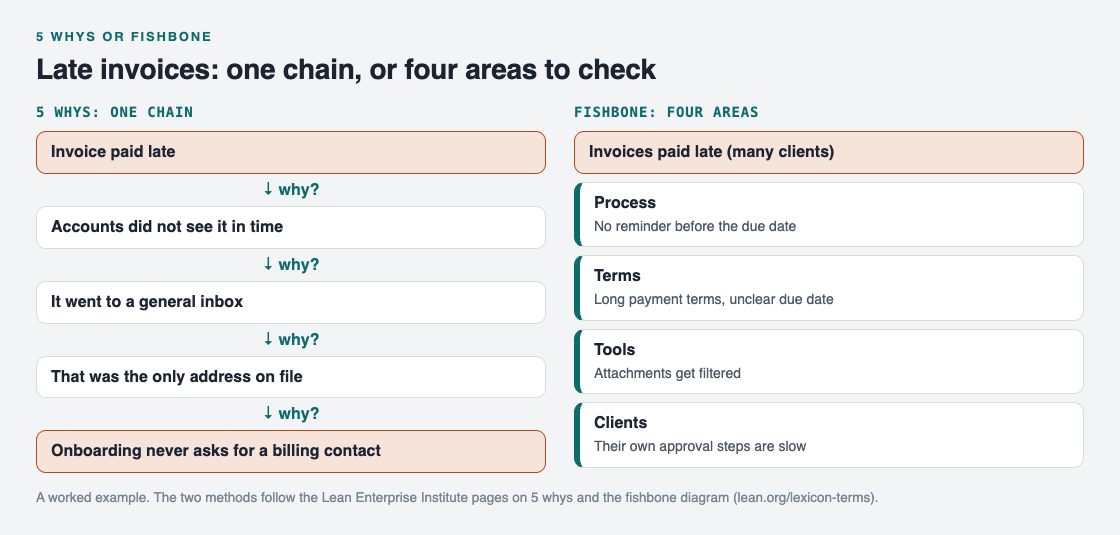
The cause you can act on: add "get a billing contact" to onboarding. That is a clean, single fix.
With a fishbone
Now say the late payments happen across many clients, and the 5 whys on one invoice does not explain the rest. Draw the fish with the head "Invoices paid late" and bones like these:
- Process: no reminder before the due date, no billing contact collected.
- Terms: long payment terms, unclear due dates on the invoice.
- Tools: invoices sent as attachments that get filtered.
- Clients: their own approval steps are slow.
Now you have several candidates. Pick the one you can test cheapest, try a fix, and note what happened. That is where the two methods meet.
When to combine 5 whys and fishbone
The Lean Enterprise Institute describes the two working together: once the fishbone lists the causes, you analyze them, for example with the 5 whys. So use both in order. Start with a fishbone to spread out the possible causes, so you do not chase your first guess. Then pick the one or two most likely bones and run the 5 whys down each. The fishbone protects you from a narrow search. The 5 whys protects you from a shallow list.
Then write down what you tried and what came of it. A cause is only a guess until a fix based on it works or fails. A fix that failed is useful information, because it tells you that cause was probably not the real one.
This is where a map helps more than a page of notes. In Problem Graph, you write the problem in one line, attach each solution you try, and mark the outcome as worked, partly or failed. You can also link related problems, even across lanes. If "late invoices" and "cash is tight at month end" both sit on your map and you link them, the pattern shows up in a way a list would not. For causes you find, you can add each as its own problem and link it to the main one.
The app also keeps failed attempts on the map. Its own words: "The graph is honest. A solution that failed three times stays on the map as a failed solution, and that is exactly what the next person needs to know." That fits root cause work well, since a failed fix rules a cause in or out.
Problem Graph also shows you similar problems other people have shared, in any lane, and which of their solutions worked, when there are any. You can borrow one into your own graph and it keeps a link back to where it came from. You can also ask the AI for suggestions grounded in what worked for others on similar problems. Treat those as proposals to test, not answers.
To see each method on its own, read our 5 whys example and our fishbone diagram example.
Frequently asked questions
Is the 5 whys better than a fishbone diagram?
Neither is better in general. The 5 whys is faster for a single, recent event. A fishbone is better when the problem is broad, repeats, or has several possible sources.
Do I have to ask why exactly five times?
No. Five is a rule of thumb. Stop when you reach a cause you can act on, even if that is the third or seventh answer.
Can I use a fishbone alone?
Yes, but it gives you possible causes, not confirmed ones. You still need to test the likely causes, or follow one down with the 5 whys.
How do I know if I found the real root cause?
Try a fix and see what happens. If the problem stops or shrinks, the cause was likely right. If not, record the failed fix and go back to the other candidates.
Get started
Pick one problem you have been circling. Run the 5 whys if it is a single event, or sketch a fishbone if it keeps coming back. Then put the problem and the first fix you will try on a map, and mark how it turns out.
Try Problem Graph: it is free, and you can look around the public network without an account. Write one problem down in a line and attach the first thing you will try.
Comments
No comments yet.
Sign in or make an account to comment.