A reading list for a topic you are learning: how to build one
A reading list for a topic you are learning is a short, ordered set of sources you commit to before you start, so you stop hopping between tabs and start building understanding. Pick one goal, one overview, a mix of source types, and an order from broad to deep. Then keep notes as you go. If you want a place to keep that list and the notes behind it, Electrified lets you make an account and write on your own page, where you can turn what you learn into articles.
Random reading feels productive. You open a search, read three articles, and each one assumes something the last one skipped. You end up with scraps and no map.
A list fixes three things:
- Order. You meet ideas in the sequence that makes them easier.
- Limits. Ten sources you finish teach you more than fifty you open.
- A finish line. You can see when you are done, and decide what comes next.
The list does not need to be perfect. It needs to exist, and you need to be willing to change it.
Define what you want to learn first
Write one sentence that says what you want to be able to do after reading. "Learn about medieval castles" is a topic. "Explain why castle builders moved from square towers to round ones" is a goal. The second tells you what to look for.
Try this prompt on yourself:
I want to be able to ___ within ___ weeks, so that I can ___.
For example: "I want to be able to explain why castle design changed within four weeks, so that I can follow a history book on fortification." Now you can test every source against that sentence. If it does not help you do that, it is not on the list yet.
Start with one beginner friendly overview
Your first item should be a single, readable overview. It gives you the vocabulary and the shape of the field. You are not trying to master anything yet. You are trying to learn which terms matter.
While you read it, underline every term you cannot explain. That list of terms becomes your search guide for the rest of the reading. Pick an overview that opens with the answer and then works through an example, so you can check the terms against something concrete.
Choose a mix of sources: books, papers, and articles
Each type does a different job. Use a mix.
- Books give you structure and depth. Pick one or two, not ten.
- Papers or primary sources show you where claims come from. Read the abstract and introduction first. You do not have to read every page.
- Articles and guides are fast, current, and good for filling gaps between the heavy items.
- Arguments from the other side. Add at least one source that disagrees with your main book. It tests what you think you know.
A primary source can be old and still be the right pick. Reading a guide to it first gives you the context to read the original with.
Order your list from broad to deep
Sort your sources into three bands:
- Orientation. The overview and one or two short articles. Aim to finish these in the first few days.
- Core. The main book and the best two or three articles. This is where most of your time goes.
- Depth. Papers, primary sources, and the opposing view. Read these only after the core makes sense.
If a source in the depth band keeps confusing you, move it down, not out. Often you just need one more core item first.
A reading list for a topic you are learning: a template to copy
Here is a layout you can paste into any notes app. Keep it short.
- Goal: one sentence, as above.
- Deadline: a date you will review the list, not a date you must finish everything.
- Orientation: 1 overview, 1 to 2 short articles.
- Core: 1 to 2 books, 2 to 3 articles.
- Depth: 1 to 3 papers or primary sources, 1 opposing view.
- Open questions: things you still cannot answer.
Cap the whole list at about eight to twelve items. A list longer than that turns into a wish list, and a wish list does not get read.
Track notes and progress as you read
For each source, write three lines when you finish:
- The main claim, in your own words.
- One thing that surprised you or that you doubt.
- One question it raised.
Then check the question against your goal sentence. Does it belong on the list? If so, add a source that answers it.
One of the best ways to find the gaps in your understanding is to write the idea up for someone else. On Electrified, you can write a note of up to 500 characters with no title, or an article with a title and as many sections as it needs. You can save an article as a draft first. A draft is seen only by you until you publish it, so it works as a private notebook that you can turn into a post later. Each post can carry up to 5 topics of your choosing, and each topic links to a page of every post about it, so a run of articles on one subject ends up filed together. If you want ideas for how others structure study notes, the knowledge building topic page collects posts on that theme.
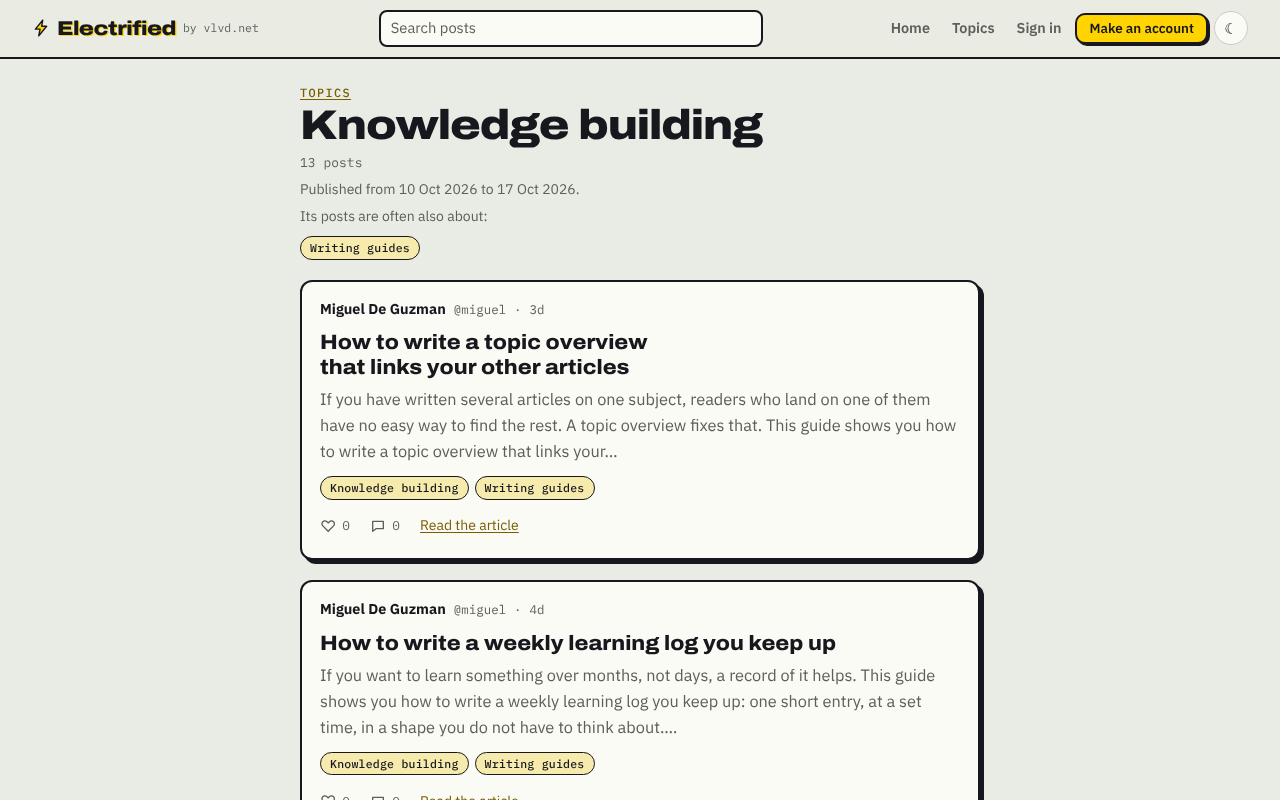
The knowledge building topic page on Electrified, with every post filed under that topic.
A shared list works too when you learn with others. A group that keeps one reading list together avoids the problem of everyone reading something different.
Know when to cut, swap, or finish a book
You are allowed to stop reading. Use these checks:
- Cut a source if, after 30 pages or the first section, you cannot say what it is trying to teach you.
- Swap a source if it assumes knowledge you do not have. Find an easier one on the same point and come back later.
- Skim a source if you only need one chapter. Read the contents page and take that chapter.
- Finish a source when the end still answers a question on your open list.
At your review date, reread your goal sentence. If you can do what it says, the list has done its job. Write the next goal and build a new list.
Frequently asked questions
How many sources should a reading list have?
Eight to twelve is enough for most topics. That gives you an overview, a couple of core items, and a few deeper sources without becoming a pile you never finish.
Should I read one book at a time or several?
One main book at a time works best, with short articles on the side. Reading several heavy books together makes it harder to keep track of what each one claimed.
What if I find a better source halfway through?
Swap it in and drop the weaker one. A list is a plan you update, not a promise you have to keep.
How do I know the list worked?
Go back to your goal sentence and try to do what it says without looking anything up. If you can explain the topic to someone else in plain words, it worked.
Get started
Write your goal sentence, pick one overview, and fill in the template above. Then, as you finish each source, write up what you learned. Make an account on Electrified to get your own page, where your notes and articles live and where you can follow people and write a run of articles on the topic at your own pace.
Comments
No comments yet.
Sign in or make an account to comment.