Abraham Lincoln and the Civil War: Preserving the Union
Abraham Lincoln and the Civil War are bound together: he led the United States through the war (1861 to 1865) with one aim above the rest: to preserve the Union. As the war went on, that aim carried him toward ending slavery. He was elected president in 1860, issued the Emancipation Proclamation in 1862, backed the Thirteenth Amendment in 1865, and was assassinated that April, days after the war effectively ended.
If you want to place Lincoln among the other leaders of that age, Learn 100 Influential People includes him in its Age of Revolutions course, in short lessons with questions that check what you remember.
The road to the presidency
Lincoln was born on 12 February 1809 in a one-room log cabin near Hodgenville, Kentucky. His family moved to Indiana and then Illinois, and he worked as a railsplitter, a flatboatman, a shopkeeper and a postmaster before turning to the law. He won a seat in the Illinois legislature in 1834, was admitted to the bar in 1836 and won a seat in the US House of Representatives in 1846 and left it in 1849.
What turned him into a national figure was slavery. World History Encyclopedia says the recent acquisition of 525,000 square miles of land from Mexico made the dispute over whether slavery could spread into the new territory worse. In October 1854, Lincoln delivered his Peoria Speech, condemning the institution of slavery publicly for the first time. At that point he did not favor total emancipation. Like many antislavery politicians, he wanted to contain slavery to the places where it already existed, but he saw it as a moral evil that clashed with the Declaration of Independence.
From the House Divided speech to the 1860 election
In 1856 Lincoln helped organize the new antislavery Republican Party in Illinois. Two years later the party chose him to run for the Senate against the Democrat Stephen A. Douglas. He accepted with his famous House Divided speech: "A house divided against itself cannot stand." The campaign included seven debates with Douglas, which were highly publicized across the country. Lincoln lost the election, but the debates put him in the national spotlight, and a speech at Cooper Union in Manhattan in February 1860 raised his profile further.
In May 1860 the Republican convention in Chicago nominated him on the third ballot. He was less known than rivals like William H. Seward and Salmon P. Chase, but that also meant he had less political baggage. In the four-way general election that followed, he won, though he received no votes at all in ten Southern states.
Secession and the first shots
The election alarmed the slaveholding South, which feared that Lincoln and the Republicans would use the federal government to end slavery. South Carolina voted to secede on 20 December 1860, and six other states of the Deep South followed. Lincoln denounced secession as illegal, but he could do nothing until he was sworn in on 4 March 1861. World History Encyclopedia says he had to sneak into Washington because of the many threats against his life.
He chose his former rivals for the nomination, Seward and Chase, as secretary of state and secretary of the treasury. In April 1861, South Carolina secessionists fired on the federal garrison at Fort Sumter. Lincoln called for 75,000 volunteers, and four more states of the Upper South then seceded and joined the Confederate States. He ordered a blockade of Confederate ports and sent an army into Virginia, which was routed at the First Battle of Bull Run on 21 July.
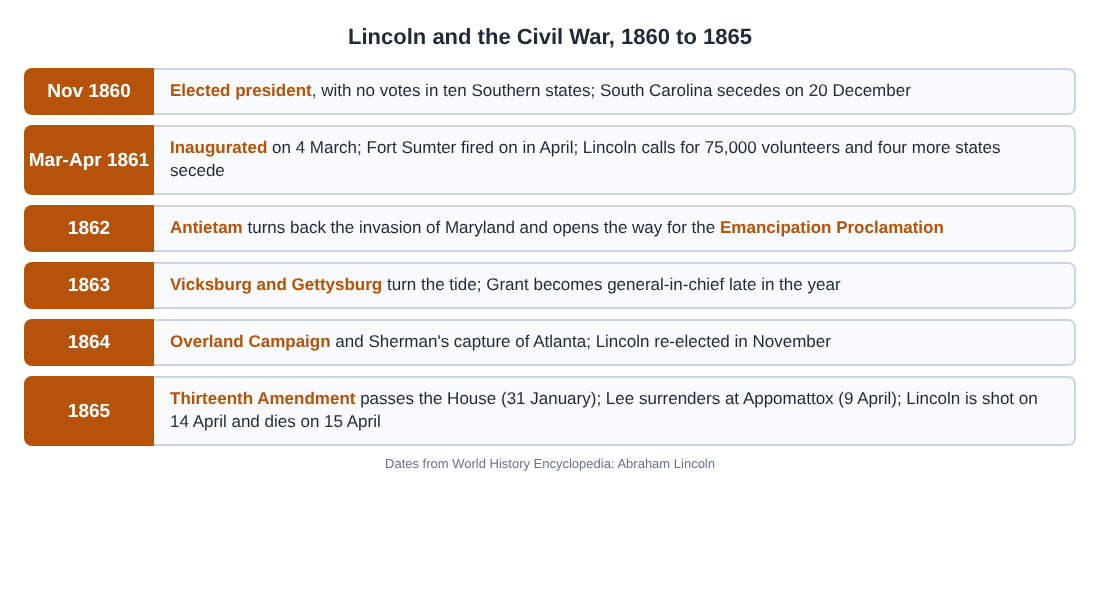
The main steps of Lincoln's war years, from World History Encyclopedia.
Abraham Lincoln and the Civil War: how he tried to preserve the Union
World History Encyclopedia says Lincoln was determined to preserve the Union at all costs. In the Gettysburg Address he said the nation had been "conceived in Liberty, and dedicated to the proposition that all men are created equal". He judged that the stakes were the future of humanity, not only of one country, and he used his executive powers to the fullest extent. Three examples show what that meant in practice:
- Habeas corpus. He suspended it and arrested thousands of suspected Confederate sympathizers.
- Foreign policy. He centered it on the war and did his utmost to keep the European powers neutral.
- Strategy. As commander-in-chief he worked with his cabinet and generals on a plan that defended the capital, Washington, while acting with aggression elsewhere.
The suspension of habeas corpus is one of the points where people still disagree about whether the means matched the aim. The source reports the fact and does not settle the argument, and neither does this post. You can hold both ideas: he thought the Union's survival justified these powers, and that is exactly what critics question.
Generals, setbacks and turning points
Lincoln's early generals disappointed him. In late 1861 he made George B. McClellan general-in-chief of the Union armies. McClellan was popular with the army but over-cautious, and he kept clashing with Lincoln over strategy. After defeats in 1862 at the Seven Days Battles and the Second Battle of Bull Run, a Confederate invasion of Maryland was turned back at Antietam, but too narrowly for comfort, and Lincoln fired McClellan.
The war turned in 1863. The capture of Vicksburg, Mississippi, effectively cut the Confederacy in two, and the Union victory at Gettysburg destroyed the hope of a successful Confederate invasion of the North. Lincoln appointed Ulysses S. Grant general-in-chief in late 1863. Grant shared Lincoln's belief that the war could only be won through aggression, and he launched the Overland Campaign toward Richmond the next spring. At the same time, General William Tecumseh Sherman captured Atlanta.
Emancipation: what the proclamation did and did not do
Antietam gave Lincoln the opening to issue the Emancipation Proclamation. It freed all the slaves in the rebellious states, though it did nothing for those in the loyal border states. Even so, World History Encyclopedia says, it brought the issue of slavery to the forefront of the war and redefined the conflict as a moral one.
In the last months of the war, Lincoln took more antislavery steps, urged on by the Radical Republicans in his party. He allowed Black soldiers into the federal army and signed the Freedmen's Bureau Bill, which set up a temporary agency to help former slaves move into freedom. After his reelection he pressed Congress to abolish slavery nationwide, and on 31 January 1865 the House passed the draft of what became the Thirteenth Amendment. In his second inaugural address on 4 March 1865, he suggested the war had been divine punishment for slavery.
As the election of 1864 loomed, war weariness grew in the North. Despite Grant's and Sherman's successes, the rising death toll led many Northerners to ask for a negotiated peace, but Lincoln would accept nothing less than total victory. He and his allies ran for a time as the National Union Party, with the Southern Democrat Andrew Johnson as vice president, and in November he handily defeated McClellan.
On 9 April 1865, General Robert E. Lee surrendered to Grant at Appomattox. Lincoln gave his last speech on 11 April and spoke of the difficulties of Reconstruction ahead. On 14 April, he was shot in the back of the head at Ford's Theatre by John Wilkes Booth, an actor and Confederate sympathizer. He died the next morning at the age of 56.
A worked example: build a one-page Lincoln chart
Here is a method to learn this period in ten minutes. Draw three columns: Aim, Means and Cost.
- Aim: write "preserve the Union" at the top. Below it, add "end slavery" and note the year it entered his policy, 1862.
- Means: list the blockade, the call for 75,000 volunteers, Grant's appointment, the Emancipation Proclamation and the Thirteenth Amendment push.
- Cost: next to each, note what it cost or limited. The habeas corpus arrests, the border states left out of the proclamation and the long death toll that caused war weariness all belong here.
Reading across the columns shows why historians argue about Lincoln: the same man shows up in every column, and no single column tells the whole story.
Frequently asked questions
Did Lincoln start out wanting to end slavery?
Not fully. By 1854 he called slavery a moral evil, but he wanted to contain it where it already existed, as many antislavery politicians did. Total emancipation came as the war went on.
Did the Emancipation Proclamation free every slave?
No. It freed the slaves in the rebellious states, not in the loyal border states. The Thirteenth Amendment, which the House passed on 31 January 1865, was meant to abolish slavery nationwide.
How did the Civil War end?
General Robert E. Lee surrendered to Grant at Appomattox on 9 April 1865, effectively ending the war. Lincoln was shot five days later.
Why did Lincoln suspend habeas corpus?
He judged that the stakes of preserving the Union justified using his executive powers to the fullest extent, and he arrested thousands of suspected Confederate sympathizers. People still debate that choice.
Get started
If you want Lincoln in a short, structured form, Learn 100 Influential People puts him in the Age of Revolutions course, alongside Washington, Jefferson, Napoleon, Bolivar and Toussaint Louverture. The lessons last about 9 minutes, and the site sets out where researchers disagree and lists the sources for every lesson. You sign in with your email and an emailed sign-in code to keep your progress. You can see how it handles your data on the privacy page, or read more on the about page.
Start Learn 100 Influential People: short hands-on lessons on the people who shaped history, with every side of the debate and the sources to read next.
100 people who shaped history, from Moses to the web.
Visit influentialpeople.vlvd.net↗
Comments
No comments yet.
Sign in or make an account to comment.