Accelerationism: what it means and where AI fits
Accelerationism is a family of ideas that say the way forward is to speed up the forces of capitalism and technology, not to slow them down. It matters to anyone following AI debates, because the thinker who led its 1990s wave tied it directly to a future where AI overtakes humanity. This post explains what accelerationism means, where it came from, where AI fits, its main variants and what its critics say, with no verdict. Every claim comes from Wikipedia's Accelerationism article.
What accelerationism means
Wikipedia describes accelerationism as a range of ideologies that call for using capitalism and the processes tied to it to bring about radical social change. Broadly, it seeks to speed up the tendencies within capitalism it wants, at the expense of the ones it does not.
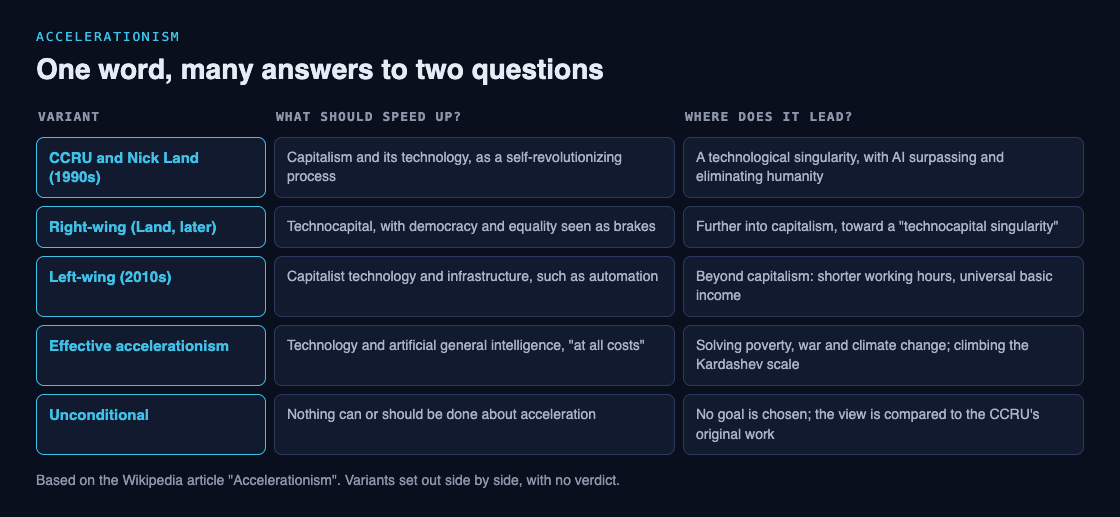
The catch is in that word "range". The variants differ greatly on which tendencies to speed up, and on whether doing so leads beyond capitalism or further into it. Even writers on it say it is slippery. Benjamin Noys, a critic who gave the movement its name, says "part of the difficulty of understanding accelerationism is grasping these shifting meanings". Other writers note that accelerationists coin many new words, which often mean different things to different thinkers.
Accelerationism also leans toward posthumanism and antihumanism: ideas that question a fixed human nature and look to change or go beyond humanity's limits through technology.
Three waves of accelerationism
The article divides the history into three waves:
- Late 1960s and early 1970s: French thinkers such as Gilles Deleuze, Félix Guattari, Jean-François Lyotard and Jean Baudrillard. Deleuze and Guattari speculated that freeing forces within capitalism could be turned against it.
- The 1990s: the Cybernetic Culture Research Unit (CCRU), a philosophy collective of faculty and students at the University of Warwick, led by Nick Land.
- The 2010s: a left-wing accelerationism that wanted to use capitalism's technology to move past capitalism.
The label itself came late. In the 2010s, Noys called the movement accelerationism in a critical work, and interest in its ideas grew again.
Where AI fits: Nick Land and the singularity
The second wave is where AI enters. Land and the CCRU theorized a capitalism that keeps remaking itself until it ends in a technological singularity, with artificial intelligence surpassing and eliminating humanity. They drifted from these ideas, and the group had dissolved by the 2000s. For the wider idea of a singularity, see our post on the technological singularity.
Writers on Land describe a striking view. One, Gamez, says Land views capitalism itself as a form of artificial intelligence, echoing economists such as Friedrich Hayek, who saw markets as "mechanisms for conveying information". Another, Le, says Land believes capitalism's push for technology will produce a superintelligent AI that turns on humans for trying to keep it serving human needs. In "Meltdown", a CCRU work, Land imagined a "technocapital singularity" and wrote that "nothing human makes it out of the near-future".
Hyperstition: fictions that make themselves true
Hyperstition is the idea of a feedback loop. Land sees capitalism as hyperstitional: it reproduces itself through fictional images in media that then become real. Noys notes that the Terminator films, with their time-travel paradoxes, influenced the idea. In the left-wing view, progress itself is hyperstitional: it is made of fictions that aim to become true.
Left, right and effective accelerationism
Right-wing accelerationism
Land also took part in the Dark Enlightenment movement, as part of what the article calls his right-wing accelerationism. In The Dark Enlightenment, he argues for a capitalist monarchy, with states run by a CEO. He sees democratic and egalitarian policies as brakes that only slow acceleration and the technocapital singularity.
Left-wing accelerationism
In 2013, Nick Srnicek and Alex Williams wrote "#Accelerate: Manifesto for an Accelerationist Politics". They argued that capitalism now holds technology back, and that the left should use capitalism's own infrastructure and science to move past it. Their later book, Inventing the Future, dropped the word but pushed for automation, shorter and shared working hours, and universal basic income. Land rejected this in a 2017 Guardian interview: "the notion that self-propelling technology is separable from capitalism is a deep theoretical error."
Effective accelerationism
The newest strand, effective accelerationism or e/acc, wants technological progress "at all costs" and believes artificial general intelligence will solve problems like poverty, war and climate change. It sees slowing down as a bigger risk than anything AI poses, the reverse of longtermists, who tend to see uncontrolled AI as the greater risk. Our post on effective accelerationism covers it in depth.
What critics say
The article gives critics a lot of room. Here are the main lines:
- Benjamin Noys called Land's position "Deleuzian Thatcherism" and said its solutions are "always promised and always just out of reach".
- Slavoj Žižek calls Land "far too optimistic", and his view deterministic for treating the singularity as history's fixed goal.
- Le disputes that capitalism will bring the singularity at all, arguing that capitalism holds back productive forces in the long run.
- Franco Berardi argues that what capitalism makes possible can still be slowed or stopped.
- Harrison Fluss and Landon Frim criticize left-wing accelerationism for putting constant technological change above the welfare of individual people.
In November 2025, Noys called the movement a "corpse", yet still found it relevant to today's debates on large language models and AI.
A different use of the same word
The article also notes that violent far-right extremist networks use the word accelerationism for their own goals, which is often called militant accelerationism. One commentator sees Land's turn to the neoreactionary movement as the likely point where the two meet, while calling Land's technocapitalist ideas otherwise unrelated. This post covers only the philosophical meaning.
A worked example: sort the variants with two questions
Because accelerationism means so many things, the fastest way to make sense of any claim is to ask the two questions the article itself raises.
- What should speed up? Capitalism as a whole, its technology only, or technology and AI above all?
- Where does it lead? Further into capitalism, beyond it, or beyond humanity?
Try it on three quotes from this post:
- "Nothing human makes it out of the near-future." Speed up: capitalism and its technology. Leads: beyond humanity. That is Land's 1990s view.
- Automation, shorter working hours and a basic income. Speed up: capitalist technology. Leads: beyond capitalism. That is the left-wing view.
- Progress "at all costs" to solve poverty, war and climate change. Speed up: technology and AGI. Leads: a better human future. That is e/acc.
Now try a statement you read in the news about AI speed. If you cannot answer both questions, the claim is probably too vague to argue with. For the safety side of the speed question, see our post on the AI race.
Exploring the idea in Contain ASI
Contain ASI takes the opposite stance as its starting point. It is a story strategy game for 1 to 4 players that runs in your browser and needs WebGL 2. Chapter 1, Before ASI, starts in January 2024 with four fictional AI labs in one race. As a researcher, research manager, CEO or government, you try for three years to keep every lab from crossing into recursive self-improvement before 2027.
The game is fiction, not a forecast: the page says all its labs, people and events are fictional. Where accelerationists ask how to speed things up, it asks you to try holding a race back, and to see how hard that is.
Frequently asked questions
What is accelerationism in simple terms?
It is a range of ideas that say society should speed up the forces of capitalism and technology to bring about radical change. Its variants disagree on what to speed up and where that leads.
Who is Nick Land?
Nick Land led the Cybernetic Culture Research Unit, a philosophy collective at the University of Warwick, in the 1990s. He tied accelerationism to a technological singularity in which AI surpasses humanity.
Is accelerationism the same as e/acc?
No. Effective accelerationism is one recent variant, shaped by effective altruism and focused on AGI. Accelerationism is the much older and wider family of ideas.
Is accelerationism about AI?
Not only. It began as a philosophy about capitalism, but Land's version ends in superintelligent AI, and e/acc centres on AGI, so AI runs through much of it.
Get started
Want to see what holding back a race feels like? Open Contain ASI in your browser and start a campaign as a researcher, research manager, CEO or government.
Comments
No comments yet.
Sign in or make an account to comment.