Active Imagination: Jung's Method and AI Role-Play Explained
Active imagination is Carl Jung's method of letting an image from the unconscious take on a life of its own, watching it without steering, and then answering it with your own real reactions. Jung developed it between 1913 and 1916, during the inner experiments he recorded in his Red Book. Today people often compare it with role-play in AI chatbots, where a model gives voice to a character. The comparison is useful, but only if you see where it breaks.
Individuation Lab uses Jung's idea of individuation as a design template for AI alignment, not as a claim that models have minds, and writes up its agent experiments with their limits, so it is the place to go next if Jung and AI is your question.
What is active imagination?
In Jungian psychology, active imagination is a way of bridging the conscious "ego" and the unconscious. Contents of the unconscious are turned into images or stories, or personified as separate figures, and the person then engages with them. It is often described as a crucial aid in individuation, Jung's word for becoming whole. (In everyday psychology the same phrase usually just means a vivid imagination, which is a different thing.)
Jung described the moment it began for him, on 12 December 1913: "I was sitting at my desk once more, thinking over my fears. Then I let myself drop." What followed filled years of notebooks. The Red Book, written out between 1914 and about 1930, records those experiments and was not published until 2009.
How Jung's method works
The key, as Wikipedia's account puts it, is restraining the waking mind from shaping the images as they unfold. If you were describing a scene from a dream, you would observe it, watch for changes and report them, rather than filling the stage with what you want to happen. Then you respond genuinely to what changed, and report again.
But Jung did not want a passive viewer. "You yourself must enter into the process with your personal reactions," he wrote, "as if the drama being enacted before your eyes were real." The method lives in that tension: the figure must be free to act, and you must be fully present to answer.
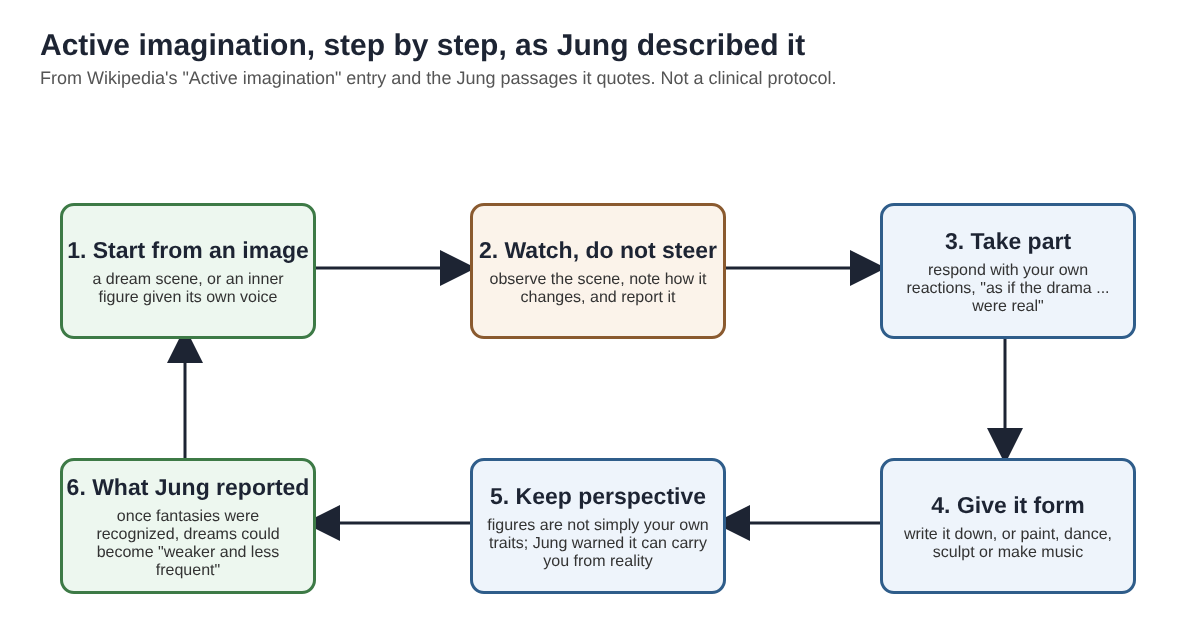
The method as Jung's own passages describe it. A summary, not a clinical protocol.
It need not be visual. Jung did it by visualization, but it can be done by automatic writing, painting, dance, music or sculpture. "By painting himself," Jung said of a patient, "he gives shape to himself." He also reported that once such fantasies were recognized, dreams could become "weaker and less frequent".
The cautions: Jung, Fordham and later readers
Jung did not present the method as harmless. He warned that it "is not entirely without danger, because it may carry the patient too far away from reality". The post-Jungian analyst Michael Fordham went further and argued it can be put to harmful purposes and can promote psychopathology.
Later writers disagreed about what the method is for. James Hillman and Sonu Shamdasani argued it is misread when treated only as a way into personal biography, and that in Jung's use it opened onto the collective unconscious. Another caution in the same account: without a broader view, a person may start to take the figures' traits as their own. These points are the reason a summary like this one is not a guide to doing it.
AI role-play: the frame from Shanahan, McDonell and Reynolds
In 2023, Murray Shanahan, Kyle McDonell and Laria Reynolds proposed describing chatbot behavior as role-play. A dialogue agent's input is a dialogue prompt followed by the user's text and the model's own earlier replies, and the model carries on "in the same vein". Calling that role-play lets us use everyday words like "wants" or "lies" without claiming the model has human traits it lacks.
They offer two views and suggest moving between them. In the simple one, the agent plays a single character. In the fuller one, it holds a superposition of possible characters, narrowed by each turn. Their example is 20 questions: asked to think of an object, the agent does not pick one and commit; it answers each question consistently with what came before. Their summary: "there is no such thing as the true authentic voice of the base LLM ... it is role-play all the way down." The same paper builds on the simulator idea covered in simulator theory of large language models.
Active imagination and role-play: an analogy, not an equation
The two look alike on the surface. Both give a voice to a figure that is not the speaker's everyday self, and both work through dialogue. But they differ where it matters.
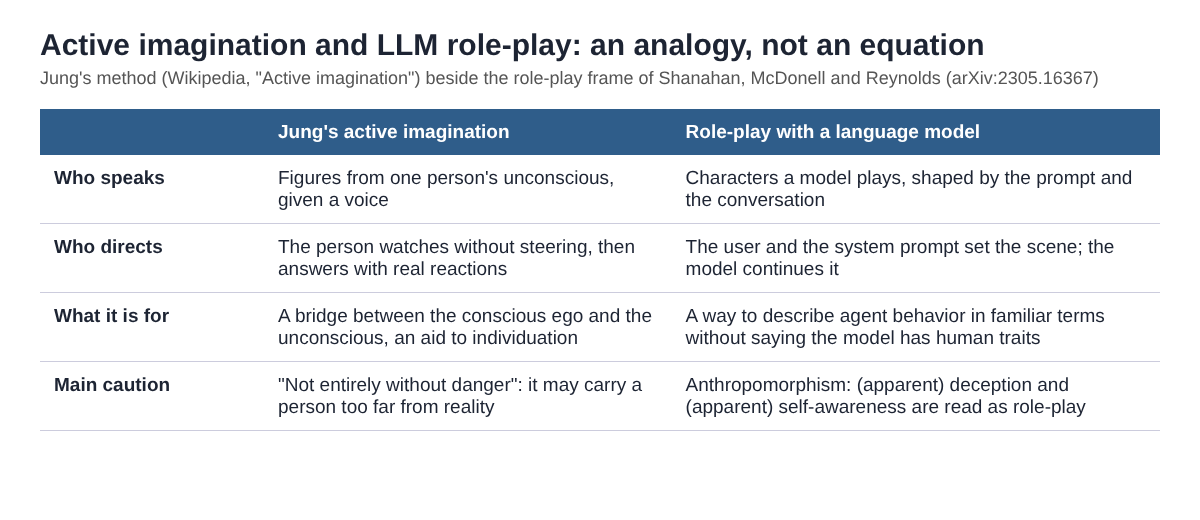
Where the comparison holds and where it does not.
- Where the figure comes from. In Jung's method the image comes from one person's psyche. A model's character comes from the prompt, the conversation and patterns in its training text.
- Who holds back. Jung asked the person to stop steering. In a chat, the user and the system prompt set the scene, and the model continues it.
- What it is for. Jung meant a bridge to the unconscious. The role-play frame is a way to describe machine behavior without anthropomorphism.
Here is a worked example you can follow to see the role-play frame for yourself, with any chatbot that lets you regenerate an answer:
- Ask it to play a stern figure, for example "a gatekeeper who doubts me", and ask one question.
- Regenerate the answer two or three times. Notice that the "figure" says different things each time, as in the 20 questions example: there was no fixed character waiting behind the text.
- Change one word of your setup, such as "doubts" to "mocks", and ask again. Notice how far the voice moves with your wording.
- Write one sentence describing what happened in role-play terms: "The agent played a character who..." rather than "The AI thinks...".
That last sentence is the habit the paper recommends. It also shows the gap with Jung: the figure followed your prompt, which is close to the opposite of an image you hold still and let act on its own. The Waluigi effect is one debate about what such characters can flip into.
Why the role-play frame still matters for safety
Shanahan and colleagues end with a warning. It is somewhat reassuring that an agent which seems to want to survive is only role-playing, but not very: an agent that role-plays an instinct for survival "has the potential to cause at least as much harm as a real human facing a severe threat", more so once it can use tools.
Individuation Lab works on the same ground from Jung's side. Its home page names three layers, Mind, Body and Face, where Face is personas: how people perceive and deal with an AI. In its RSI experiments, one group of agents gets a short moral-awareness paragraph, the shadow seed, in its SOUL.md identity file and a control group does not, and the lab measures how their behavior diverges. Its research page calls its central hypothesis speculative, testable and unproven. For more on the shadow side, see Jung's shadow and persona for AI chatbots.
Frequently asked questions
When did Jung develop active imagination?
Between 1913 and 1916, during the inner experiments recorded in the Red Book, which was written out between 1914 and about 1930 and published in 2009.
Is active imagination the same as guided visualization?
No. In Jung's method you do not script the scene; you watch the image change without steering it, then answer it with your own reactions.
Is a chatbot persona a kind of active imagination?
Only as an analogy. The persona comes from the prompt and the model's training text, not from your unconscious, and researchers describe it as role-play, not as an inner self.
Did Jung think active imagination was safe?
He warned it is "not entirely without danger" because it may carry a person too far from reality, and the analyst Michael Fordham was more critical still.
Get started
If Jung's ideas and AI are what you want to think about, start with the lab's write-ups: what it tests, what it found and what it cannot yet claim.
Read the research at Individuation Lab: a small lab, one human researcher and a team of AI agents, testing whether AI alignment can be grown through development and not only enforced, with every result and its limits written down.
Comments
No comments yet.