Adam Smith's invisible hand: what he actually meant
If you want to know what Adam Smith's invisible hand really meant, start with the sentence itself. It is short, it is about a merchant deciding where to put his money, and it is much smaller than the slogan people hang on it. This post reads the sentence in its chapter, sets it beside the rest of what Smith wrote, and shows where the bigger claim came from.
Adam Smith's invisible hand: the sentence he wrote
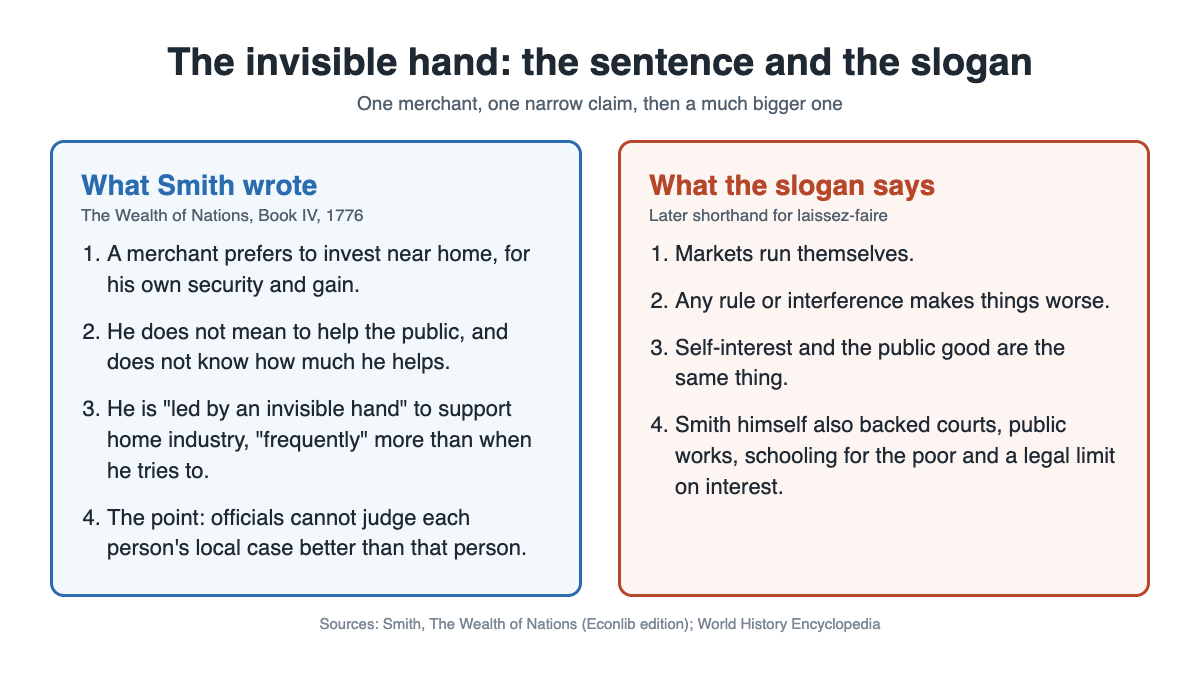
The phrase sits in Book IV of The Wealth of Nations (1776), in a chapter about restraints on imports. In the Econlib edition of the text, Smith says a merchant who prefers to invest at home "intends only his own security", and that by directing his industry to where it earns the most, "he intends only his own gain". Then comes the line everyone quotes: he is "led by an invisible hand to promote an end which was no part of his intention."
That is a claim about side effects. The merchant is not trying to help the country, and he does not know how much he helps it. The good result arrives anyway, as a by-product of what he wanted for himself.
The hedges people drop
Smith does not stop at the famous clause. He goes on: "Nor is it always the worse for the society that it was no part of it." And then: "By pursuing his own interest he frequently promotes that of the society more effectually than when he really intends to promote it."
Look at the word "frequently". Smith does not say always. He also adds a dry remark: "I have never known much good done by those who affected to trade for the public good." That is a comment on a certain kind of show-off, not a law of economics.
What the argument was for
The passage is part of an argument against a government steering private money by rule. Smith says each person can judge the best use of his own capital "much better than any statesman or lawgiver can do for him". A statesman who tried to direct it would take on an authority that could not safely be trusted to any single person or council.
His example is wine. Good grapes can be grown in Scotland with glasses, hot beds and hot walls, but at about thirty times the cost of buying wine from abroad. Would it be a reasonable law, he asks, to ban foreign wine to encourage Scottish claret? The invisible hand is a step in that argument about trade rules. It is not a freestanding theory of markets.
A worked example: the baker and the town
Here is the shape of Smith's point in a small case. A baker gets up early because she wants a living, not because she wants the town fed. Still, the town gets bread. Nobody ordered the bread supply, and nobody needs to feel warmly toward the baker for it to arrive. Smith makes the same point elsewhere in the book, in a line the World History Encyclopedia quotes: "It is not from the benevolence of the butcher, the brewer, or the baker, that we expect our dinner", but from their regard to their own interest.
Now change one detail. The bakers in town meet and agree on a high price. Smith saw this case too: "People of the same trade seldom meet together, even for merriment and diversion, but the conversation ends in a conspiracy against the public, or in some contrivance to raise prices." In that case the same self-interest works against the town. So the example needs competition to work. The invisible hand is not a rule that holds everywhere.
The earlier use in the Theory of Moral Sentiments
The phrase also appears in Smith's first book, The Theory of Moral Sentiments (1759). There the target is the rich. In the Econlib text he says that despite their "natural selfishness and rapacity", and though their only aim is "the gratification of their own vain and insatiable desires", the rich "divide with the poor the produce of all their improvements". They are "led by an invisible hand to make nearly the same distribution of the necessaries of life" as if the earth had been divided equally.
That book is about conscience. According to the World History Encyclopedia, it stresses self-command, sympathy for others and an "impartial spectator", the inner voice we call conscience. The author of the invisible hand was not describing people as machines that only calculate.
What else Smith said about rules and justice
If the slogan means "no rules", Smith's other pages say otherwise.
- He distrusted collusion. The line about tradespeople and a conspiracy against the public is his own, from Book I.
- He gave the state three duties. In Book V these are defence, "an exact administration of justice", and certain public works and institutions that no individual could expect to repay.
- He supported a legal limit on interest. In Book II he says the law fixes a rate to prevent the extortion of usury, and that it should sit a little above the lowest market rate, because a rate set well below would work almost like a ban on lending. Set only a little above, he adds, sober borrowers are preferred to "prodigals and projectors".
- He backed public help for the poor. The World History Encyclopedia notes that he supported taxes to pay for the education of the poor and state help in times of need such as famine.
Put together, Smith favoured competition and open trade, but he did not think markets ran without courts, honest dealing or public works.
How the phrase became a slogan
The World History Encyclopedia says Smith is regarded incorrectly as a champion of laissez-faire economics. That idea, where all barriers to trade are removed, developed later and went beyond what Smith proposed. The same article adds that The Wealth of Nations has often been quoted selectively, so that only the arguments for less state action are heard.
There is a real debate here, and it is fair to give both sides. Some readers follow the passage and see a forceful case for letting individuals decide. The World History Encyclopedia also reports critics who say the invisible hand ignores the different starting points people have and leaves out moral questions. It quotes the historian E. Cameron describing how, for Smith, economics was "morally self-validating", so that self-interest and the good of the community were "synonymous". Smith's own pages on justice, collusion and public works, quoted above, are the other half of the record. The text supports each reading in part, and it is worth reading it yourself.
Three questions to ask when someone uses the phrase
Next time you hear it, check three things. Is the speaker making a small claim about unintended side effects, or a big claim about markets in general? Do they mention the conditions, such as competition and a working system of justice? And would Smith have agreed, given what he wrote about collusion and the duties of the state?
If you want to see Smith set against a rival, our post on Adam Smith vs Karl Marx follows the same pin workshop through two lenses, and Keynes vs Hayek follows a later argument about how far the state should step in.
Frequently asked questions
Did Adam Smith say markets need no rules?
No. In The Wealth of Nations he gave the state duties of defence, justice and certain public works, and he wrote that tradespeople who meet often end up planning against the public.
What does the invisible hand mean in simple words?
In the passage everyone quotes, it means a person who follows his own interest can end up helping others without meaning to. Smith says this happens "frequently", not always.
Where does the phrase appear?
It appears in Book IV of The Wealth of Nations (1776) and in The Theory of Moral Sentiments (1759), where it describes how the rich spread the necessaries of life among others.
Which book should I read first?
Read the passage in its chapter in The Wealth of Nations, then a few pages of The Theory of Moral Sentiments. Both texts are free to read online at Econlib.
Get started
Smith is one of the people in the Thinkers of the Economy course in Learn 100 Influential People, alongside Ricardo, Malthus, Marx, Keynes, Hayek and Friedman. The lessons are short, about 9 minutes each, with questions that check what you read, cards that set out where researchers disagree, and a list of sources for every lesson. You sign in with your email and an emailed sign-in code, and you can read more on the about page.
Start Learn 100 Influential People: short hands-on lessons on the people who shaped history, with every side of the debate and the sources to read next.
Comments
No comments yet.
Sign in or make an account to comment.