AI Alignment Fellowships and Programs for Beginners
If you are searching for AI alignment fellowships and programs for beginners, you are probably asking two things: what is out there, and do I know enough to apply? This guide shows how to read a program listing, which kind of program fits where you are today, and how to prepare so your application shows real understanding.
One note on scope. Dates, length, cost and selection rules change often, so this article does not list named programs or their terms. It teaches you to read the listings and check each program's own page.
AI alignment fellowships and programs for beginners: what they are
AI alignment is the problem of making AI systems do what we intend. A program in this field is any structured way to learn it with other people or with guidance. The field is young and its material is spread over papers and forum posts, so a schedule and some feedback help.
The place to start looking is the Training programs page on aisafety.com. It describes itself as a way to find fellowships, bootcamps and courses in AI safety, online and in person. On 14 October 2026 it counted 91 training programs, 37 of them upcoming. That is a lot to sort, so the next section shows what to read first.
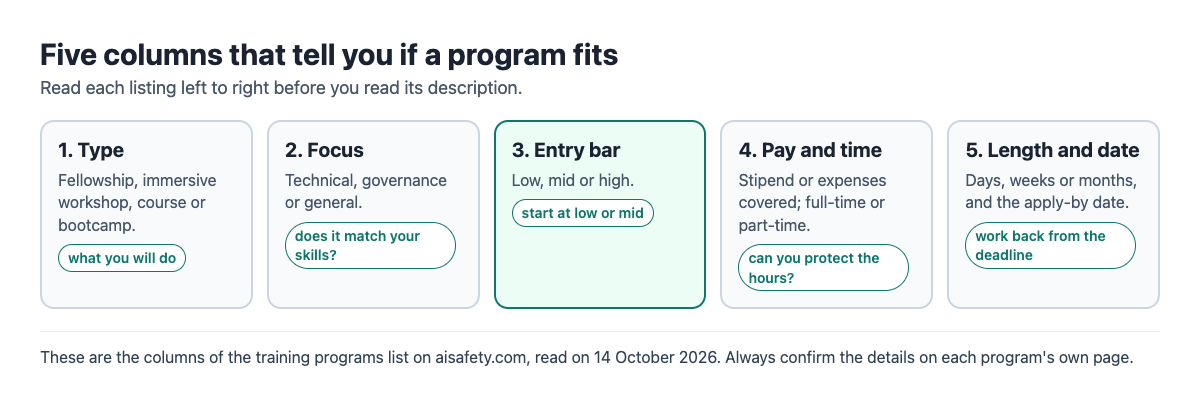
How to read a listing in five columns
Each listing on that page carries the same labels. Read them before the description, because they answer most of your questions in seconds.
- Type. The page lists fellowships and immersive workshops, among others. A workshop can last 3 days. A fellowship can last months.
- Focus. Technical, governance or general. A general focus is the friendliest for a newcomer.
- Entry bar. Low, mid or high. This is the page's own label for how much you are expected to know already.
- Pay and time. Some listings say a stipend is included or expenses are covered. Each is marked full-time or part-time.
- Length and date. Each listing has a length and an apply-by date, so you can work back from the deadline.
Two real listings show how far apart the extremes are. One was a 6-week part-time online fellowship for undergraduates and content creators, with a low entry bar and a general focus. Another was a 4-month full-time fellowship for technical people, with a high entry bar, working on a project in scalable oversight, adversarial robustness, interpretability or model organisms. Both are fellowships, and they are very different commitments.
Which type of program fits your background
Match the program to where you are, not where you want to be.
- New to AI and alignment: filter for a low entry bar and a general focus, or learn alone first with a self-study path. The AI safety self-study path and the beginner reading list cover that stage.
- Technical background, new to alignment: a mid entry bar with a technical focus is a stretch worth trying once you can explain the core ideas. See the math you need to start.
- Policy, law, philosophy or economics: look at the governance focus. You still need the core ideas, but you can go deep where your skills apply.
- Already reading papers: a high entry bar becomes realistic. Prepare a clear research idea first.
If two programs both fit, take the one with the lower weekly hours you can truly protect. A program you finish teaches more than one you drop in week three.
What to prepare before you apply
Selective programs usually ask for written answers. Prepare these before you open the form.
- A specific reason. Name the problem that pulled you in, such as why a system can follow its objective and still miss your intent, rather than "AI is important."
- Evidence you did the reading. Mention particular ideas you studied and one question you still have. The post on how to read an alignment paper gives a method for turning a paper into notes.
- A small piece of your own thinking. One page is enough. How to write up an AI alignment research idea shows a structure a reviewer can follow quickly, and the beginner project ideas give you something to write about.
- Honest limits. Say what you do not know yet. It is true, and it shows you can tell a known result from an open question.
- A plan for the year. If you are aiming at a career, a first-year plan shows where a program fits among other steps.
A four-week plan before your first application
Learn AI Alignment Theory teaches the groundwork in short lessons. It has three levels: Basic (5 courses, the core ideas, no background needed), Intermediate (10 courses on how today's training methods can go right or wrong) and Advanced (7 courses on open research problems and live debates). Lessons run about 8 minutes each. You sign in with Google or an emailed code to use them.
- Week 1: the Basic courses What Is Alignment? and How Modern AI Works. Goal: explain the problem to a friend in two minutes.
- Week 2: Specifying Goals, with lessons such as Goodhart's Law and Specification Gaming. Goal: write down one case where an objective is met and the intent is missed.
- Week 3: the Intermediate courses Learning from Humans and Inner Alignment, with lessons like Goal Misgeneralization and Deceptive Alignment and Scheming. Goal: list two ways training can go wrong.
- Week 4: open the Advanced course The Big Debates, where 71 debate cards across the app set out where researchers disagree, each serious position stated fairly with no verdict. Pick one disagreement and write one page on where you land and why. That page can become your application sample.
Two features help the reading stick. Questions from finished lessons come back after 1, 3, 7, 16, 35 and 90 days, up to 5 a day, and a wrong answer comes back the next day. Every lesson also lists its sources and separates what is known from what is still open. You can read more on the about page.
Common mistakes beginners make
- Applying only to the highest bar. A high entry bar is the listing's own label for people who already have experience. Try a low or mid listing first.
- Ignoring the focus. A technical program will not teach policy, and a governance program will not teach interpretability.
- Counting the title, not the hours. A part-time program and a full-time one are different weeks of your life.
- Missing the apply-by date. Each listing has an apply-by date that falls before the start date. Check it first.
- Trusting a summary. The listing is a pointer. The program's own page has the current terms.
Frequently asked questions
Do I need a technical background to join an alignment program?
Not for all of them. Listings carry a focus label (technical, governance or general) and an entry bar (low, mid or high), so you can filter for what fits you. Read each program's own page for its prerequisites.
Should I start with a fellowship or with self-study?
If you are new, start with self-study or a program marked with a low entry bar. Many fellowships are marked mid or high and assume you can already discuss the basics.
Where can I find a list of programs?
The Training programs page on aisafety.com lists fellowships, bootcamps and courses, online and in person. Its Self-study page lists curricula and reading lists for learning on your own.
How long does it take to get ready to apply?
It depends on where you start. With lessons of about 8 minutes, a few focused weeks of reading plus one short written page is a realistic first goal.
Get started with Learn AI Alignment Theory
If you want a base before you apply anywhere, begin with the Basic level at learnaialignment.vlvd.net. It is a web app: you sign in with Google or an emailed code, and you must be 13 or older.
Start Learn AI Alignment Theory: short hands-on lessons from first principles to open research, with every side of every debate and the sources to read next.
Comments
No comments yet.
Sign in or make an account to comment.