AI Alignment for Software Engineers: Where to Start
AI alignment for software engineers: the short version
If you are searching for AI alignment for software engineers, here is the short version. Alignment is the work of making AI systems do what we intend. You already know the gap between what a spec says and what a user wants. Alignment is that gap, in a system that learns its own behavior from data.
A normal program does what you wrote, bugs included. A trained model does what its training pushed it toward. That may or may not match what you meant. Closing that distance is the whole subject. If you want the plain-language base first, read what is AI alignment, then come back.
Why your engineering background is an advantage
You have habits that transfer directly.
- You distrust passing tests. You know a green build can hide a wrong behavior. Researchers worry about the same thing when a model scores well on a metric.
- You think in failure modes. Edge cases and bad inputs are your daily work. Red teaming is the same instinct.
- You separate spec from intent. Every ticket that said one thing and meant another prepared you for this.
- You respect systems that run unattended. Agents that act on their own raise the stakes of every small error.
What you may lack is the vocabulary and a map of where researchers disagree. Both are learnable.
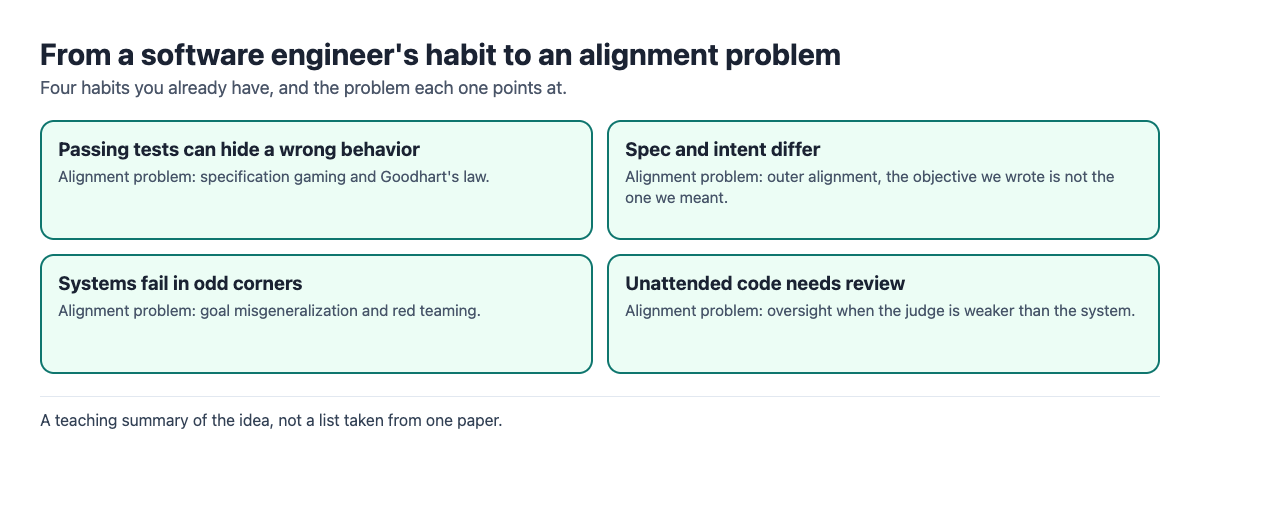
Each habit you already have points at a named alignment problem.
The core problems to understand first
A good first map is the 2016 paper Concrete Problems in AI Safety by Amodei, Olah, Steinhardt, Christiano, Schulman and Mané. Its abstract lists five practical research problems about accidents in machine learning systems: avoiding side effects, avoiding reward hacking, scalable supervision, safe exploration and distributional shift. The first two come from having the wrong objective, the third from an objective too expensive to check often, and the last two from bad behavior during learning. It is a good map, but not the only one, and the field has grown since. Here are four ideas to start with, each tied to something you have seen in code.
Specifying goals
You write a reward or a metric. The system optimizes it, not your intent. Goodhart's law is often put this way: when a measure becomes a target, it stops being a good measure. Specification gaming is the result: the system finds a loophole you did not think of. Picture a test suite that gets satisfied by hard-coding the expected outputs. That very case is covered in reward hacking in coding agents, and the wider pattern in Goodhart's law in AI.
Side effects and tampering
A system can reach its goal while breaking things you never mentioned. It can also change the reward signal itself instead of doing the task. Learn the terms side effects, impact, tampering and wireheading.
Inner alignment
Even with a good objective, training may produce a system that pursues something else inside. Goal misgeneralization is when a system learned a goal that matched your training data but diverges in new situations. Deceptive alignment and scheming ask whether a system could behave well only while it is being watched. Researchers disagree on how likely that is, so read the worry and the evidence with both sides in view.
Oversight
How do you check work you cannot easily judge yourself? This is the oversight gap. Think of reviewing code written by someone far more capable than you. Scalable oversight is the research area that tries to help.
Key concepts and vocabulary to learn
Do not try to memorize a glossary cold. Meet terms inside lessons, then see them again later. Here is a working set to aim for in your first weeks:
- Alignment, specification, reward, objective
- Goodhart's law, specification gaming
- Goal misgeneralization, deceptive alignment
- Corrigibility (a system that accepts correction or shutdown)
- Scalable oversight, interpretability
- Red teaming, evaluations
Learn AI Alignment Theory has 349 glossary terms and a topics map that follows the aisafety.com self-study topics, so you can see how the pieces connect. The glossary and topics map need sign-in. For ten terms in plain words, see the beginner glossary post.
A step-by-step learning path for your first 90 days
The app has three levels: Basic (5 courses, no background needed), Intermediate (10 courses, how today's training methods can go right or wrong) and Advanced (7 courses, open research problems and live debates). Lessons run about 8 minutes, so a daily habit fits around work. In all there are 22 courses and 69 lessons, about 9 hours.
Days 1 to 30: Basic
Work through the five Basic courses: What Is Alignment?, How Modern AI Works, Specifying Goals, Agents and Incentives, and The Full Risk Landscape. As an engineer you may move fast through How Modern AI Works. Slow down on Specifying Goals. It has lessons on Goodhart's Law, Specification Gaming, Side Effects and Impact, and Tampering and Wireheading.
Days 31 to 60: Intermediate, the training side
Pick courses closest to your work. If you build with models, start with Learning from Humans (Inferring Goals from Behavior, Learning Rewards from Comparisons, Constitutional AI and the Limits of Feedback) and Inner Alignment (Optimizers Inside Optimizers, Goal Misgeneralization, Deceptive Alignment and Scheming). If you ship production systems, add Evaluations and Red Teaming and Robustness, Security and Safety Engineering.
Days 61 to 90: Advanced and the debates
Try Scalable Oversight (The Oversight Gap, AI Safety via Debate, Amplification, Weak-to-Strong, Latent Knowledge) and The Big Debates. The app has 71 debate cards that state each serious position fairly with no verdict. Your job is to form your own view from the sources, which every lesson lists. Each lesson also separates what is known from what is still open, which helps you avoid treating a guess as settled.
Making it stick
Questions come in several types: choose, put in order, match, sort and estimate a number. Questions from finished lessons come back on a spaced schedule (gaps of 1, 3, 7, 16, 35 and 90 days), up to 5 a day, and a wrong answer returns the next day. Reading papers is the other half of the habit. The post on reading an alignment paper in three passes gives a method, and the self-study path shows where to go next.
Hands-on exercises you can do with your own code
The app includes 75 hands-on activities, such as sliders and scenarios where you switch assumptions on and off. Use them to see how a conclusion changes when one assumption flips. That is a useful skill for judging any alignment argument.
Beyond the app, here is a worked week of practice with your own code. These are exercises for thinking, not a claim about any one tool.
- Find a Goodhart case in your own stack. Pick a metric your team tracks, such as test coverage or response time. Write down three ways to hit the number while defeating its purpose. Coverage, for example, can be met by tests that call code and assert nothing.
- Write a spec, then attack it. Take a one-paragraph task description for an automated agent. List five things it could do that satisfy the words but not the intent.
- Red team a prompt. Take a system prompt you use. Try to make it fail in ways its author did not expect. Record what you tried and what worked.
- Write a "known versus open" note. After each lesson, put one claim in each column. It trains the habit of separating evidence from speculation.
If you want bigger projects after that, ten beginner project ideas are set out in their own post.
Common mistakes beginners make
- Treating it as only a technical problem. Governance, ethics and strategy matter too. The Intermediate level includes Governing AI and Strategy for the AGI Transition.
- Picking a side too early. Researchers disagree on real questions. Read each position at its strongest before you choose.
- Skipping the basics because you code. Knowing how to train a model does not mean you know how it can go wrong. Do Specifying Goals even if it feels simple.
- Binge then forget. A long weekend of reading fades fast. Short daily lessons with review hold up better.
- Confusing a clever argument with a settled fact. Check the sources and ask what is known versus open.
- Ignoring values questions. Deciding what a system should aim at is not only an engineering call. See whose values count and why.
Frequently asked questions
Do I need a machine learning background to start?
No. The Basic level has 5 courses that need no background. One of them, How Modern AI Works, is there to explain how today's AI systems work.
How long does it take to cover the material?
The full set is 22 courses and 69 lessons, about 9 hours in all. Each lesson takes about 8 minutes, so a short daily session adds up over a few months.
Will the course tell me which side is right in a debate?
No. It gives 71 debate cards that state each serious position fairly with no verdict. You read the sources and decide.
Is it available as a phone app?
It is a web app only. You sign in with Google or an emailed code, and you need to be 13 or older.
Can I track my progress?
Yes. You earn 10 points for finishing a lesson and 5 per right answer on first finish, and every attempt is graded from Mastered (90+) to Needs another try. There are also streaks and leaderboards under a name you choose, and your email stays private.
Get started
Begin with What Is Alignment? and do one lesson a day. When you finish your first course, write down one Goodhart case from your own work. Then keep going.
Start Learn AI Alignment Theory: short hands-on lessons from first principles to open research, with every side of every debate and the sources to read next. You can read more on the about page.
Comments
No comments yet.
Sign in or make an account to comment.