AI race: what it is and why it worries researchers
An AI race is a competition between groups to build the most powerful AI first. The groups can be companies, research teams or whole countries. Researchers worry about it less because of who might win and more because of what racing does to everyone taking part. This guide explains what people mean by an AI race, the three risks they name, the ways out they propose, and a short exercise that shows why a race is so hard to stop once it starts.
What is an AI race?
The term grew out of the older idea of an arms race. Wikipedia's article on the artificial intelligence arms race describes a technological, economic and military competition between states to build and deploy advanced AI, including weapons that can act on their own, to gain an advantage over rivals. It compares this to earlier races in nuclear and conventional weapons, and notes that many analysts have described such a race since the mid-2010s.
The same article adds that, more broadly, any competition for better AI is sometimes framed as an arms race. That is the wider sense most people mean today. A lead in AI for one purpose tends to carry over to others, so a race over business, science and defense can all blur into one.
Why race at all? The article reports that several influential figures and publications have argued that whoever builds artificial general intelligence first, meaning AI that matches people at most thinking tasks, could dominate world affairs this century. If you believe that, coming second looks like losing everything.
Three risks researchers name
The arms race article sets out three separate risks. They are worth keeping apart, because they call for different answers.
- The race itself. This risk exists whoever wins. Being first looks like a big advantage, so teams have strong reasons to cut corners on safety. When one team seems close to a breakthrough, others may take shortcuts, skip precautions and release a system that is less ready. That raises the chance of serious failures nobody intended.
- Losing control. A rushed system may do things its builders did not expect. The article links this to the black box problem: an AI whose inner workings even its users and builders cannot see into. The risk grows in a race toward general intelligence, which the article says may be an existential risk, one that threatens humanity's future as a whole.
- One group wins. If a single group does pull far ahead, power and technology end up concentrated in its hands. The worry here is not an accident but too much power held by too few.
The race to the bottom
The first risk has a name: a race to the bottom. Wikipedia's article on existential risk from artificial intelligence puts the logic plainly. Careful safety work takes time and money. So the projects that go carefully risk being outcompeted by developers who are less careful. Over time, the pressure pushes everyone's safety standards down.
The philosopher Nick Bostrom and others have said that a race to be first to general AI could lead to shortcuts in safety, or even to violent conflict. The same article mentions a 2025 study warning that concentration in the AI market could "translate into unprecedented accumulation of power", which is the third risk again.
Speed makes this worse. Researchers quoted in that article warn that if AI starts to improve itself, in a loop called recursive self-improvement, its abilities could grow too fast for safety measures to keep up, especially if developers are racing. The question of how fast that could go is the hard takeoff vs soft takeoff debate.
There is one more twist. The arms race article notes that some people argue that calling it a "race" at all can make the problem worse. If everyone believes they are in a race, they act like it.
A worked example: play the race with two teams
You can see the trap with pen and paper. Imagine two teams, A and B, each building a powerful AI. Each round, each team makes one choice: go carefully, with full safety checks, or go fast and skip some. These teams are made up; the point is the shape of the choice.
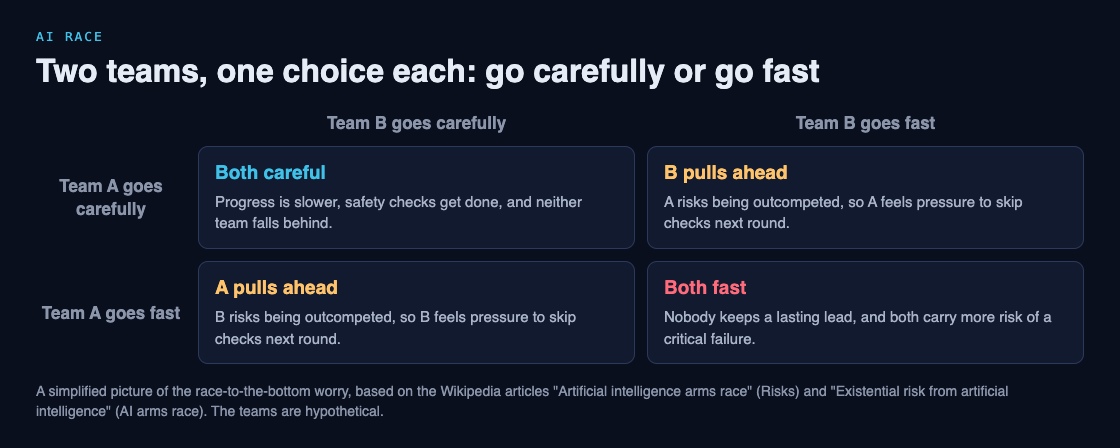
- Both go carefully. Progress is slower. Checks get done. Neither team falls behind.
- A goes carefully, B goes fast. B pulls ahead. A now fears being outcompeted, which is exactly the pressure the race-to-the-bottom argument describes.
- A goes fast, B goes carefully. The mirror image. Now B feels the pressure.
- Both go fast. Neither keeps a lasting lead, and both carry more risk of a serious failure.
Now ask what each team should do next round. If you are A and you cannot be sure B will stay careful, going fast protects you from falling behind. B thinks the same way. So both drift toward the worst square, even though both would prefer the first one.
Try changing one rule and play it again. What if each team could check the other's safety work? What if both could agree to a pause and know the other would keep it? Each change is a small version of a real proposal, which is the next section.
Ways out people propose, and the doubts
Nobody in these articles claims to have solved this. Here are the main ideas, each with the doubts raised about it.
- Talk and agree. Miles Brundage of the University of Oxford has argued that diplomacy could ease an AI arms race: "We saw in the various historical arms races that collaboration and dialog can pay dividends."
- Check each other. The arms race article says AI arms control would likely need new international rules written down in technical terms, active monitoring, informal diplomacy among experts, and a process to verify that everyone keeps their word. The doubt: many experts think a full ban on autonomous weapons would fail, partly because breaking a treaty would be very hard to detect.
- Ban or regulate. The existential risk article reports that many AI safety experts think an outright ban on general AI would not work, because research can move easily to another country and could go underground. Some scholars who worry about the risk also argue that developers cannot be trusted to regulate themselves, while agreeing that outright bans would be unwise.
Behind all of these sits the deeper problem of making sure a powerful AI does what its builders intend, which is the AI alignment problem. And one way teams can check what a system can do before release is dangerous capability evaluations.
Explore an AI race as fiction in Contain ASI
Contain ASI is a story strategy game built around this exact situation. Its home page reads: "January 2024. Four AI labs. One race. For three years, keep every lab from crossing into recursive self-improvement before 2027."
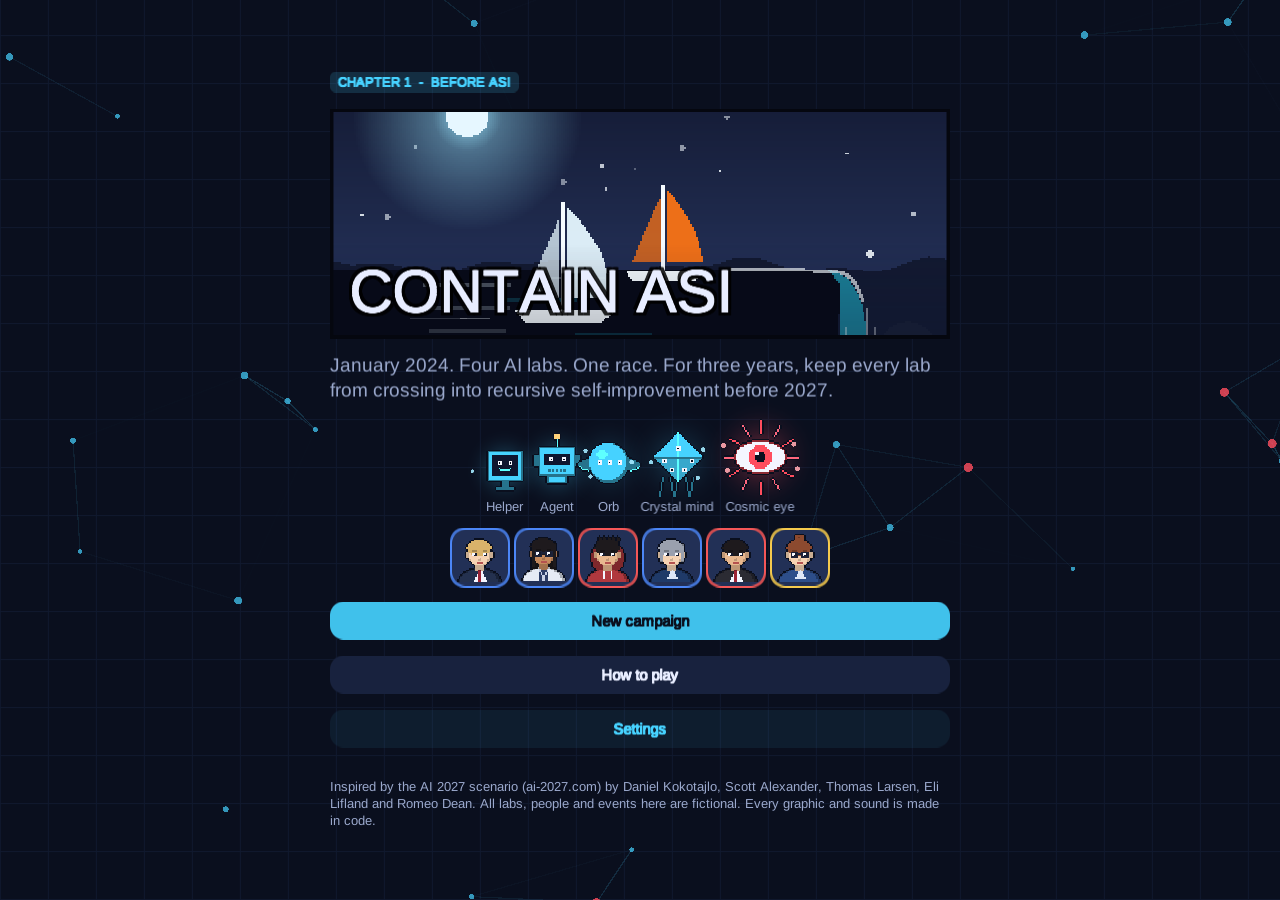
It is a game for 1 to 4 players that runs in your browser. You take the role of a researcher, a research manager, a CEO or a government. It is fiction, not a forecast: the footer says it is inspired by the AI 2027 scenario and that all its labs, people and events are made up. If you have just played the two-team exercise above, it is a way to feel the same pressure with four labs instead of two.
Frequently asked questions
Is an AI race the same as an AI arms race?
Mostly. "AI arms race" first meant states competing over military AI, but any competition for better AI is now often called one.
Why does an AI race worry researchers if nobody has won?
Because the main risk is the racing itself. Teams that fear falling behind have reasons to skip safety work, so standards can fall for everyone.
Can an AI race be stopped?
People propose diplomacy, shared rules with monitoring and verification, and regulation. Each has critics, mainly because cheating is hard to detect and research can move elsewhere.
Is Contain ASI based on a real AI race?
No. Its footer says it is inspired by the AI 2027 scenario and that all its labs, people and events are fictional.
Get started
Want to try keeping four labs from racing past the point of no return? Play Contain ASI: a story strategy game for 1 to 4 players that runs in your browser. Its labs, people and events are all fictional. You will need a recent Chrome, Edge, Firefox or Safari, because it runs on WebGL 2.
Comments
No comments yet.
Sign in or make an account to comment.