AI Startup Gross Margin: What's Healthy and How to Improve It
Your AI startup gross margin is the share of each sales dollar left after you pay the direct cost of serving customers. For most AI products that direct cost includes model calls, which is why the number often runs lower and moves more than it does for ordinary software. Here is how to calculate it, what to count and how to raise it. For the wider picture, read how AI company economics differ from SaaS. It helps founders who are used to software where an extra user costs almost nothing, and it works through margins and pricing with a worked example. One thing worth knowing from it: every request has a real cost, so your costs follow usage, not the number of accounts.
If you want the economics as a course, Scaling an AI Company in Age of AI Entrepreneur has a lesson on the economics of AI companies, and you sign in with your email and an emailed code to open it.
What AI startup gross margin means
The formula is simple:
gross margin = (revenue - cost of goods sold) / revenue
Revenue is what customers pay you in a period. Cost of goods sold (COGS) is what it cost you to deliver the product to them in that same period. Subtract one from the other and you get gross profit. Divide by revenue and you get the percentage.
Gross margin sits above salaries for building the product, marketing and rent. It is the money that is left to pay for all of those. If gross margin is thin, growth does not fix it. Selling more of a product that barely covers its own delivery cost only makes the problem bigger.
Why AI gross margins run lower than SaaS
In classic software, serving one more customer costs a little hosting and some support. The code is already written. Most of the cost is fixed, so margin rises as you add customers.
An AI product behaves differently. Each time a user asks for something, your app sends text to a model and pays for the tokens that go in and come out. That cost is variable. It rises with every request, and it rises faster with long documents, long answers and chains of several calls.
This creates two problems. First, two customers on the same plan can have very different costs. Second, if you charge a flat monthly price with no limit, your margin depends on how your users behave, which you do not control. You can shape it with product and pricing decisions, and the rest of this post covers how.
What goes into cost of goods sold for an AI product
Count every cost that scales with serving customers. For a typical AI app that includes:
- Model API calls. Input tokens and output tokens, usually priced separately.
- Retrieval. Embeddings, vector storage and search, if you give the model your own data.
- Hosting and compute. The servers, databases and queues that run each request.
- Other paid services your product calls. Speech, search, data providers and similar.
- Payment fees. What your payment processor takes per charge.
- Support and human review. Include these if they scale with customers. Pick a rule and apply it the same way every month.
Leave out the cost of building the product, marketing and general overhead. Those belong below gross profit.
The biggest line is usually the model. The lesson "Model APIs, Tokens and What a Request Costs" in the AI Product Stack course covers how to read a request in tokens and price it. You sign in to open the course.
A worked example: calculating margin per user
Take an imaginary product that summarizes contracts. Every number below is made up for illustration. Swap in your own.
- Price: $30 per user per month.
- One summary sends about 6,000 input tokens and gets back about 800 output tokens.
- Assumed model prices: $3 per million input tokens and $15 per million output tokens.
Cost of one summary:
- Input: 6,000 / 1,000,000 x $3 = $0.018
- Output: 800 / 1,000,000 x $15 = $0.012
- Total: $0.03 per summary
Now add the other monthly costs per user: $0.50 for retrieval and storage, $1.00 for hosting, $1.20 for payment fees and $1.30 for support. That is $4.00 of costs that do not depend on the model.
A light user runs 100 summaries a month. Model cost is $3.00. Total COGS is $7.00. Gross profit is $23. Margin is about 77 percent.
A heavy user runs 600 summaries. Model cost is $18.00. Total COGS is $22.00. Gross profit is $8. Margin is about 27 percent.
Same plan, same price, very different result. Now suppose 80 percent of your users are light and 20 percent are heavy. Average model cost is (0.8 x $3) + (0.2 x $18) = $6.00. Add the $4.00 and average COGS is $10.00. Average margin is $20 / $30, about 67 percent.
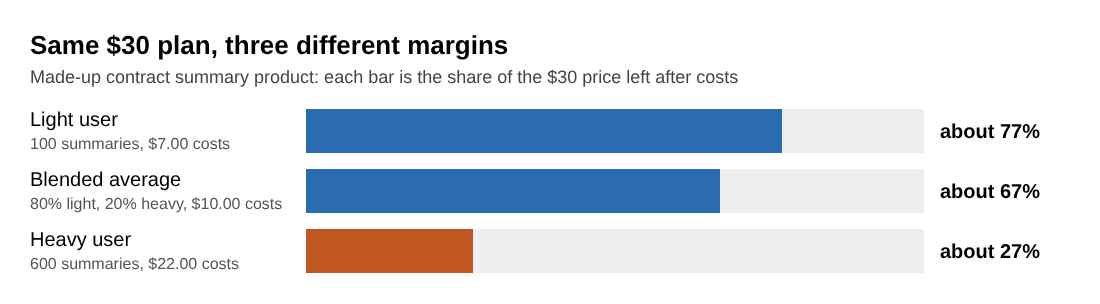
The blended number looks fine. It hides a group of users who barely pay for themselves. Always look at margin by plan, by feature and by usage band, not only the average. The lesson on revenue, costs and unit economics in the Business Basics course covers this kind of per-customer arithmetic.
What counts as a healthy AI gross margin
No single percentage is right for every product, and you should be careful with any benchmark you read unless the source shows how it was measured. A more useful test has four parts:
- Every plan is positive. Even your heaviest realistic user should pay more than they cost.
- The trend goes up. Margin should hold or improve as you add customers and optimize, not shrink.
- There is room above it. Gross profit has to cover the team, marketing and the rest. Work backward from what your company needs to spend.
- You can explain it. You know which line items move it and by how much.
As a planning habit, set a target margin before you set a price, then check each plan against it. Early on, a lower margin is understandable while you learn how people use the product. What matters is that you can see a path to improving it.
Five ways to improve margin without hurting quality
- Route easy requests to a smaller model. Not every request needs your largest model. Send simple classification, formatting or short answers to a cheaper one, and keep the large model for hard cases.
- Send less text. Trim long instructions, drop repeated context and use retrieval to pass in only the relevant passages instead of whole documents. Input tokens add up quickly.
- Cap and shape the output. Output tokens often cost more than input. Ask for the format you need, set a sensible maximum length and avoid answers that run on.
- Reuse work. If many users ask the same thing, store the result and serve it again. Check whether your model provider offers discounts for repeated context or for work that can wait.
- Cut wasteful calls. Look for retries that fire too often, loops that never stop and calls made before they are needed. Agents that run in loops can quietly multiply cost, so set a step limit.
Every one of these changes the output in some way, so test before you ship. Build a small set of real examples, run old and new versions side by side and compare the results. A simple checklist for testing LLM prompts before release is a good place to start. The lessons in the Evals: Shipping AI That Works course go deeper on building an eval set and judging outputs.
How pricing and usage limits protect your margin
Cost control is half the job. Pricing is the other half. If your costs follow usage, your price should follow usage in some way too.
- Include a usage allowance in each plan. In the example above, a plan that includes 200 summaries caps the model cost at $6.00 for that user, so margin stays healthy.
- Charge for extra use. Let heavy users pay for what they consume instead of absorbing it.
- Tier by value. Put the costly features, such as long documents or the large model, on higher plans.
- Watch free use. Free users have costs too. Limit what they can do, or you pay to serve people who never convert.
Strict limits can annoy customers, and loose limits can drain margin, so test with real customers. The lesson "Pricing AI Products" in the Launch, Price and Get Paid course covers the options, and "The Economics of AI Companies" in the Scaling an AI Company course puts margin in the context of a growing business.
Frequently asked questions
What is gross margin for an AI startup?
It is revenue minus the direct cost of serving customers, divided by revenue. For an AI startup, that direct cost usually includes model API calls, retrieval, hosting and payment fees.
Why can AI gross margin be lower than SaaS?
Every AI request calls a model that you pay for per token, so cost grows with usage. In traditional software, most costs are fixed, so an extra user adds very little.
What is the biggest cost in AI cost of goods sold?
For many products it is the model API. Check your own numbers, though, because retrieval, hosting and support can matter more in some products.
How do I raise margin without lowering quality?
Route easy requests to smaller models, send fewer tokens, cap output length, reuse repeated work and cut wasteful calls. Test each change against a set of real examples before you ship it.
Should I limit usage on my plans?
Usually yes. A usage allowance per plan, with a way to pay for more, keeps your heaviest users from turning a profitable plan into a loss.
Get started
Do three things this week. List every cost in your COGS. Calculate margin for a light user and a heavy user, as in the example above. Then pick one of the five fixes and test it against real examples. For more on why these costs behave the way they do, read how AI company economics differ from SaaS.
If you want to learn the economics step by step, Age of AI Entrepreneur teaches how to build and grow a business with AI in short hands-on lessons. You sign in with your email and an emailed code,.
Building a business in the age of AI, from a first project to a company.
Visit aientrepreneur.vlvd.net↗
Comments
No comments yet.
Sign in or make an account to comment.