AI winter: what it was and what caused each one
An AI winter is a stretch of years when money and interest drain out of artificial intelligence research after a burst of big promises. The term sounds like weather, but it is a story about expectations meeting results. This post explains what an AI winter was, what set off each one, and why historians still argue about it, using Wikipedia's AI winter article as its only source.
What is an AI winter?
The article defines an AI winter as a period of reduced funding and interest in AI research. It says the field has had several hype cycles: enthusiasm, then disappointment and criticism, then funding cuts, then renewed interest years or even decades later.
It names two major winters, lasting roughly from 1974 to 1980 and from 1987 to 2000, and several smaller episodes. Interest and investment have generally grown since the low point of the early 1990s, and the article dates the current boom from about 2012.
The 1984 warning
The term itself is young. It first appeared in 1984, as the topic of a public debate at the annual meeting of the American Association of Artificial Intelligence. Roger Schank and Marvin Minsky, two leading AI researchers who had lived through the winter of the 1970s, warned the business world that enthusiasm for AI had spiraled out of control in the 1980s and that disappointment would follow.
They described a chain reaction, like a "nuclear winter":
- Pessimism begins among AI researchers.
- Pessimism spreads to the press.
- Funding is cut severely.
- Serious research ends.
The article says that three years later the billion-dollar AI industry began to collapse.
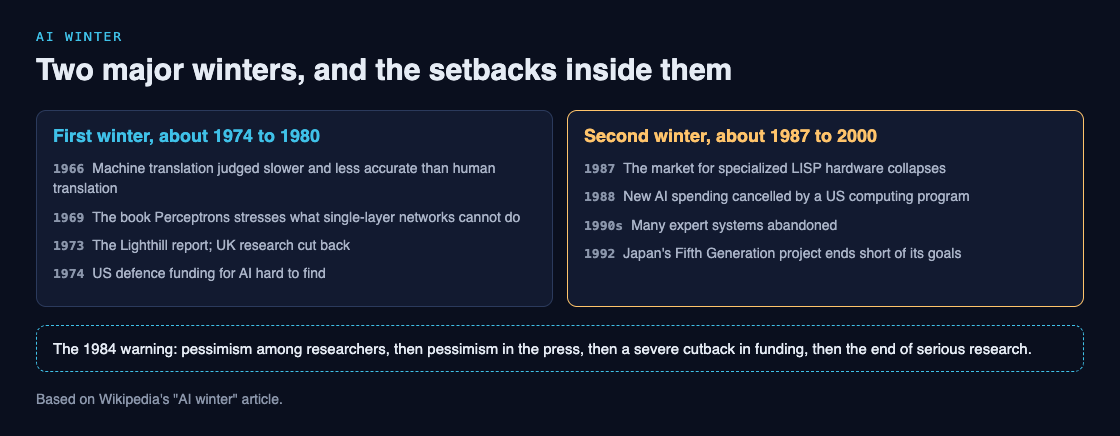
The two winters and the setbacks inside them, as Wikipedia's article lists them.
The first winter: 1966 to about 1980
The article traces the first winter to four setbacks.
Machine translation, 1966
Machine translation drew heavy US government support from 1954. A 1954 public demonstration got headlines like "Robot brain translates Russian into King's English", yet it translated only 49 curated Russian sentences with a vocabulary of 250 words. Researchers had underestimated how hard it is for a machine to know what a sentence is about. In 1964 a committee was formed to look into the lack of progress, and its famous 1966 report found machine translation more expensive, less accurate and slower than human translation. After spending some 20 million dollars, the National Research Council ended all support.
Perceptrons, 1969
Early single-layer neural networks, called perceptrons, were kept alive largely by the force of one researcher's personality. The 1969 book Perceptrons by Marvin Minsky and Seymour Papert stressed the limits of what they could do. The article notes that multilayer versions were not subject to that criticism, but nobody then knew how to train one. Funding for neural network work was hard to find in the 1970s and early 1980s, and the "winter" for that approach ended in the middle 1980s.
The Lighthill report, 1973
The UK Parliament asked Professor Sir James Lighthill to evaluate AI research in Britain. His report criticized the "utter failure" of AI to achieve its "grandiose objectives" and singled out "combinatorial explosion", the way many successful methods grind to a halt on real-world problems. The article says it led to the dismantling of AI research in the UK, which continued at only a few universities until 1983.
Defence funding, 1969 to 1974
In the 1960s the US defence research agency gave out millions with few strings attached. After a 1969 law required it to fund "mission-oriented direct research", AI proposals faced a very high standard. A five-year speech understanding program produced a system that worked only if words came in a particular order, and in 1974 the agency cancelled a three-million-dollar-a-year contract. The researcher Hans Moravec blamed the crisis on exaggeration: researchers could not promise less in their next proposal than in the first, so they promised more.
The second winter: 1987 to about 2000
The second winter followed a boom in "expert systems", a form of AI program that corporations around the world adopted in the 1980s. By 1985 corporations were spending over a billion dollars a year on AI, mostly on in-house AI departments, and an industry grew to support them.
- 1987: the special-hardware market collapses. Specialized machines built to run the programming language LISP lost out to cheaper general workstations and desktop computers. The article says an industry worth half a billion dollars was replaced in a single year.
- Early 1990s: expert systems prove costly. The earliest successes were too expensive to maintain. They were hard to update, could not learn, and were "brittle": they made grotesque mistakes on unusual inputs.
- 1992: Japan's Fifth Generation project ends. Started in 1981 with 850 million dollars, it aimed at machines that could converse, translate and reason like humans. By 1991 its goals had not been met, and it ended "not with a successful roar, but with a whimper".
- 1987 to 1988: new US spending is cut. A US strategic computing program that had spent 100 million dollars on 92 projects by 1985 saw its AI funding cut "deeply and brutally" under new leadership.
Afterwards, the article says, many researchers in the mid-2000s deliberately called their work "machine learning", "analytics" or "intelligent systems" to avoid the stigma of false promises attached to the name "artificial intelligence".
Was there really a winter?
Not everyone accepts the story. The article reports the historian Thomas Haigh arguing that for the 1970s "there was no AI winter". He used membership of a major AI interest group as a proxy: it had 1,241 members when the Lighthill report came out in 1973 and almost tripled to 3,500 by mid-1978. On his reading, the cuts hit the major laboratories and largest projects, a tiny fraction of the people now working in the field.
The article also records a quiet success inside the cuts: a battle management system the defence agency funded was, it says, enormously successful and repaid all the agency's investment in AI. So a winter can look different depending on whether you count money, careers, headlines or discoveries. This post gives no verdict.
A worked example: read a hype cycle
You can test any AI headline against the pattern in about ten minutes.
- Write the promise. Copy the claim in one sentence, with its date.
- Find the demonstration. Ask what was actually shown. The 1954 demonstration was 49 sentences and 250 words.
- Find the money. Note who is paying and what they were told. Moravec's point is that each proposal had to promise at least as much as the last.
- Look for the brittle case. Ask what happens on an unusual input. This is where expert systems failed.
- Check the other counts. Look at researcher numbers and discoveries as well as funding, as Haigh did.
The same steps work on a rosy forecast and a gloomy one. For the other end of the debate, our posts on hard takeoff vs soft takeoff and the technological singularity cover ideas about very fast AI progress.
Exploring the idea in Contain ASI
Contain ASI is a story strategy game for 1 to 4 players that runs in your browser and needs WebGL 2. Chapter 1, Before ASI, starts in January 2024 with four fictional AI labs in one race. As a researcher, research manager, CEO or government, you try for three years to keep every lab from crossing into recursive self-improvement before 2027.
Our post on the AI race covers what a race between rival groups is and why researchers worry about it. The page says the game is inspired by the AI 2027 scenario and that all its labs, people and events are fictional. It does not say how the game treats funding or setbacks, so this post does not either. It is a game, not a forecast.
Frequently asked questions
What is an AI winter?
It is a period of reduced funding and interest in AI research that follows a wave of hype and disappointment. The field has had several.
When were the AI winters?
The article names two major ones, roughly 1974 to 1980 and 1987 to 2000, plus smaller episodes such as the 1966 end of machine translation support.
Where does the term come from?
It first appeared in 1984, as the topic of a public debate at an AI conference, where Roger Schank and Marvin Minsky warned that disappointment would follow the enthusiasm of the 1980s.
Did the winters really happen?
Mostly yes for funding, but the historian Thomas Haigh argues there was no broad winter in the 1970s, because the number of researchers kept growing.
Get started
Want to feel the pressure of a fast race? Open Contain ASI in your browser and start a campaign as a researcher, research manager, CEO or government.
Comments
No comments yet.
Sign in or make an account to comment.