Alexander Fleming and penicillin: what he found
The story of Alexander Fleming and penicillin is usually told in one line: a scientist leaves a dish out, mould grows, and the world gets antibiotics. The Nobel Prize's own pages tell a longer and more interesting story. Fleming saw something no one had followed up before, proved some of it, and then could not turn it into a medicine. That took a team in Oxford more than ten years later. This post follows both halves, from the Nobel Prize pages, and ends with a way to read the 1945 prize speech yourself.
Who was Alexander Fleming?
According to his Nobel biography, Fleming was born at Lochfield, near Darvel in Ayrshire, Scotland, on 6 August 1881. After four years in a shipping office he trained at St Mary's Medical School in London, and began research there under Sir Almroth Wright, a pioneer of vaccine therapy.
He served through the First World War as a captain in the Army Medical Corps. After the war he went back to St Mary's to work on substances that would kill bacteria without harming the body's own tissues. In 1921 he found one: a substance in the body's tissues and secretions that dissolves bacteria, which he named lysozyme.
Alexander Fleming and penicillin: what he saw in 1928
The Nobel facts page says Fleming used to leave dishes of bacteria standing by his worktable. In 1928 he saw that a mould had begun to grow in one of them, and that the bacteria near the mould had stopped growing.
His biography adds the detail: the mould had grown by accident on a plate of staphylococcus bacteria, and it had made a bacteria-free circle around itself. Fleming grew the mould and found that the liquid it grew in stopped staphylococci growing even when diluted hundreds of times. He named the active substance penicillin.
The presentation speech at the 1945 prize gives the mould's name, Penicillium notatum, and makes a point worth keeping. Because of his work on lysozyme, Fleming "was therefore always on the look-out for fresh substances which checked bacteria." The mould was luck. Noticing it was not.
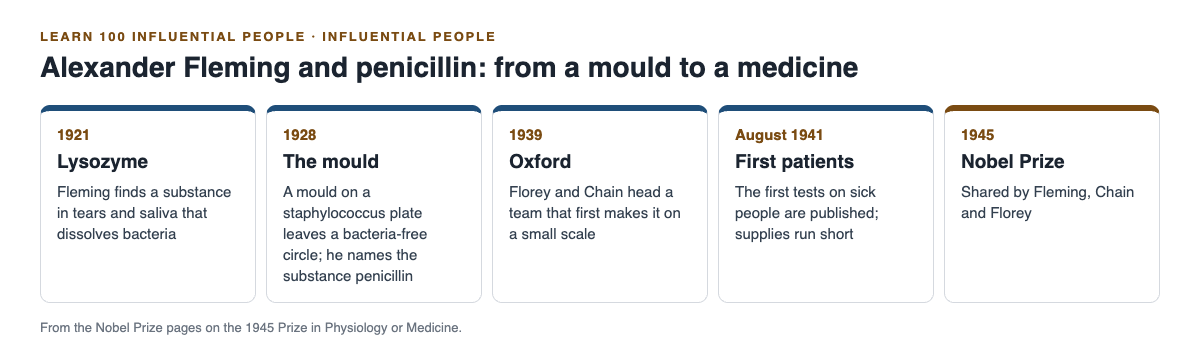
Five dates from the Nobel Prize pages on the 1945 prize.
What Fleming proved, and what he could not do
The 1945 presentation speech lists what Fleming showed. Penicillin worked against many kinds of bacteria, including those behind pneumonia, meningitis, diphtheria, anthrax and gas gangrene, but not against others, such as the typhoid and tuberculosis bacilli. It did not harm white blood cells, and it was fairly harmless when injected into mice.
That last point mattered. Earlier substances made by microbes had killed bacteria but harmed the body's cells just as much. So a medicine was within reach, and Fleming tried penicillin on infected wounds, the speech says, "in some cases with moderate success."
But no one could make it pure. Three years after his discovery, three English biochemists tried and failed: penicillin lost its power while being purified. The speech is blunt about what would have happened next. Penicillin would have stayed "of no great practical importance" if Oxford had not taken it up.
How Florey and Chain turned it into a medicine
At Oxford, Howard Florey and the chemist Ernst Chain had also studied lysozyme. Florey's Nobel biography says that in 1939 the two headed a team of British scientists, funded by a grant from the Rockefeller Foundation, that managed to make the drug on a small scale. Chain's biography calls this the reinvestigation of penicillin, nine years after Fleming described it.
The speech names others in the team, including Heatley, who worked out a way to measure how strong a sample was, the Oxford unit. In tests on infected mice, over 90 percent of those given penicillin recovered, while all the untreated mice died.
The first results in sick people were published in August 1941. They looked promising, but there was so little of the drug that some treatments had to stop early. Florey then interested authorities in the United States, and with government help large amounts were made, above all to treat wounds in the Second World War.
In 1945 the Nobel Prize in Physiology or Medicine was shared by all three, Fleming, Chain and Florey, "for the discovery of penicillin and its curative effect in various infectious diseases."
Was penicillin discovered by accident?
Partly, and the sources say so. Fleming's biography says the mould grew on the plate by accident, and the speech calls it "a so-called accidental observation."
But two other things are just as true. Fleming was looking for exactly this kind of substance, and recognised what he saw. And the discovery became a medicine only through years of planned work by another team. The prize itself reflects that: it went to the person who noticed, and to the two who made it work. How much credit belongs to each is a fair question to argue, and the sources give you the evidence for both sides.
What penicillin could and could not cure
By 1945, the speech says, penicillin had proved itself against blood poisoning, meningitis, gas gangrene, pneumonia, syphilis, gonorrhoea and many other infections, including some that the newer sulfa drugs could not cure.
It also set limits. Penicillin did not work against tuberculosis, typhoid fever or polio. In the speaker's words: "penicillin is not a universal remedy, but it is of the highest value for certain diseases." He also warned that a cure that looks miraculous in one patient must be tested on many, against patients who did not get it, quoting Hippocrates: "Experience is deceptive, judgment difficult." Our post on Hippocrates' contributions to medicine explains where that idea comes from.
Worked example: read the 1945 prize speech in 20 minutes
The presentation speech is a primary source: a scientist speaking in December 1945, the year of the prize. Use the steps from our guide to how to analyze a primary source.
- Source it (3 minutes). Open the speech. Note who gave it (Professor G. Liljestrand of the Caroline Institute), when (10 December 1945) and for whom (the prize ceremony, in front of the King).
- Find Fleming's part (5 minutes). Read the paragraph that begins with Fleming's 1928 observation. List two things he proved.
- Find Oxford's part (7 minutes). Read on to the Oxford team. List two things they did that Fleming could not.
- Check it (5 minutes). Compare the dates with Florey's biography. Write one sentence on who deserves credit, citing both sources.
Then put the five dates on a timeline of your own; our guide on making a history timeline shows how.
Frequently asked questions
When did Alexander Fleming discover penicillin?
In 1928, when he saw that a mould growing on a plate of staphylococcus bacteria had cleared a bacteria-free circle around itself.
Did Fleming make penicillin into a medicine?
No. He showed it killed many bacteria and was fairly harmless in mice, but it could not be purified; Florey, Chain and their Oxford team made it usable from 1939.
Who won the Nobel Prize for penicillin?
Alexander Fleming, Ernst Chain and Howard Florey shared the 1945 Nobel Prize in Physiology or Medicine.
Was the discovery of penicillin an accident?
The mould got onto the plate by accident, but Fleming was already looking for substances that stopped bacteria, which is why he noticed it.
Get started
Fleming is one of the people who changed medicine, and his story is a good example of a debate over credit. Learn 100 Influential People teaches the 100 people who most shaped human history, in war, philosophy, religion, art, science, engineering and economy, in 15 courses and 46 lessons of about 9 minutes. Its 272 questions check what you learned, 38 cards set out where researchers disagree, and every lesson lists its sources. Sign in with your email and an emailed code, and read what the site is for.
Comments
No comments yet.
Sign in or make an account to comment.