Alexander the Great's legacy: what his empire changed
Alexander the Great died in 323 BCE, aged 32, after about a decade of conquest. The empire he built broke apart almost at once. So what did he actually leave? This guide sets out Alexander the Great's legacy in four changes his empire made, using World History Encyclopedia's articles on Alexander, Alexandria, the Hellenistic Period and the wars that followed his death, and then where the sources and historians disagree.
Alexander's life in brief
Alexander was born in July 356 BCE, the son of King Philip II of Macedon. As a boy he was taught by the philosopher Aristotle. When Philip was assassinated in 336 BCE, Alexander became king.
In 334 BCE he crossed into Asia Minor to attack the Persian Empire. He beat the Persians at the Granicus that year, defeated King Darius III at Issos in 333 BCE, took Egypt in 331 BCE and beat Darius again at Gaugamela the same year. Darius was killed by one of his own generals in 330 BCE. Alexander then fought in Bactria and Sogdiana, and in 326 BCE defeated King Porus at the Hydaspes River in India. There his worn-out troops mutinied and refused to go further. He died at Babylon in June 323 BCE after ten days of high fever.
Alexander the Great's legacy: an empire split among his generals
The first thing Alexander left was a problem. According to World History Encyclopedia's article on the Wars of the Diadochi, most historians agree that the empire was left without adequate leadership, because there was no clear successor or heir. His commanders split. Some backed his half-brother Arrhidaeus, others the child his wife Roxanne was expecting.
The generals who fought over the empire are called the Diadochi, which means "successors". Their wars lasted decades. Out of them came dynasties that, with exceptions, ruled their regions until Rome arrived:
- The Ptolemies in Egypt, founded by his general Ptolemy and lasting until 30 BCE, when Cleopatra VII died.
- The Seleucids, founded by Seleucus, whose empire took in Mesopotamia, Anatolia and parts of India.
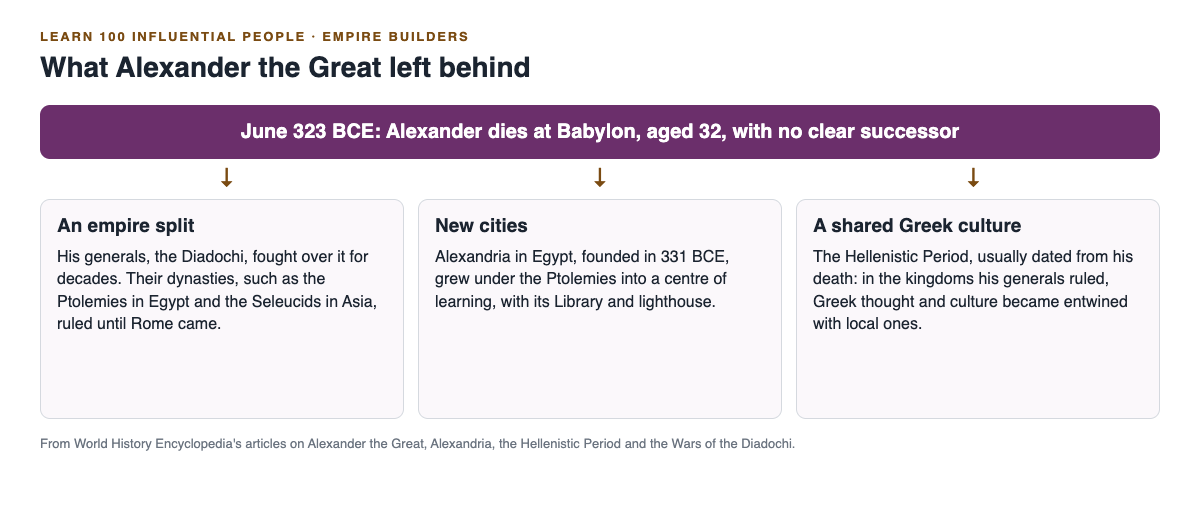
Three lasting results of a short reign.
New cities, above all Alexandria
Alexander founded cities as he went. The most famous is Alexandria in Egypt, founded in 331 BCE at a small port called Rhakotis. Alexander laid out the basic design, then left to continue his war on Persia. He founded another Alexandria, Alexandria-Eschate, on the Iaxartes River in 329 BCE.
It was under the Ptolemies that Egypt's Alexandria grew into an intellectual, cultural and commercial hub. It held the Pharos lighthouse and the Library of Alexandria, and World History Encyclopedia calls it at one time the most vital cultural centre of the ancient world, rivalling even Athens. Its Mouseion, a home for scholars, is where the English word "museum" comes from.
The Hellenistic Period
Historians usually date the Hellenistic Period from Alexander's death in 323 BCE. The name comes from the spread of Greek, or Hellenic, culture across the lands his conquests opened. World History Encyclopedia's Alexander article puts it this way: in the regions his generals controlled, Greek thought and culture became entwined with the culture of the people who already lived there.
The period changed how people were governed. The Greek city-state gave way to kingdoms with more centralized power, ruled in the name of one person rather than the community, and armies leaned more on hired soldiers. It was also a rich time for learning: Euclid, Archimedes and Eratosthenes all lived and worked in it, and libraries were founded, the most famous in Alexandria.
That is a point historians have changed their minds on. The Hellenistic Period article notes that it was once described as a mere gap between the classical Greek age and the Roman one, and rejects that view.
A policy of mixing cultures
Alexander did not only conquer Persia. From 329 BCE he adopted Persian dress and manners, and in 324 BCE he held a mass wedding at Susa, where his senior officers married Persian noblewomen and he himself married a daughter of Darius III. Many of his Macedonian troops objected.
According to the ancient historian Diodorus Siculus, Alexander's will called for a united empire of former enemies, with people of Europe and the Near East marrying each other. The Diadochi did not carry this out in peace. But the author of World History Encyclopedia's article argues that by spreading Greek culture through their kingdoms they still served Alexander's hope of cultural unity, even if that unity could never be fully realized.
Where the sources and historians disagree
- How he died. Theories range from poisoning to malaria, meningitis or an infection from bad water. His mother Olympias was among those who claimed he was poisoned. Historians have debated the exact cause, says the Diadochi article.
- Who he meant to succeed him. On his deathbed he handed his signet ring to his commander Perdiccas, and Plutarch and Arrian say he passed his rule to Perdiccas. The generals ignored this, and Perdiccas was assassinated in 321 BCE.
- How real the cultural unity was. The Alexander article's author argues that his successors still spread a shared Greek culture through their kingdoms. Against that, the same sources record his own troops' resistance to his Persian policy, decades of war among his successors, and destruction: according to Diodorus Siculus and other ancient sources, Alexander started the fire that destroyed the main palace at Persepolis, as revenge for the Persian burning of the Acropolis in 480 BCE. Weigh both before you decide.
Even his last words are reported differently in two of World History Encyclopedia's own articles, which is a good reminder to check any famous quotation before you repeat it. The post on how to analyze a primary source shows how.
A worked way to study Alexander's legacy
- Draw his life as a bar from 356 to 323 BCE and mark 336, 334, 331, 326 and 323. The post on how to make a history timeline that sticks uses Alexander and his tutor Aristotle as its example.
- Write one line for each of the four changes above, from memory.
- Answer one question in five sentences: "Was Alexander's legacy mainly destruction or mainly connection?" Give evidence for both sides.
- Compare him with another empire builder, such as Julius Caesar, and note one thing they share and one they do not.
Frequently asked questions
What is Alexander the Great's legacy?
His empire split among his generals, whose dynasties ruled until Rome. He founded cities such as Alexandria, and his conquests began the Hellenistic Period, when Greek culture mixed with local cultures across his former lands.
What happened to Alexander's empire after he died?
With no clear successor, his generals, the Diadochi, fought over it for decades. Dynasties such as the Ptolemies in Egypt and the Seleucids in Asia came out of those wars.
Why is Alexandria important?
Founded by Alexander in 331 BCE, it grew under the Ptolemies into a leading centre of learning, home to the Library of Alexandria and the Pharos lighthouse.
How did Alexander the Great die?
He died at Babylon in June 323 BCE after ten days of high fever. The cause is still debated, with theories from poisoning to malaria.
Get started
Alexander is one of seven people in Empire Builders, a Basic course on Learn 100 Influential People, alongside Cyrus, Caesar, Augustus, Constantine, Qin Shi Huang and Genghis Khan. Basic courses cover the best-known names, with no background needed. Each lesson takes about 9 minutes and lists its sources, the site's debate cards set out where researchers disagree, and questions from lessons you finish come back, spaced out, so they stick. You sign in with your email and an emailed code.
Comments
No comments yet.
Sign in or make an account to comment.