Analyzing a painting as historical evidence: 4 steps
Analyzing a painting as historical evidence means treating it as something a person made for a reason, not as a window onto the past. The National Archives gives teachers a worksheet for it, "Analyze an Artwork", in a novice and an intermediate version. Both walk you through the same four steps, and this post turns them into a method you can use on any painting, then tries it on one famous canvas.
Why analyzing a painting as historical evidence works
A painter chooses what goes in, what stays out and how it looks. That makes a painting a record of a choice. It can tell you what people wore, what boats they used and how they dressed a scene, but it also tells you what the maker, or the person who paid for it, wanted you to feel.
The National Archives sets its worksheets up for exactly this. The same four stages run through its sheets for photographs, written documents, maps and artwork. If you have used the method on a historical photograph or a written document, you already know the shape. A painting adds one hard question: someone built this by hand, so every detail was a decision.
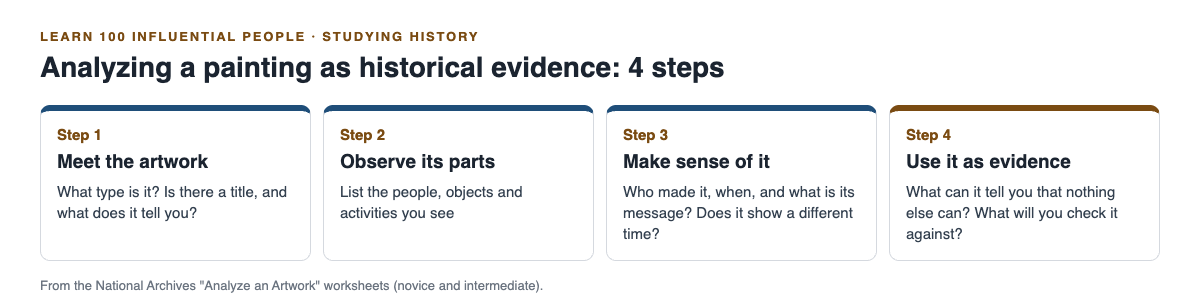
The four steps, in the order the worksheets use them.
Step 1: Meet the artwork
Start with a quick look. The intermediate worksheet asks what you notice first. Then name the type: the worksheets list painting, drawing or sketch, engraving or lithograph, mural, sculpture and mixed media, and also ask whether it is a scene or event, a portrait, a landscape or an abstract work.
Read the title too. Both versions ask whether there is one and, in the novice sheet, what it tells you. A title can name a person, a date or a moment, and it can also tell you what the maker wanted you to see before you looked.
Write your first impression down before you read anything else about the work. It is the one thing you cannot get back once you have read a caption.
Step 2: Observe its parts
Now list what is there. The worksheet splits this into people, objects and activities. For each group you write what you can see, not what you think it means.
- People: how many, where they stand, what they wear, what they are doing, where they look.
- Objects: what each one is and what it was used for.
- Activities: what is happening, and what is not.
The intermediate sheet ends the step with one sentence summing up the artwork, and the novice sheet asks for two words that describe it. Both are a good test. If your sentence contains a word like "heroic" or "brave", you have moved from observing to judging. Keep it for step 3.
Step 3: Try to make sense of it
This is where the painting turns into a source. The intermediate worksheet asks who made it, when it was made, and whether it shows a different time from the one it was made in. That last question matters most for history paintings, which often show an event long after it happened.
It also asks what the colors, people, objects or activities represent, and what was happening in history when the work was made. The novice sheet asks why you think it was created and what its main idea is, with two examples from the artwork to support your answer.
Keep two dates apart: the date of the thing shown, and the date of the painting. The gap between them tells you what kind of source you hold. A painting made on the spot by someone who watched is evidence for the event. A painting made decades later is mainly evidence for the time that made it.
Step 4: Use it as historical evidence
The last step asks what you learned from the artwork that you might not learn anywhere else, and which other documents or evidence you will use to understand the topic. The novice sheet puts it more simply: where could you find out more about the people or activities in it?
That second question is the safeguard. A painting should never carry a claim alone. Set it beside a written account, an object, or another picture, and say where they agree and where they do not. If you want a method for a second kind of evidence, how to analyze an artifact works the same way, and primary vs secondary sources explains why the date of a source changes its job.
A worked example: Leutze's Washington Crossing the Delaware
Take one famous painting and run the four steps. World History Encyclopedia's image page gives the label: George Washington crossing the Delaware River on the night of 25 December 1776, to launch a surprise attack on the Hessian troops at the Battle of Trenton, an oil on canvas by Emanuel Leutze, 1851, in the Metropolitan Museum of Art in New York.
Step 1, meet it. It is a painting, and a scene or event. The title names a person and an act.
Step 2, observe. In the image on that page, a man stands at the centre of a boat while others row and pole through floating ice. A large flag with stars blows in the wind. The sky is bright where the clouds break, and more boats follow in the distance. Those are things you can point to.
Step 3, make sense of it. The label gives two dates, 1776 for the event and 1851 for the canvas. That is a gap of 75 years, so you are not looking at a record made by someone in the boat. You are looking at how a painter, working three quarters of a century later, chose to picture the night. Why Leutze made that choice is a question this label cannot answer, so you note it as open and look for a museum catalogue or a study of the painter.
Step 4, use it as evidence. Now compare it with a written account. World History Encyclopedia's article on the Battle of Trenton says that Christmas saw a freezing storm that turned into a nor'easter, with the river overflowing and coated in sheets of ice while snow, hail and rain fell. It says the men were loaded into flatbottom boats at midnight, that it was hard to hear one another over the wind, and that it was 4 a.m. before all 2,400 men were across.
The two sources agree on the ice and on the river crossing at night. They differ in mood and in what they stress. The account tells of a storm, a long delay and a crowd of men with 18 field guns to ship across. The painting shows a bright sky and one crowded boat in front. Neither is wrong, because they do different jobs. A fair conclusion would be:
The painting is weak evidence for how the crossing looked, and good evidence for how a mid-nineteenth-century painter chose to picture a founding moment.
You reached it by asking what the painting was for, then checking it against a second source.
Mistakes to avoid
- Reading it like a photograph. A painter decides what to show. Nothing is there by accident.
- Skipping the dates. A later painting of an earlier event is evidence about the later time.
- Judging before you list. Words like "noble" belong in step 3, after step 2.
- Trusting a symbol without a source. Say what a symbol means only when a reliable source says so.
- Using the painting alone. One image cannot settle a question. Find a second source.
Frequently asked questions
Is a painting a primary source?
It can be. A painting made at the time of an event, by someone who saw it, is a primary source for that event. A painting made much later is a primary source for the time it was made, and a weaker one for the event it shows.
What questions should I ask about a painting?
Ask what you see, who made it, when, whether it shows a different time, what its message is and what evidence supports your answer. Then ask what other sources you will use to check it.
Can a painting be useful if it is not accurate?
Yes. A painting that stages a scene still shows what its maker thought worth showing. You use it for that, and you use other sources for the facts.
Which worksheet should I use, novice or intermediate?
The National Archives made the novice sheet for younger students and English learners and the intermediate sheet for secondary students. They cover the same four stages, and the intermediate one asks more about time, message and evidence.
Get started
Paintings, speeches and letters are how you meet the people who shaped history. Learn 100 Influential People teaches the 100 people who most shaped human history, from Moses to the web, in 46 lessons of about 9 minutes, where you read, study the diagrams and try hands-on activities. Its 272 questions check what you learned, 38 cards set out where researchers disagree, and every lesson lists its sources. Sign in with your email and an emailed code, and read what the site is for.
Comments
No comments yet.
Sign in or make an account to comment.