Andon at home: make a problem visible early
Many household problems announce themselves quietly before they get loud. A drip under the sink, a homework topic your child stopped mentioning, a subscription that renewed twice. The idea behind andon at home is simple: make a problem visible early. You give everyone in the house a clear, safe way to say "something is off" while the problem is still small and cheap to fix. This post shows you how to set that up, how to respond, and how to keep a record so the same problem does not come back next month.
Andon at home: the factory idea behind it
The Lean Enterprise Institute's lexicon entry for andon describes it as a visual management tool that shows the status of an area at a single glance and signals whenever something abnormal happens. Andon is the Japanese term for lamp. On a typical board, a number lights when a machine sensor detects a problem or an operator pulls a cord or pushes a button, and the lit number summons a quick response from the team leader.
A home version borrows three rules from that picture:
- Anyone can raise it. You do not need rank or permission.
- Raising it is expected, not punished. The person who spots the problem is helping.
- Someone responds right away. A signal nobody answers is not much of a signal.
A home has the same shape as a small line. Several people do recurring work: meals, laundry, school, bills, repairs. Small defects get passed along until they become big ones. The difference is that at home there is usually no cord, so problems can travel in silence.
Why problems at home stay hidden until they are expensive
People can sit on problems for ordinary reasons. A child does not want to admit they are lost in fractions. A partner does not want to start an argument about money on a Tuesday night. You notice the car making a noise and decide to "keep an eye on it."
Each delay feels reasonable on its own. Together they can add up. A missed reading assignment can become a missed unit. A loose tile can become water damage. The post on root cause vs symptom shows how to tell the small sign from the thing behind it.
The fix is not more vigilance from one person. It is a shared signal that makes speaking up the easy option.
Pick your home andon signal: cords, cards, lights, and a shared board
Choose a signal that fits your household. It should be fast to use and hard to ignore.
- A card on the fridge. A red card means "I have a problem I need help with." The person writes one line on a sticky note under it.
- A light or object. Some families use a small lamp or a specific magnet. Moving it to a set spot is the signal.
- A phrase. "Andon" or "I'm pulling the cord" works well with older kids and adults. It is short and has no blame built in.
- A shared board. A written list or a shared map where problems go the moment they appear.
The physical signal gets attention in the moment. The shared board keeps the memory. You want both: the card says "now," the board says "and here is what we tried last time."
Set the rule: anyone can pull it, and pulling it is never punished
Say the rule out loud at a family meeting, and keep it short:
Anyone can raise a problem at any time. Raising it early is the right move. Nobody gets in trouble for the problem they raise.
The last sentence matters most. If your child flags "I broke the remote" and gets a lecture, the next problem will stay hidden. Separate the signal from the consequence. You can still deal with the remote. But the act of telling you earns thanks, every time.
Lead by example. Pull the cord yourself on your own problems: "I forgot to pay the water bill, I'm flagging it."
How to respond when someone flags a problem
A fast, calm response is what keeps the system alive. Use the same short routine each time:
- Thank them. First words, before anything else.
- Write it in one line. "Maya doesn't understand the reading questions." "Bathroom fan makes a grinding noise." One line keeps it concrete.
- Agree on a first thing to try. Not the perfect fix. A next step.
- Set a check. "Let's look at this again Friday."
- Record what happened. Did it work, partly work, or fail?
Do not skip step five. Without a record, you can repeat the same fix that failed in March, because nobody remembers it failed.
From quick fix to root cause: mapping the problem so it does not come back
A quick fix stops the line from bleeding. A root cause fix stops it from happening again. To get there, you need to see problems next to each other, along with what you tried.
This is where Problem Graph fits. It is a problem and solution journal that draws itself as a map. You write a problem in one line and put it in a lane: personal, work, expert or scientific. It lands on the graph when you press Enter. Then you attach solutions as ideas, mark the one you are trying, and record the outcome as worked, partly, or failed.
Here is a worked example. Say three cards went up in one month:
- "Homework fights start at 7pm."
- "Kids are tired at breakfast."
- "Dinner keeps running late."
In a list, these look like three separate problems. On a map, you link them. Now you can see that late dinner pushes homework later, which pushes bedtime later. The root cause is the dinner schedule, not the homework. Your first solution, "Do homework before dinner," gets marked as trying. Two weeks later you record it as partly: better on weekdays, not on practice nights. That partial result is useful. It tells you the next thing to try.
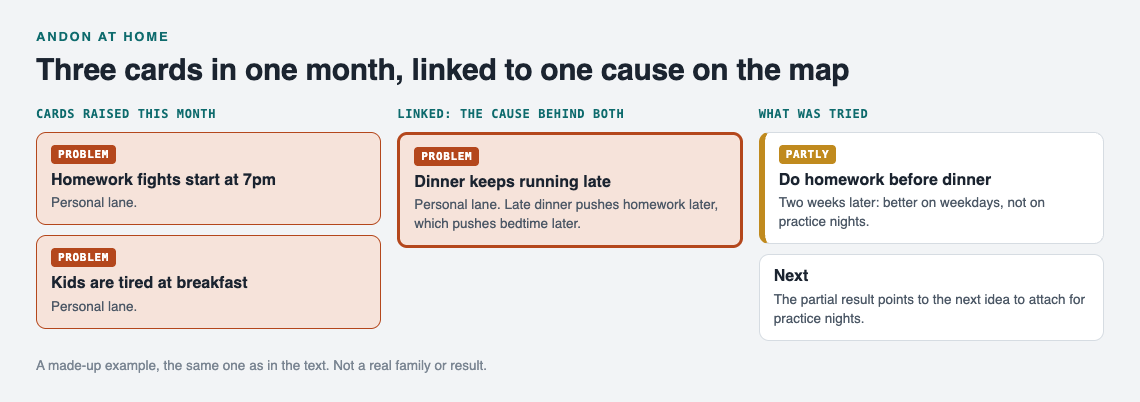
The made-up month of cards from this post, linked on one map.
Keep the failed attempts on the map. The app's own line puts it well: a solution that failed three times stays on the map as a failed solution, and that is exactly what the next person needs to know. In a family, the next person might be your partner, or you in six months.
If you want the family to see the same map, you can mark one problem as a main node and share it into a private network. You create the network and give the invite code to the people you choose. Members see it, nobody else does. Keep in mind that anyone with the invite code can join, so share it only with your household. When you share a main node, its solutions, their outcomes and the requirements they need go along with it. Anything you do not share stays private, which is the default.
Real examples: chores, homework, money, and household repairs
Chores
Card: "Laundry piles up on Sundays." First try: one load per person on Wednesday. Outcome: worked for two weeks, then failed when the schedule changed. Linked problem: "Sports kit not washed before Saturday." Same root cause, one fix.
Homework
Card: "I read the chapter but can't answer the questions." This is a useful early flag, because it can show up before a bad grade. First try: read one page together and ask one question about it. Record the outcome, and if it was partly, attach the next idea under the same problem. For more on solving problems as a household, see family problem solving with a shared list of what worked.
Money
Card: "Two streaming charges this month." First try: list every recurring charge. Outcome: worked. Linked problem: "Grocery spending up." Seeing both on one map shows that small recurring costs are the pattern, not one bad week.
Household repairs
Card: "Bathroom fan grinding." First try: clean the fan. Outcome: partly. Second try: replace the motor. Outcome recorded either way, so the next time the noise comes back you know what you already did and what it cost.
Frequently asked questions
Is andon at home just a fancy chore chart?
No. A chore chart assigns work ahead of time. Andon is a signal for when work goes wrong, plus a promise that someone will respond and record what was tried.
How do I get kids to actually raise problems early?
Thank them every time they flag something, and never tie the flag itself to a punishment. Use the signal on your own problems so they see it is normal.
What if the signal gets pulled for every small thing?
In the first few weeks that can be a good sign: people are using it. Write each one in a line, and you will soon see which ones link together and share a cause.
Can andon work for couples or roommates without kids?
Yes. The rules are the same: anyone raises it, nobody is blamed for raising it, and someone responds. A shared map of problems and outcomes helps adults avoid repeating the same argument.
Get started
Pick one card that is already up in your house, even if it is only in your head. Open Problem Graph, write it in one line in the personal lane, and attach the first thing you will try. If the graph is empty and you want to see how a map looks before you start, use the "Load example set" button on the app page. Then record the outcome when you check back.
Try Problem Graph: it is free, and you can look around the public network without an account. Write one problem down in a line and attach the first thing you will try.
Comments
No comments yet.
Sign in or make an account to comment.